

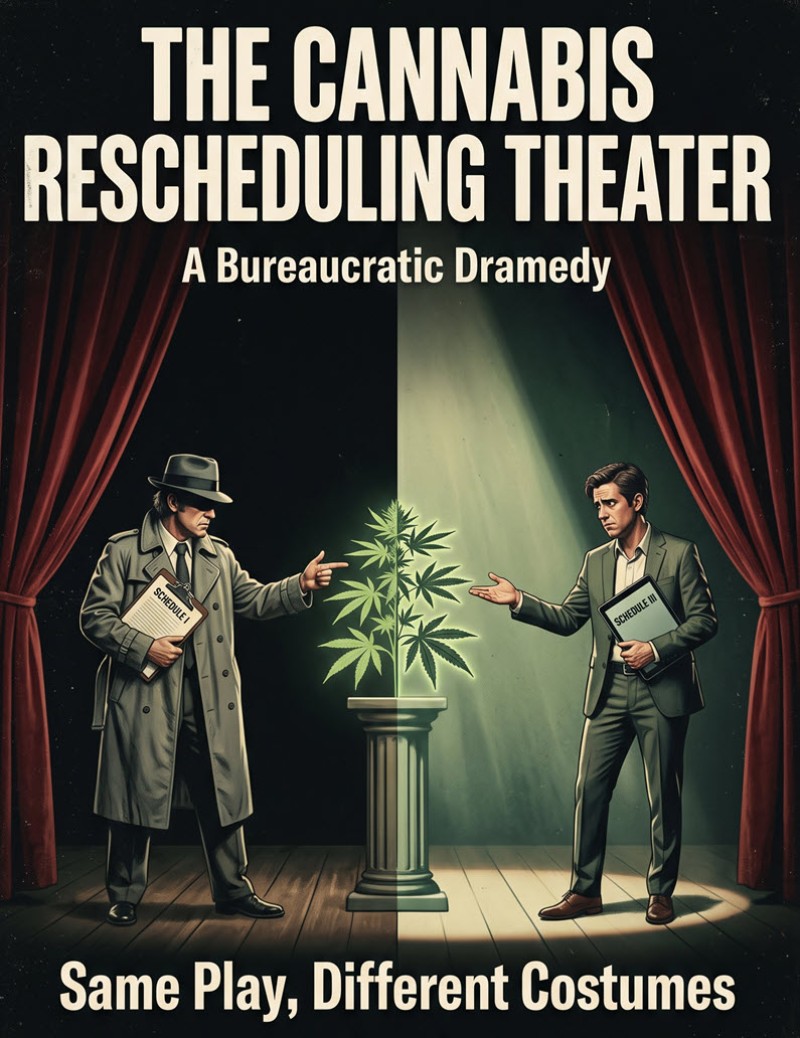
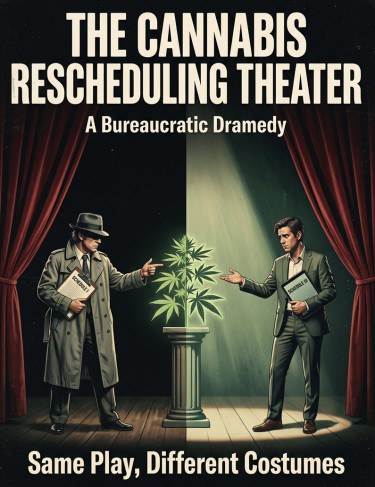
The DEA announced the participants for its upcoming cannabis rescheduling hearing. June 2026. Momentous occasion, right? The machinery of federal government finally grinding toward something resembling justice for a plant that’s been federally prohibited for over fifty years.
Except only opponents of rescheduling were invited.
That’s not an exaggeration or a framing choice. The Drug Enforcement Administration selected participants for its formal hearing on cannabis rescheduling, and the guest list consists entirely of people opposed to the reform. No researchers who spent decades documenting the plant’s medical applications. No patients whose lives changed when they gained legal access. No industry representatives. No advocates. Just the same coalition of prohibitionists who’ve been running this same play since Nixon’s administration signed the Controlled Substances Act and declared it science.
If you’re surprised, I genuinely don’t know what it would take to remove that surprise.
Democracy Cosplay
Every few years, the government stages what I can only call democracy cosplay — a formal process that looks like deliberation, sounds like deliberation, has all the correct procedural furniture of deliberation, and produces whatever outcome was decided before anyone walked in the room. Hearings with predetermined guest lists. Comment periods that generate hundreds of thousands of responses supporting reform, which are then filed and ignored. Agency panels where the conclusion was written before the witnesses were called.
This hearing is that process made visible. They didn’t even try to disguise it. When you invite only opponents to a hearing about whether to move forward, you’re not conducting a hearing. You’re building a legal record to justify a decision that’s already been made.
And right on schedule — because the timing of these things is never accidental — a “massive study” published in JAMA Health Forum landed in the news cycle, tracking 463,000 adolescents and linking teen cannabis use to double the risk of psychotic and bipolar disorders. The headlines wrote themselves. Cable news ran with it. The prohibitionist organizations distributed the press release with the enthusiasm of people who’d been waiting for it.
Now, I want to be precise here, because I’m not in the business of dismissing research that inconveniences my preferred narrative. That’s what the other side does. Teen cannabis use is a legitimate concern — the developing brain and the endocannabinoid system have a genuinely complicated relationship, and I’ve written about that at length. The ECS is still building itself through the mid-twenties. Introducing potent exogenous cannabinoids during that window carries real risks that deserve real discussion.
But let’s read the actual methodology before we let the headline do all the work.
The study relied on self-reported cannabis use during routine pediatric visits. The cannabis use was reported, on average, 1.7 to 2.3 years before a psychiatric diagnosis. Funding came from the National Institute on Drug Abuse — which, to be clear, is not automatically a disqualifier, but is a context worth noting when you’re tracing who benefits from the headline. And the study, by its own design, cannot answer the question that most undermines its conclusions: whether adolescents with early-stage or undiagnosed psychiatric conditions are self-medicating with whatever’s available to them, including cannabis. Correlation running in that direction looks identical to correlation running the other way. The study doesn’t distinguish between the two.
What the study also doesn’t examine: whether those risk ratios hold when you control for trauma history, socioeconomic stress, household instability, or prior substance use. Mental health outcomes in adolescence don’t emerge from single variables. But single variables make better headlines.
I’m not saying the research is worthless. I’m saying the way it’s being deployed — dropped into a news cycle during an active federal rescheduling hearing from which reform advocates were excluded — is not a coincidence. This is the playbook. Learn to recognize it.
Massachusetts: This Is What Rollback Looks Like
While the DEA was curating its hearing guest list, legislators in Massachusetts were moving to reverse marijuana laws in a state where voters chose to legalize. Let that land for a second. A state where the democratic process produced a clear outcome. A state that built a regulated industry on top of that outcome. And elected officials are now working to undo it.
This is not a fringe development. It’s a signal.
The wins of the last decade in cannabis reform were real, but they were never permanent. Legalization exists at the pleasure of political will, and political will is something that gets purchased. The same industries that benefit from cannabis prohibition — pharmaceutical companies with synthetic cannabinoid patents, alcohol distributors protecting market share, private prison contractors with capacity to fill — haven’t gone away. They’ve just shifted their strategy from blocking initial legalization to chipping away at what’s been won.
The people who told you it was over once recreational use passed in California were wrong. The people who told you rescheduling was a done deal were wrong. The people who tell you now that there’s no real threat to what’s been built are still wrong.
It’s not done until it’s done. And even then, you have to keep watching.
The Domesticated Ape Problem
Here’s the question I keep circling without a clean answer: at what point does the pattern become undeniable enough that something actually changes?
Because the pattern is visible. Stacked hearings. Timed studies. Legislative rollbacks. The same organizations, the same funding networks, the same arguments that have been losing in the court of public opinion for thirty years but keep winning in the institutions that matter. The public supports legalization. Polling on this has been consistent and growing for over a decade. And yet the federal government still classifies cannabis alongside heroin, and the DEA holds reform hearings where only opponents are invited.
In the past, the mechanism for breaking entrenched power structures was uncomfortable. Revolutions. General strikes. Economic disruption that made the cost of maintaining the status quo higher than the cost of changing it. The historical record on this is not particularly subtle.
But the apparatus we live inside now is more sophisticated. Distraction is abundant and cheap. The cost of survival is high enough to consume most of people’s energy. The tribal sorting machine of modern media keeps any sustained coalition from forming across the lines that would make it effective. The government doesn’t need to silence dissent when dissent can be redirected into outrage at the wrong target, or dissipated into an election cycle that produces no structural change.
Are we too domesticated to do anything about it? I include myself in this. I write articles. I explain the mechanics of the system to people who can already see it. And the system continues.
I don’t have a revolution on offer. I don’t have a political party that has earned your trust on this issue — neither of them has, and the evidence for that claim is fifty years long. What I have is something simpler, and something that has worked since before any of these hearings existed.
Overgrow the Government
The most powerful act of cannabis civil disobedience isn’t a protest sign or a petition or a vote for a candidate who will probably disappoint you on this within eighteen months of taking office.
It’s a seed in soil.
It has always been a seed in soil. The government can control commerce. It can regulate dispensaries and tax supply chains and revoke licenses. What it cannot do is reach into every backyard, every basement, every balcony where someone with a few seeds and some basic knowledge is growing their own medicine. Prohibition has never stopped that, and it never will.
Grow your own. Share seeds with people you trust. Build the knowledge networks — how to cultivate, how to breed, how to process, how to store. Make the plant so distributed, so woven into the fabric of community practice, that the enforcement apparatus runs out of things to effectively prosecute. Not as an act of aggression, but as an act of autonomy. Your body, your medicine, your garden.
They can stack a hearing with opponents. They can fund studies calibrated to produce alarming headlines. They can roll back laws in states where voters said yes. But they cannot dig up every seed.
If you’ve followed this situation closely and haven’t yet lost faith in the formal process to produce real change on its own, I genuinely don’t know what additional evidence you’re waiting for. The emperor has been naked for years. We’ve been politely describing his outfit.
For the rest of the free thinkers: build the future in the dirt. One seed at a time. Because if they won’t liberate the plant, we will.
Sources: Marijuana Moment, JAMA Health Forum (via ScienceDaily, June 2026), The Independent
THE FEDS WANT YOUR OPINION ON CANNABIS RESCHEDULING, READ ON...