

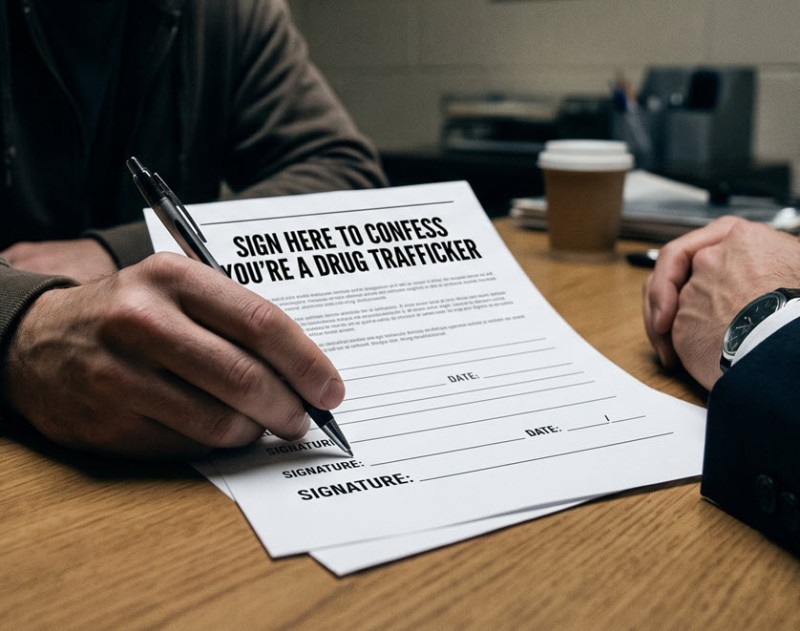
The federal government has spent the better part of a century treating cannabis like a public menace. Now, in what passes for progress, they have handed the industry a lifeline with one hand and a loaded gun with the other. Welcome to the DEA's Schedule III registration portal — where signing up for legal protection requires you to legally confess to federal drug trafficking.
Let me walk you through what actually happened. On April 23, 2026, Acting Attorney General Todd Blanche signed an order immediately moving state-licensed medical cannabis and FDA-approved cannabis products from Schedule I to Schedule III of the Controlled Substances Act. Big headline. Real movement. Genuinely the most significant federal shift in over fifty years.
But read the fine print. Because the fine print will haunt you.
The Monster in the Registration Form
The DEA opened its Medical Marijuana Dispensary Registration Portal on April 29, 2026. Operators have a 60-day window — until June 27 — to apply for expedited review. The benefits on paper look meaningful: 280E tax relief, federal compliance standing, improved banking access. Things the industry has desperately needed for years.
Here is where it breaks down. Section 2 of the application — the Activity section — asks applicants to specify which substances they handle. One of those questions asks whether your firm will be handling or dispensing recreational marijuana. If you answer yes, you are, by the federal government's own definition, admitting to trafficking a Schedule I controlled substance. On a federal form. With your name, address, Social Security number, and Tax ID attached.
Cannabis Business Times reached out to the DEA for clarity on what happens when an operator answers yes to that question — whether it helps, hurts, or has no impact on the application. The DEA did not provide guidance. What it did provide was a warning at the end of the form: intentionally furnishing false information carries up to four years of imprisonment, a $250,000 fine, or both. So you cannot lie. And if you tell the truth, you have created a federal record of your own criminal activity.
That is not a registration form. That is a confession booth.
95% of Cannabis Is Still Schedule I. Remember That.
The rescheduling applies only to marijuana regulated by a state medical marijuana license, or contained in an FDA-approved product. Every other form of cannabis — adult-use, smokables, concentrates, extracts not tied to a medical license, unlicensed products — remains fully Schedule I. As Foley & Lardner put it in their analysis, 'individuals and entities handling such material remain subject to the full range of regulatory controls and criminal sanctions applicable to Schedule I substances.'
This means operators holding both medical and adult-use licenses are now running two businesses under two different federal regimes inside the same building. The DEA expects them to separate accounting, recordkeeping, inventory, and ideally physical operations by license type. The IRS will expect documentation proving which revenue and expenses belong to which license. Any commingling creates exposure on the medical side that destroys the very relief operators just gained.
The system they built is not a bridge. It is a tightrope over a legal abyss.
The Question Nobody Is Asking Loudly Enough
Here is the scenario that deserves serious discussion. An operator fills out the DEA form honestly. They note that yes, they handle recreational cannabis. That answer sits in a federal database alongside their personal information, business structure, state license details, and prior conviction history.
Now fast-forward. The political winds shift. A zealous DOJ under a future administration decides to make an example. The June 29 hearing on broader rescheduling fails to produce a final rule. Congress passes a measure tightening 280E back to cover marijuana specifically, which has already been proposed in the 119th Congress. Or simply — the current fragile framework gets reversed.
Those federal records do not disappear. Every operator who answered honestly about recreational cannabis just handed the government a prebuilt trafficking case. The DEA even said so on the form itself: this information may be used in federal proceedings.
This is not paranoia. The penalties under the Controlled Substances Act for trafficking in Schedule I controlled substances — mandatory minimums, quantity-based sentencing enhancements — do not change with rescheduling. Congress built those in separately. Rescheduling marijuana to Schedule III does not touch them.
Frankenstein Walked Into a Dispensary
What the US government has assembled here is a patchwork that serves almost nobody cleanly. Medical operators get tax relief but must register with the same federal agency that has treated them as criminals for decades. Recreational operators get nothing except continued Schedule I exposure and the privilege of watching their medical counterparts navigate a registration system designed to create records, not protections. Dual-license operators get an administrative nightmare stitched together with compliance tape.
And all of them — every operator considering the DEA portal — must decide whether the short-term financial relief is worth the permanent federal paper trail they are about to create.
The cannabis industry has survived prohibition, banking blackouts, astronomical tax burdens, and state-by-state regulatory chaos. Now it faces a different kind of trap — one dressed in the language of progress. Before you sign that form, understand what you are signing. Because the DEA certainly does.
THE CANNABIS RESCHEDULING DEAL, READ ON...
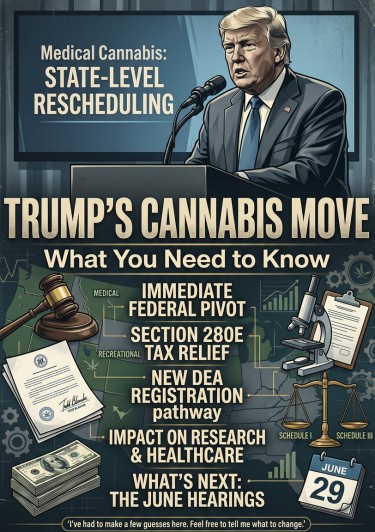
CANNABIS RESCHEDULE OR NO, WHAT DID TRUMP DO?