

I’m 42. I’ve been smoking since before I was 16. And I will never again get as high as I did that first year.
That’s not a complaint. It’s not even a loss, once you understand what was actually happening. But most long-term users chalk the change up to “tolerance” and leave it there, which is a bit like describing a car engine seizing up as “the car got tired.” Technically something in that direction, but missing the actual mechanism entirely.
The real explanation goes deeper than familiarity. It lives inside a biological system that most people don’t know they have, that changes dramatically across a lifetime, and that cannabis interacts with differently depending on where you are in that arc. Understanding this changes not just how you interpret your relationship with the plant, but how you use it as you age.
The System You Didn’t Know You Had
Before we talk about the high, we need to talk about the endocannabinoid system.
The ECS is a regulatory network woven through your brain and body — a constellation of receptors (primarily CB1 and CB2), the endogenous molecules that bind to them (anandamide and 2-AG being the two most studied), and the enzymes that synthesize and break those molecules down. It’s involved in regulating mood, pain perception, memory consolidation, sleep architecture, appetite, immune response, inflammation, reproductive function, and neuroprotection, among others. The breadth of what the ECS touches is why cannabis seems to affect so many different things — the plant’s phytocannabinoids are chemically similar enough to your body’s own endocannabinoids to fit into the same receptors and trigger similar responses.
The ECS wasn’t discovered until the late 1980s and early 1990s, when researchers following the trail of THC’s mechanism of action stumbled onto the fact that the human body had receptor systems that appeared to be built to receive cannabinoids. Dr. Raphael Mechoulam’s decades of research on cannabinoid pharmacology laid much of the groundwork. The inconvenient implication — that the body has a system that cannabis interacts with naturally — has been quietly awkward for prohibition ever since.
Here’s the part that explains your teen highs: during adolescence and through the mid-twenties, your ECS is not finished. It’s under active construction. Your body produces endocannabinoids at elevated levels during this period, not because you’re especially relaxed or well-regulated, but because the system is calibrating itself. The overproduction is the scaffolding. The ECS is building the receptor density, refining the signaling pathways, and establishing the baseline homeostatic set-points it will maintain for the rest of your adult life.
Into that actively building, endocannabinoid-flooded system, the 16-year-old version of me introduced phytocannabinoids. THC slotting into CB1 receptors that were already saturated with the body’s own molecules. The effect was amplification on top of amplification. The highs were enormous — nearly psychedelic at times, ceiling seemingly nonexistent, everything dialed up past what I had any frame of reference for. I thought that was just what cannabis was.
It wasn’t. That was what cannabis was in a developing ECS running at full production. It was gasoline on an already burning fire.
After 25: The Architecture Settles
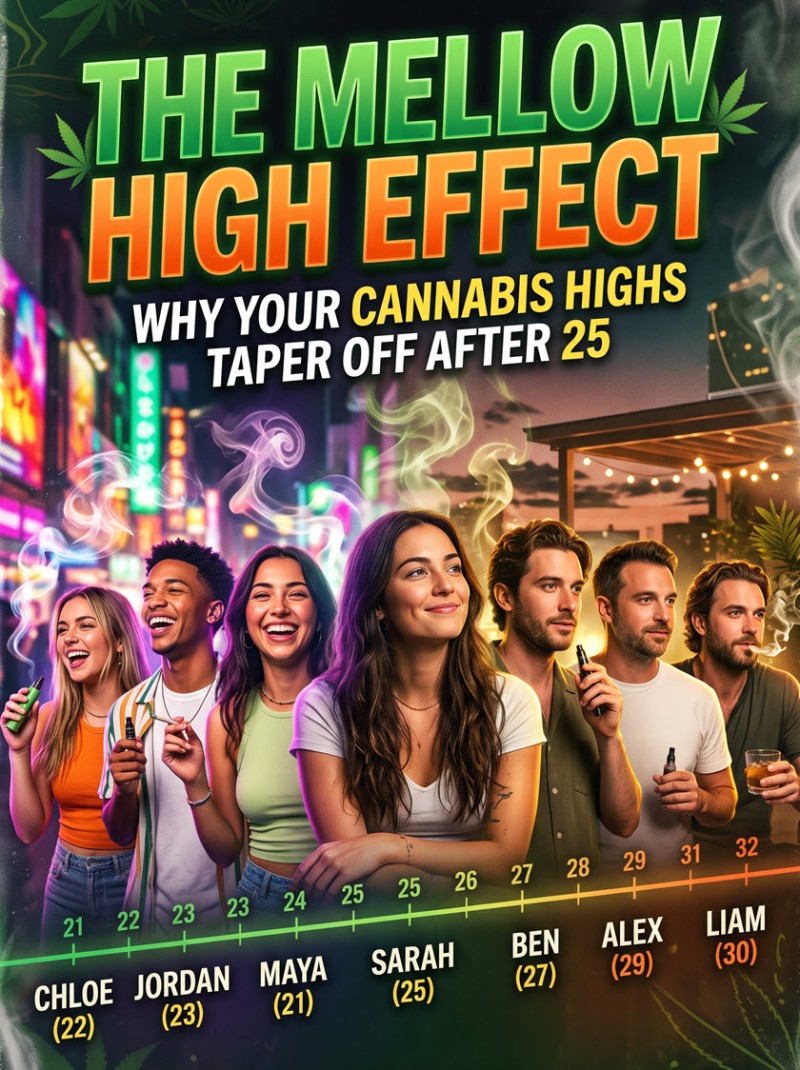
Around 25, the ECS completes its development. The scaffolding comes down. Endocannabinoid production drops from the elevated levels of adolescence to adult maintenance levels — a significant reduction that shifts the entire baseline of the system.
What this means practically is that the receptor landscape you’re introducing cannabis into has changed. The sheer volume of endocannabinoid activity that previously amplified THC’s effects is no longer present in the same quantity. The ECS in a developed adult brain is tighter, more regulated, more efficient. It’s doing its job rather than building toward it.
This is why the highs feel different after your mid-twenties, and it’s not simply tolerance in the conventional sense. Tolerance — the pharmacological concept of receptor downregulation requiring more of a substance to achieve the same effect — is a real component of the picture for heavy daily users. But what most people experience in their late twenties as a general shift in the quality and intensity of the high isn’t primarily receptor downregulation. It’s a different underlying system.
The highs become more functional. More manageable. You can hold a conversation, follow a thread of thought, be present in your body in a way that the adolescent experience didn’t quite allow. What was once an overwhelming altered state becomes something closer to a shift in register — a change in the texture of experience rather than a departure from it. Many users report that this is actually when cannabis becomes most useful, because the effect is calibrated enough to work with rather than simply be inside of.
The wrong response to this shift is to chase the adolescent high by escalating doses or moving to higher-potency concentrates. You won’t get there. The system that produced that experience no longer exists in its prior form. Escalation in this context means delivering more cannabinoids to a system that can’t produce the same amplified response, while simultaneously stressing the ECS with chronic receptor downregulation. That path runs toward diminishing returns, increased anxiety at higher doses, and a flatter baseline when you’re not consuming.
The right response is to understand what the plant is doing for you now, which is different from what it was doing then, and to decide whether that’s useful.
After 60: The Depletion Phase
Here’s where it gets medically significant, and where most conversations about cannabis and aging fail to go.
As you continue past the developmental peak, endocannabinoid production doesn’t stabilize — it continues to decline, gradually, over decades. By the time someone reaches their sixties, the ECS that was once running at full capacity is often substantially depleted. Chronic stress compounds this: the ECS is your body’s primary stress-regulation system, and a life spent under sustained pressure draws down the system’s reserves. Add the accumulated inflammation of decades, chronic pain from injuries that didn’t heal cleanly, the neurological wear of aging, and you have an ECS that’s running low on what it needs to regulate all the things it’s supposed to regulate.
Some researchers have proposed the concept of clinical endocannabinoid deficiency — the hypothesis that a persistently depleted ECS is an underlying factor in conditions like fibromyalgia, migraine syndromes, and irritable bowel syndrome, conditions that share the feature of appearing as regulatory failures across multiple systems without an obvious single cause. The research on this is still developing, but the logic of the hypothesis fits what we know about the ECS’s regulatory role.
This is why older adults trying cannabis for the first time often report effects that strike them as profound — sometimes more so than effects reported by younger users. A 65-year-old who hits an edible for the first time and describes it as remarkable isn’t responding to something cannabis is doing that it doesn’t do for everyone. They’re responding to what happens when a depleted endocannabinoid system receives a supplement it’s been running short on. The phytocannabinoids fill receptors that the body has stopped stocking adequately. The regulatory system gets a top-up.
Think of it the way you’d think about a nutritional deficiency. You don’t necessarily feel the absence of magnesium until the symptoms — muscle cramps, poor sleep, anxiety — accumulate enough to notice. Then you supplement, and things stabilize. The deficiency was silent until it wasn’t. Cannabis for older adults can function similarly: the ECS was depleted in ways that expressed as symptoms, and the supplement addresses the underlying shortage.
At this stage, the delivery method matters less and the consistency matters more. You don’t need to smoke. Raw cannabis — juiced fresh leaves, consumed without heat — delivers cannabinoid acids like THCA and CBDA that interact with the ECS without significant psychoactive effect. Tinctures and extracts allow precise dosing without combustion. Low-dose edibles provide sustained delivery. The goal after 60 isn’t to get high in the way a teenager gets high. It’s to keep the regulatory system supplied with what it needs to do its job.
The Arc
At 16, your ECS is overproducing and actively building. Cannabis throws the whole system into overdrive. The highs are enormous because the system underneath them is enormous.
At 30, your ECS is mature and well-calibrated. Cannabis modulates rather than amplifies. The high is real and functional, and for many people this is the most productive relationship they have with the plant.
At 60, your ECS is depleted. Cannabis supplementation restores regulatory function that the body is no longer generating at adequate levels on its own. Whether you feel high in the traditional sense matters considerably less than whether your pain, your sleep, your mood, and your inflammation are being managed.
Cannabis isn’t one thing across a lifetime. It’s a phytocannabinoid supplement that docks into a biological system that changes fundamentally over decades — and what it does for you depends almost entirely on where that system is when you use it.
The mellow highs of your thirties and forties aren’t a loss. They’re the plant in conversation with a different version of your body. Both conversations are worth having.
TOLERANCE TOO HIGH, READ ON...