
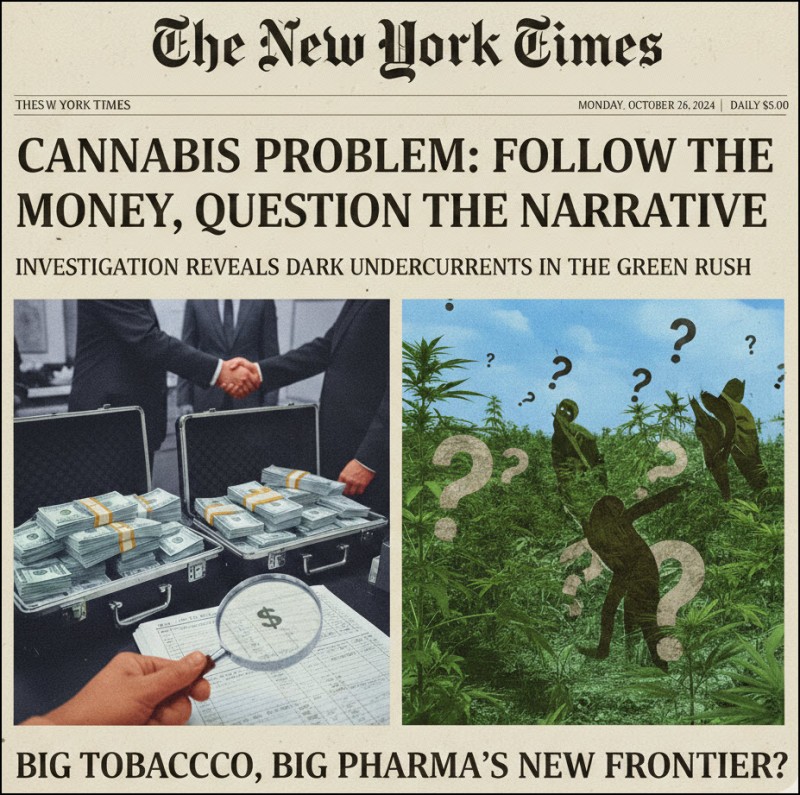
The New York Times' Cannabis Problem: Follow the Money, Question the Narrative
The New York Times wants you to believe America has a marijuana problem. I want you to believe the New York Times has an integrity problem.
In February 2026, the editorial board of what's supposedly America's "paper of record" published a breathtaking reversal of their decade-old position on cannabis legalization. The headline might as well have been written by Kevin Sabet himself: essentially declaring that marijuana legalization was a "mistake" requiring "sober reassessment."
This wasn't just a policy pivot. This was a complete capitulation to every prohibitionist talking point that's been debunked by actual evidence for years. And if you think that happened in a vacuum—if you believe the Times suddenly developed concerns about "Big Weed" out of pure journalistic integrity—then I've got a bridge in Brooklyn to sell you.
Let me show you what really happened when you follow the money.
The 2025 Consolidation: Fewer Voices, More Control
Before we get into the financial entanglements, we need to understand the structural transformation that made this editorial possible.
In early 2025, under Opinion Editor Kathleen Kingsbury and Editorial Director David Leonhardt, the Times editorial board underwent a significant reorganization. The stated goal was to produce "fewer but more strategically impactful editorials"—which is corporate-speak for "we're consolidating power."
Several long-standing board members were offered buyout packages or reassigned to other roles: Mara Gay, Brent Staples, Jesse Wegman, and Farah Stockman. Notice anything interesting about that list? Wegman and Gay were among the board's most consistent voices for criminal justice reform and marijuana prohibition ending.
Their departure coincided almost perfectly with the board's shift toward a "more sober and skeptical tone" on legalization.
Funny how that works.
The result was a streamlined board concentrated around a core group—including Jeneen Interlandi (health policy), David Leonhardt (economics), and Nick Fox (former whiskey columnist with extensive ties to the alcohol industry). This smaller, more ideologically unified group could speak with singular authority on complex policy issues.
Translation: fewer dissenting voices, easier narrative control.
The Institutional Shareholders: Who Actually Owns the Times?
The New York Times Company is a $12 billion enterprise. And like every major media corporation in America, it's owned by institutional investors who have their fingers in every profitable pie—including pharmaceuticals and alcohol.
Here's who owns the New York Times as of early 2026:
|
Shareholder |
Percentage |
Value |
|---|---|---|
|
Vanguard Group |
9.64% |
$1.11 billion |
|
BlackRock |
9.28% |
$1.07 billion |
|
T. Rowe Price |
7.26% |
$833 million |
|
Darsana Capital |
5.24% |
$601 million |
|
Carlos Slim Helu |
6.07% |
$696 million |
Now, here's where it gets interesting: Vanguard and BlackRock aren't just the top shareholders of the Times. They're also the top institutional shareholders of virtually every major pharmaceutical company—Pfizer, AbbVie, Johnson & Johnson, Eli Lilly.
Are these passive index investors? Sure. But they're also the connective tissue of a corporate ecosystem that prioritizes established, highly regulated industries over emerging, decentralized markets. When the Times' largest shareholders profit from pharmaceutical stability, the paper exists within a financial environment that inherently favors the status quo.
You don't need a conspiracy. You just need aligned incentives.
The Advertising Bonanza: Pharma's Digital Gold Rush
Let's talk about the money that actually keeps the lights on at the Times.
In 2025, the Times' digital advertising revenue surged to $132.3 million in a single quarter, driven by what they euphemistically call "strong marketer demand" and "branded content." The pharmaceutical industry is one of the largest contributors to this revenue stream.
Who's buying ad space in America's most prestigious newspaper?
-
Pfizer: Vaccines and emerging mRNA technologies
-
AbbVie: Immunology and chronic condition medications
-
Eli Lilly: GLP-1 weight-loss drugs (Zepbound), a massive trend in 2025
-
Johnson & Johnson: Precision medicine and oncology
The rise of GLP-1 agonists like Wegovy and Mounjaro was particularly dominant in 2025, with pharmaceutical companies seeking "branded content environments that project authority and reliability."
Guess which newspaper provides exactly that kind of environment?
Now, add the alcohol industry to the mix. In 2025, alcohol companies shifted their advertising strategy toward "mindful drinking" and low-alcohol alternatives, targeting Gen Z and health-conscious consumers—the exact demographic that overlaps with the Times' high-subscriber base.
Brands like Athletic Brewing and Recess increased their marketing spend by up to 50% in early 2026, utilizing the Times' "Cooking" and "Audio" verticals to reach affluent, educated consumers who view these products as "healthy alternatives" to traditional drinking.
Here's the uncomfortable question: when your business model depends on pharmaceutical and alcohol advertising revenue, how objective can you really be about a plant that threatens both industries' market share?
The Editorial Board's Professional Entanglements
Let's audit the key players whose professional backgrounds shaped that February 2026 editorial.
David Leonhardt: The Economics of Regulation
As Lead Editor and the voice behind "The Morning" newsletter, Leonhardt is arguably the most influential figure on the board. His Pulitzer-winning work has consistently emphasized the need for "institutional cost control and evidence-based policy."
Leonhardt holds a senior fellowship at Yale University's Jackson School of Global Affairs—an institution with extensive ties to federal health policy and the pharmaceutical industry. His analytical framework prioritizes what he calls the "stability of the American Dream," which translates into skepticism of emerging industries he perceives as "potentially destabilizing or exploitative."
In other words, he's ideologically predisposed to view "Big Weed" as a threat while viewing Big Pharma as a manageable problem that just needs better regulation.
Jeneen Interlandi: Pharmaceutical History and the Regulatory Lens
Interlandi provides the board's scientific and health policy expertise. And here's where her background becomes particularly relevant:
In 2012, she was a Nieman Fellow at Harvard, where she specifically studied the "history of pharmaceuticals" and the "cultural forces that have shaped our relationship to medication."
This deep immersion in pharmaceutical history manifests in her writing as a preference for rigorous, FDA-style oversight. She consistently frames unregulated cannabis products as a "risk to public health and safety" because they lack the labeling and laboratory standards of pharmaceutical products.
Notice the framing? The problem isn't that we over-regulate medicine—it's that we under-regulate cannabis. The solution is always more regulation, more institutional control, more deference to the pharmaceutical model.
It's a worldview that serves pharmaceutical interests perfectly, even if it's sincerely held.
Nick Fox: The Alcohol Connection
Among board members, Fox has the most extensive professional relationship with the alcohol industry. As a veteran whiskey columnist for the Times, he spent years writing detailed explorations of spirits and the hospitality industry.
While this work was journalistic, it established a professional comfort with the "regulated alcohol model." In the board's coverage of cannabis legalization, alcohol is consistently framed as a "more manageable public health problem" than cannabis.
This framing ignores a rather inconvenient fact: alcohol kills approximately 140,000 Americans annually. Cannabis kills zero.
But sure, let's worry about the plant.
Kathleen Kingsbury: The Institutional Pragmatist
As Opinion Editor, Kingsbury oversees a section that serves as a "primary vehicle for subscription retention"—which inherently ties her editorial strategy to the paper's overall financial health.
Her Pulitzer-winning work examined the financial struggles of restaurant workers, an industry deeply tied to alcohol and hospitality sectors. While she's built a career exposing corporate hypocrisy, she also operates within a business model that depends on pharmaceutical advertising for digital growth.
That's not corruption. That's structural constraint.
The Kevin Sabet Connection: SAM's Intellectual Infiltration
You can't understand the Times' pivot without understanding Smart Approaches to Marijuana (SAM) and its founder, Kevin Sabet—the man dubbed the "prodigy of drug politics."
SAM is a 501(c)(3) nonprofit that opposes marijuana legalization and commercialization, advocating instead for a "middle road" between incarceration and legalization. While SAM claims it receives no funding from pharmaceutical or alcohol industries, its "third-way" approach has found an remarkably receptive platform at the New York Times.
Sabet has been featured on the front page of the Times. He's published multiple op-eds in the paper. His advocacy focuses on the "harms of marijuana commercialization"—a concept the editorial board began echoing almost word-for-word in 2025 and 2026.
SAM's influence operates through multiple channels:
Direct Commentary: Sabet's op-eds provide the intellectual scaffolding for the "Big Weed" narrative, comparing the cannabis industry to Big Tobacco.
Scientific Advisory: SAM's Science Advisory Board provides data on "drugged driving" and "marijuana-induced psychosis" that the editorial board frequently cites—often without the statistical context that would reveal these risks as marginal compared to alcohol.
Lobbying on Rescheduling: SAM has been the most vocal critic of the Biden administration's move to reschedule marijuana to Schedule III, arguing it's a "tax break for the addiction-for-profit sector."
The February 2026 editorial was basically SAM's policy platform with a Times masthead.
The "Pro-Regulation" Bias: Protecting the Pharmaceutical Market
Here's what most people miss about the Times' cannabis coverage: it's not a crude "pay-for-play" arrangement with Big Pharma. It's something more sophisticated and more insidious—a pro-institutional bias that favors established, highly regulated, corporate-led markets over emerging, decentralized ones.
The board consistently creates a binary where the pharmaceutical industry is viewed as a "known entity that can be managed through regulation" (even if currently flawed), while the cannabis industry is framed as a "novel threat" requiring aggressive intervention.
This is evident in how Interlandi and Leonhardt approach health policy: they advocate for strengthening the ACA and expanding Medicaid—policies that create stable, government-backed revenue streams for pharmaceutical companies—while simultaneously calling for high taxes and potency caps on cannabis to "deter heavy use."
But here's the conflict nobody wants to acknowledge: if cannabis is legalized and regulated like a pharmaceutical product, it poses a direct threat to the profit margins of several pharmaceutical sectors—particularly those dealing with pain management, sleep aids, and anxiety medications.
Multiple studies have shown that cannabis access correlates with reduced opioid prescriptions, decreased benzodiazepine use, and lower spending on traditional pharmaceuticals. By advocating for a model of "grudging toleration" that restricts the commercial viability of cannabis, the board effectively protects the market share of the Schedule III pharmaceutical industry.
The Post-COVID Trust Collapse
Let's address the elephant in the room: COVID-19 fundamentally broke the credibility of major media institutions.
During the pandemic, the New York Times—along with virtually every other major publication—danced to Pfizer's tune while people's rights were trampled and the Nuremberg Code was treated like a suggestion rather than a foundational principle of medical ethics.
We watched in real-time as newspapers that claimed to "speak truth to power" became megaphones for pharmaceutical companies and government agencies. Dissenting voices—even credentialed scientists—were marginalized or silenced. Natural immunity was dismissed. Early treatment protocols were ridiculed. Vaccine injuries were denied or downplayed.
And throughout it all, pharmaceutical advertising dollars kept flowing.
The Times wants us to forget that institutional betrayal. They want us to trust their judgment on cannabis policy as if the last few years never happened—as if we didn't watch them abandon journalistic skepticism in favor of corporate and governmental narratives.
But we remember.
The "Big Weed" Hypocrisy
The February 2026 editorial argued that America legalized marijuana "without sufficient regulation," allowing a "profit-driven industry" to target vulnerable demographics. The board cited rising rates of daily use and hospitalizations as proof that legalization had failed to protect public health.
Let's apply that same standard to the industries that advertise in the Times:
Alcohol kills 140,000 Americans annually, contributes to 40% of violent crimes, causes fetal alcohol syndrome, and is the third leading preventable cause of death in the United States. The Times runs alcohol advertising and employs former whiskey columnists on its editorial board.
Pharmaceuticals are responsible for the opioid epidemic that killed over 500,000 Americans in the last two decades. Prescription drug advertising is legal only in the U.S. and New Zealand. The Times runs pharmaceutical advertising throughout its digital platforms.
Tobacco kills 480,000 Americans annually. While the Times no longer accepts tobacco advertising, it spent decades profiting from it.
Where's the editorial calling for a "sober reassessment" of alcohol commercialization? Where's the hand-wringing about Big Pharma's profit-driven targeting of vulnerable populations?
The selective outrage is remarkable. And remarkably transparent.
The Sticky Bottom Line
I'm not here to tell you the New York Times editorial board is "bought and paid for" by Big Pharma and Big Alcohol. That's too crude, and it's not how institutional capture works in 2026.
What I'm telling you is this: when your largest shareholders profit from pharmaceutical stability, when your advertising revenue depends on pharmaceutical and alcohol spending, when your editorial board is staffed by people whose professional identities are built around institutional regulation and pharmaceutical history, when you provide a prominent platform to prohibitionist advocacy groups—you don't need a conspiracy to explain bias.
You just need aligned incentives and ideological predisposition.
The Times' pivot on cannabis isn't corruption in the traditional sense. It's something more insidious: structural bias dressed up as sober analysis, financial incentives masquerading as public health concern, and institutional gatekeeping presented as journalistic wisdom.
After COVID-19, we learned a hard lesson: major media institutions will prioritize their relationships with powerful industries over their obligation to their readers. The pharmaceutical advertising kept flowing while people lost jobs for refusing experimental medical interventions. The "experts" were always the ones aligned with corporate and governmental interests. Dissent was reframed as disinformation.
The Times' cannabis coverage is just the latest chapter in that story.
So when the editorial board tells you to worry about "Big Weed" while ignoring Big Pharma's body count, when they clutch their pearls over cannabis commercialization while running ads for drugs with side effects that read like horror novels, when they platform Kevin Sabet's prohibitionist propaganda while marginalizing reform advocates—don't just accept it.
Question it. Follow the money. Examine the incentives. Look at who profits from maintaining cannabis prohibition.
Because the New York Times doesn't have a marijuana problem. They have a credibility problem.
And until they address the structural conflicts that shape their coverage—until they acknowledge how their business model influences their editorial positions—they deserve exactly the level of skepticism they've earned through their institutional betrayals.
The paper of record has become the state's echo chamber, the pharmaceutical industry's amplifier, and prohibition's intellectual cover.
That's not journalism. That's public relations with a Pulitzer Prize.
References
-
New York Times Company. (2026). "SEC Form 13F Filings - Institutional Ownership." https://www.sec.gov/edgar/browse/?CIK=71691
-
Vanguard Group Holdings. "Major Institutional Investments in Media and Pharmaceutical Companies." https://investor.vanguard.com/
-
BlackRock Investment Portfolio. "Cross-Industry Holdings Analysis." https://www.blackrock.com/corporate/
-
New York Times Editorial Board. (2026). "America's Marijuana Problem." The New York Times. https://www.nytimes.com/section/opinion
-
Smart Approaches to Marijuana (SAM). "Policy Positions and Advisory Board." https://learnaboutsam.org/
-
Sabet, Kevin. Multiple op-eds published in The New York Times (2020-2026). https://www.nytimes.com/by/kevin-sabet
-
New York Times Company. (2025). "Q4 2025 Earnings Report - Digital Advertising Revenue." https://investors.nytco.com/
-
Kingsbury, Kathleen & Leonhardt, David. (2025). "Editorial Board Reorganization Announcement." The New York Times. https://www.nytimes.com/section/opinion/editorial-board
-
Interlandi, Jeneen. (2012). "Nieman Fellowship Research: History of Pharmaceuticals." Harvard University. https://nieman.harvard.edu/
-
Fox, Nick. "Spirits Column Archive." The New York Times. https://www.nytimes.com/by/nick-fox
-
Pharmaceutical Research and Manufacturers of America (PhRMA). "2025 Marketing and Advertising Expenditure Report." https://www.phrma.org/
-
Bradford, A.C. & Bradford, W.D. (2016). "Medical Marijuana Laws Reduce Prescription Medication Use In Medicare Part D." Health Affairs. https://www.healthaffairs.org/doi/10.1377/hlthaff.2015.1661
-
Bradford, A.C. & Bradford, W.D. (2017). "Medical Marijuana Laws May Be Associated With A Decline In The Number Of Prescriptions For Medicaid Enrollees." Health Affairs. https://www.healthaffairs.org/doi/10.1377/hlthaff.2016.0782
-
Alcohol and Public Health Data. Centers for Disease Control and Prevention. https://www.cdc.gov/alcohol/fact-sheets.htm
-
New York Times Company. "Ethics and Journalism Standards." https://www.nytco.com/company/standards-ethics/
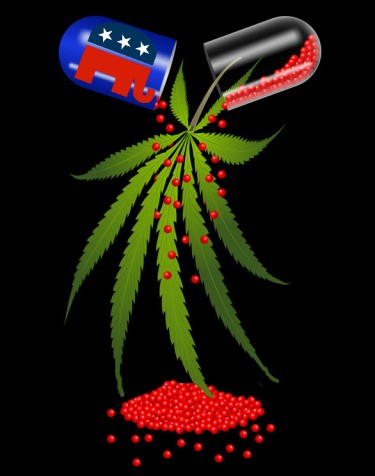
WHY DOES AMERICA HAVE AN OPIOID EPIDEMIC, READ ON..