
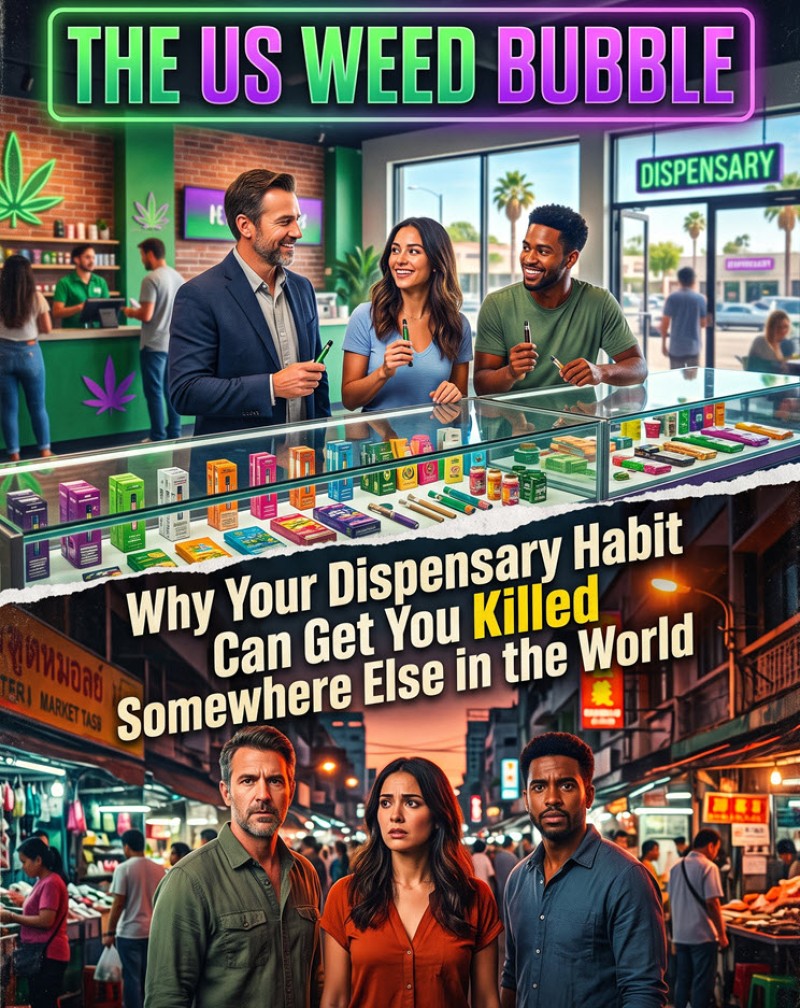
Americans have gotten comfortable. Forty-plus states have some form of legal cannabis on the books, dispensaries have started to look like Apple Stores, and an entire generation of consumers has grown up assuming weed is basically fine everywhere now. It is not fine everywhere now. It is barely fine in most of the country, and the second you cross an international border, or even a state line into the wrong state, you are stepping out of a bubble that the rest of the world never agreed to build with you.
Thailand just gave everyone a reminder. In June 2026, the kingdom sharply increased penalties for anyone caught importing or exporting cannabis across its borders, even though the country decriminalized possession back in 2022. Get caught now and you're looking at up to ten years in prison, a fine of 500,000 baht, roughly $15,000, or both. The U.S. Embassy in Thailand put out a plain warning about it, and cannabis attorney Jeffrey Hoffman told Fox News Digital the thing every American traveler needs tattooed on the inside of their eyelids: "Cannabis is still generally illegal across the overwhelming majority of the planet." Legal at home does not mean legal in transit, and it definitely does not mean legal on arrival.
This is American arrogance, and I mean that as a diagnosis, not an insult
I've watched otherwise careful people toss a stray gummy or a half-used vape cartridge into a jacket pocket and forget about it for months. In a legal state, that's a non-event. In a Thai airport, in a Singapore customs line, in a Filipino checkpoint, that same forgotten gummy is a legal event with your name on it. Travel expert Bobby Laurie put it simply: people assume that if something is legal where they live, it's automatically legal everywhere they go. That assumption is the entire problem. It's not malicious, it's just lazy, and lazy gets expensive fast outside U.S. borders.
The fix is boring and nobody wants to hear it: empty every pocket, every liner, every gym bag compartment before an international flight. Don't assume a medical card protects you abroad, because in the vast majority of countries it means nothing. Don't assume decriminalization means legalization, because Thailand just proved those are two completely different legal categories that can turn on you separately.
Asia is where this stops being a fine and starts being your life
Southeast and East Asia are where the gap between the American bubble and global reality gets genuinely dangerous. The Philippines has run drug enforcement campaigns with body counts in the thousands since the mid-2010s, and cannabis is swept into that same enforcement machinery as harder drugs. Singapore is the sharpest example on the map: trafficking more than 500 grams of cannabis carries a mandatory death penalty, full stop, no judicial discretion once the threshold is met.
This isn't theoretical. In April 2023, Singapore executed Tangaraju Suppiah, a 46-year-old man convicted of coordinating the delivery of about a kilogram of cannabis. He was never caught holding the drugs himself, prosecutors linked him through phone records, and he still hanged. Amnesty International called the case arbitrary and flagged serious due process failures, including limited access to a lawyer and an interpreter. The UN Human Rights Office publicly asked Singapore for a moratorium on drug-related executions. Singapore executed him anyway, and three weeks later hanged a second man for trafficking roughly 1.5 kilograms of cannabis. Sixty people sat on death row in Singapore at the time, most of them there for drug offenses. Singapore's government maintains the death penalty deters trafficking; the UN and most human rights researchers say the evidence for that claim doesn't hold up. Either way, the law is the law until somebody with more political capital than a tourist changes it, and it does not bend for Americans who assumed their home state's dispensary rules would travel with them.
China runs its own zero-tolerance version of this, and it doesn't spare celebrities or their families. Jaycee Chan, Jackie Chan's son, was detained in Beijing in August 2014 after police found roughly 100 grams of marijuana in his apartment and he tested positive for the drug. He was charged with "sheltering others to use drugs," a charge that could have carried up to three years, and ultimately pleaded guilty. He served six months and paid a fine equivalent to about $320, a relatively light sentence that courts attributed to his cooperation and lack of prior record. His father, Jackie Chan, had been named a goodwill anti-drug ambassador for the Chinese government back in 2009, which made the case a genuine embarrassment on top of a genuine prosecution. Jackie Chan publicly apologized, called himself a failure as a father, and said the state was helping him do the disciplining he couldn't. Jaycee, for his part, apologized on release and said prison had been harsh. Wealth and fame bought him leniency in sentencing. It bought him nothing in terms of avoiding arrest, a criminal trial, or actual time behind bars in a Chinese prison.
The places that actually welcome you
None of this means the whole world is a minefield. It just means you have to know which hemisphere you're standing in. Canada has federal legalization and a mature retail market. Germany legalized possession and limited home cultivation in 2024 and continues to build out its framework. The Netherlands has operated its coffee shop tolerance model for decades. South Africa allows private cultivation and use following a 2018 constitutional court ruling. Mexico has a patchwork but functionally tolerant reality on the ground, with dispensary-style shops operating in a legal gray zone that authorities mostly leave alone. Spain has its cannabis social clubs. Even the UK has loosened medical access, though recreational use remains illegal there.
The line isn't East versus West and it isn't really about wealth or development. It's about which legal tradition and which political history shaped a given country's drug law, and that can shift dramatically within the same region. Vietnam and Indonesia sit close to Thailand on a map and treat cannabis with the same severity Thailand just walked back toward, including the death penalty in Indonesia's case for large trafficking quantities. Japan tightened its own cannabis law in 2023 to criminalize use itself, not just possession, closing a loophole that had technically existed for decades. Meanwhile South Korea prosecutes citizens for cannabis used legally abroad if they can prove it happened, one of the few countries that claims that kind of extraterritorial reach over its own nationals. None of this tracks neatly with wealth, democracy, or how Western a country's pop culture looks from the outside. Treat every border crossing like it's a fresh legal environment, because it is one, and the version of you that got comfortable buying eighths at a strip mall dispensary needs to stay home when the passport comes out.
Even inside the U.S., the bubble has edges
This isn't purely a passport problem either. Cross from Colorado into a state like Idaho or Kansas with cannabis in the car and you've committed a crime under that state's law, full stop, regardless of what your home dispensary receipt says. Federal land complicates things further: national parks, military bases, and federal buildings enforce cannabis prohibition regardless of the state around them, because federal law still controls on federal property. A gummy that's perfectly legal in your hotel room in Denver becomes a federal offense the moment you carry it onto federal land ten minutes away. Most Americans have no idea that boundary exists until they've already crossed it.
None of this is meant to scare people out of traveling, or out of using a plant that's legal for them at home. It's meant to replace assumption with information, which is the one thing every story in this genre keeps proving Americans don't bother to gather before they pack a bag.
Check the State Department's country-specific travel advisories before you fly, not after you land. It takes ten minutes, it's free, and it's a better return on your time than almost anything else you'll do to prepare for a trip. The bubble Americans are living in isn't going away, because the domestic legal market isn't going away. That just means the responsibility for knowing where the bubble ends sits with the traveler, every single time, with no exceptions for good intentions or forgotten pockets.
Fly high at your own risk domestically. Just don't try to bring the high across a border with you, and definitely don't try to join the mile-high club with anything more incriminating than turbulence. Some mistakes cost you a fine. In the wrong country, this one can cost you everything.
Sources referenced: Fox News Digital / U.S. Embassy and Consulate in Thailand travel advisory (July 2026); Amnesty International statement on the execution of Tangaraju Suppiah (April 2023); PBS NewsHour, NBC News, and CBS News reporting on Singapore drug-trafficking executions; CNN, E! News, and South China Morning Post reporting on the Jaycee Chan case (2014–2015).
CANNABIS OUTSIDE OF AMERICA, READ ON...