

You Were Promised Legalization. You Got a Press Release.
A federally funded study confirms what cannabis consumers already knew: the people want full reform, not a scheduling tweak
Let me start with what the data actually says. A study published in the journal Addiction — funded by the National Institute on Drug Abuse, a branch of the federal government — analyzed 42,913 public comments submitted to the DEA during the marijuana rescheduling process. The results: 28.9 percent of commenters supported moving cannabis from Schedule I to Schedule III as proposed. Another 63.5 percent wanted further rescheduling or outright descheduling. Only 6.7 percent wanted to keep cannabis in Schedule I entirely.
The researchers, from Johns Hopkins University and UC San Diego, concluded that public sentiment 'supports the DEA's proposal for cannabis rescheduling, though the majority views the proposed Schedule III classification as inadequate and supports further rescheduling or complete de-scheduling of cannabis.'
More than nine out of ten Americans who participated in this process wanted cannabis moved to a lower schedule or removed from scheduling entirely. The federal government heard that. Then it gave them Schedule III for medical cannabis only and called it a historic win.
This Is the Pattern. It Has Always Been the Pattern.
You do not have to work very hard to see how this plays out across every major policy domain. The people express overwhelming preference for a thing. The political class acknowledges the polling. Then they deliver a fraction of it, declare victory, and move on.
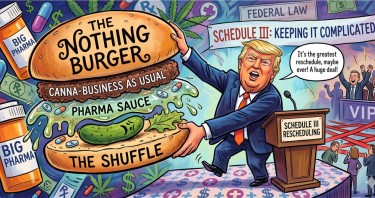
Cannabis is no different from any other promise made by the American political machine. Voters in state after state have legalized cannabis at the ballot box. Public polling has shown majority support for federal legalization for years. The Biden administration proposed rescheduling in 2024 and stalled. The Trump administration picked it up, narrowed it to medical cannabis only, issued a press release about historic action, and Trump himself credited a friend named Howard Kessler who told him medical marijuana helped him feel better.
That is where we are. A policy affecting tens of millions of Americans, underpinned by decades of activism, scientific research, and human cost — moved forward because the president's friend had a good experience. And the move itself covers perhaps five percent of the actual cannabis market.
White House Press Secretary Karoline Leavitt described the rescheduling as something the president did 'at the behest of the American public, who largely support it.' That framing deserves scrutiny. The American public largely supports full federal legalization. They were given partial medical rescheduling. These are not the same thing, and the study makes that impossible to misread.
The Disconnect Is Structural, Not Accidental
Study coauthor Johannes Thrul put it plainly: 'Many commenters have lived under state legalization for medical or adult use for years already. Their expectation of federal policy reflects that reality.' That is the crux of it. The population has moved. Federal policy has not kept up, and it appears designed not to keep up.
The researchers named the gap directly: the disconnect between federal proposals and public expectations is 'potentially shaped by state-level legalization experiences.' People in Colorado, California, Oregon, and dozens of other states have watched cannabis treated as an ordinary consumer product for years. They walk into dispensaries, pay taxes, and go home. The federal government's position that this same product has 'no currently accepted medical use' for anyone outside a state medical license is not just outdated — it is a deliberate fiction maintained for purposes that have little to do with science or public health.
The study noted that opponents of any change cited public health risks, addiction, and underage use. These concerns deserve engagement. But they do not explain a system that for decades has imprisoned people for a substance that a federally funded study now confirms most Americans want treated as medicine or less.
The System Was Not Designed to Serve You
I want to say something plainly, without dressing it up. If the past decade has not made it obvious that the political system operates in favor of those who already hold power, then I do not know what will. This is not a partisan observation — it applies regardless of which party holds office. The Epstein client list sits unsolved. Wars get started under the banner of 'no new wars.' The petrodollar infrastructure starts cracking while the public gets handed fiscal theater.
Cannabis policy is smaller than those things, but it runs by the same logic. The people want full legalization. The industry wants a functional, fair marketplace. Researchers want unrestricted access to study a plant that 63 percent of the commenting public believes deserves Schedule II or lower. What they got is a partial medical carve-out that requires operators to register with the DEA and potentially confess to trafficking.
The way forward is not to petition the existing structure harder. It is to build around it. Legal cannabis states have already demonstrated that the plant can be regulated, taxed, and sold without civilization collapsing. The market exists. The science exists. The public will exists. What remains is the political will to stop treating incremental capitulation as a victory.
A federally funded study just confirmed, using the government's own comment data, that the population wants more than it was given. File that next to the polling numbers. Then decide what kind of pressure actually moves things — because asking nicely through a DEA comment portal clearly gets you 5% of what you asked for.
TRUMP'S CANNABIS REFORM BOMBSHELL, READ ON..