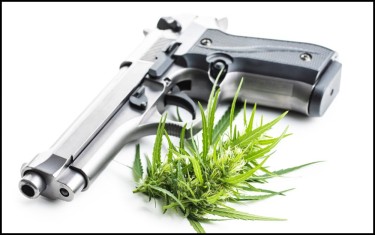

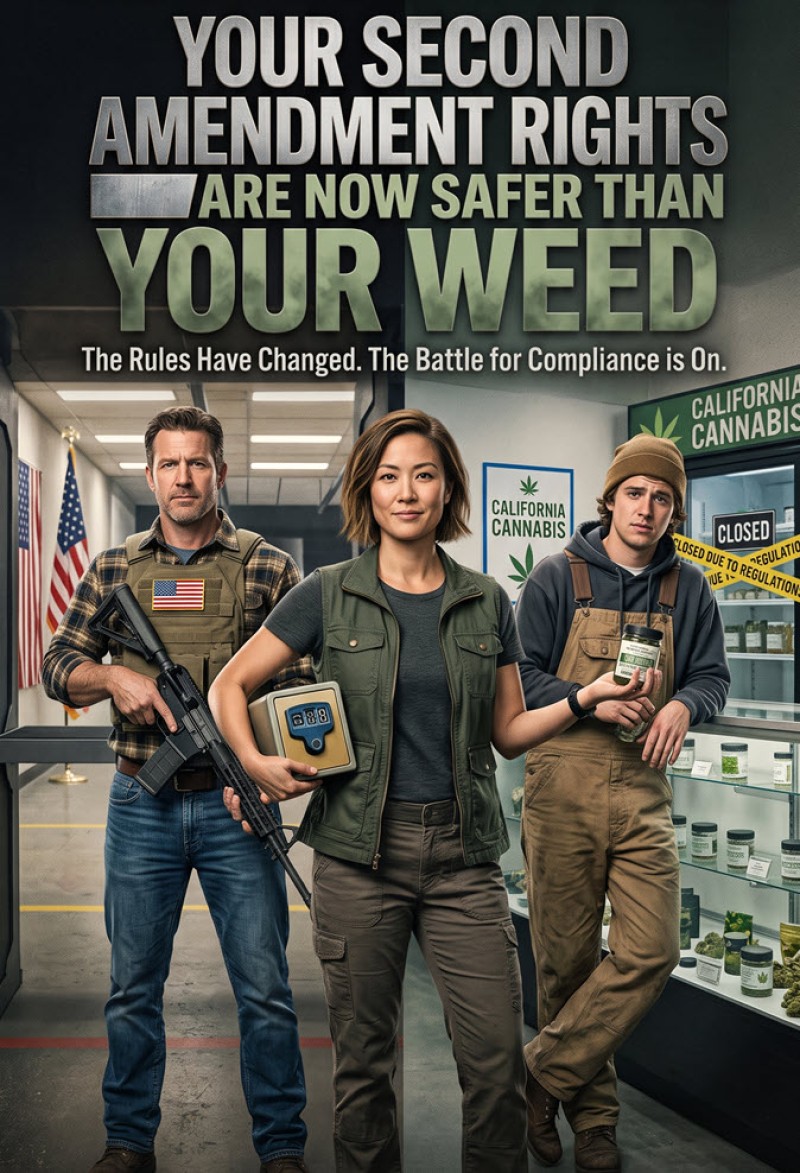
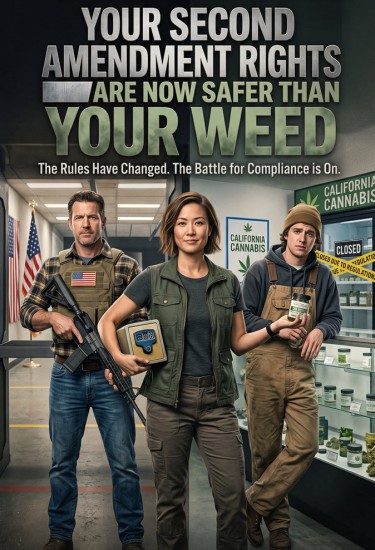
Nine to zero. That’s the score from the Supreme Court’s June 18th ruling in United States v. Hemani, and for once, every justice in that building agreed on something involving cannabis. The Court ruled that the federal government cannot restrict gun ownership based solely on the fact that someone uses marijuana, finding that certain prosecutions under 18 U.S.C. § 922(g)(3) intrude on the Second Amendment’s right to “keep and bear arms.”
Let’s talk about what actually happened here, because the details matter.
The Case
In 2022, FBI agents executed a search warrant on the home of Ali Danial Hemani, a Texas-based American-Pakistani dual citizen. They found a 9mm pistol, 60 grams of marijuana, and 4.7 grams of cocaine. Hemani told agents he used marijuana roughly every other day. A grand jury charged him under the “unlawful user” provision of federal law for possessing a firearm while also being in possession of marijuana.
The case worked its way up from a trial judge who dismissed it, to the Fifth Circuit who upheld the dismissal, and finally to the Supreme Court. The Trump administration asked the justices to adopt a rule allowing “habitual users” of illegal drugs to be stripped of gun rights. They lost. Unanimously.
Justice Neil Gorsuch, writing for the majority, concluded that the government’s argument “fails under every measure it asks us to consider: The historical laws on which it relies targeted different kinds of people, did so for different reasons, and operated in different ways.”
That’s a clean sweep. The government brought its historical analogy argument — the one requiring modern gun restrictions to have an 18th or 19th century precedent under the Bruen framework — and the Court told them they came empty-handed.
Why the Ruling Is Right
The Court rejected the federal government’s claim that anyone who uses marijuana is categorically dangerous, calling that position “based on little more than its own say-so” and “at odds with its own regulatory actions.”
That last part deserves a moment. The government is currently in the middle of rescheduling cannabis. Hearings are scheduled. The DEA has already moved state-licensed medical marijuana to Schedule III. The feds can’t simultaneously argue that weed users are so dangerous they forfeit constitutional rights, while also acknowledging the plant has accepted medical use and a lower abuse potential than Schedule I suggests. That’s not a policy. That’s a contradiction.
Gorsuch wrote: “We appreciate that drugs and guns can sometimes make for a dangerous mix. We appreciate, too, that the government’s effort to analogize a modern statute addressing drug use to historical laws must be approached with a sensitivity to the fact that many drugs well known today were unknown in early America.”
That’s not a soft ruling. That’s the Court telling the government its entire analogical framework doesn’t translate to a substance that didn’t exist in American law when the Second Amendment was written.
And the practical consequence of the old law was severe. Those prosecuted under it faced up to 15 years in prison and a permanent ban on owning firearms. A permanent ban. For smoking weed a few times a week. That’s not public safety policy. That’s punishment dressed up as policy.
The Ruling Doesn’t Solve the Problem
Here’s where I have to pump the brakes on the celebration.
The decision doesn’t entirely strike down the criminal charge. It leaves the door open for prosecutions if the government can prove the individual was under the influence of an unlawful drug at the time they were discovered with a gun.
So if you’re high and holding, you’re still exposed. The ruling narrowed the law. It didn’t end it. Gorsuch went out of his way to call the ruling a “narrow” one, specifically noting the Court wasn’t addressing efforts to ban addicts or intoxicated people from having guns, other laws Congress might pass regarding people who use certain drugs that pose special dangers, or the law’s ban on convicted felons from having guns.
There’s also the ATF Form 4473 problem. That’s the form you fill out when you buy a firearm from a federally licensed dealer. It still asks whether you’re an unlawful user of controlled substances. Cannabis remains federally illegal for recreational use. For Texas gun permit holders, since marijuana remains illegal under Texas state law, the federal ruling changes nothing for them. The patchwork doesn’t go away.
What this ruling did was remove one weapon from the federal prosecution arsenal. It’s meaningful. It’s not enough.
The Theater of Schedule III
On April 23, 2026, the Justice Department and DEA announced the placement of FDA-approved marijuana products and state-licensed medical marijuana into Schedule III of the Controlled Substances Act, with a new administrative hearing beginning June 29, 2026, to evaluate broader rescheduling.
A DEA hearing. In 2026. Fifty-six years after Congress planted cannabis in Schedule I alongside heroin.
The Final Order does not broadly reclassify marijuana. It adopts a narrow and conditional rescheduling framework. Recreational marijuana, unlicensed activity, and synthetically derived THC remain in Schedule I.
So let me make sure I understand this correctly. If you live in a state where recreational cannabis is completely legal, have never been arrested, never harmed anyone, and simply buy weed from a licensed dispensary, you are still operating under a federally Schedule I substance. Your neighbor who gets a medical card for a bad knee just moved to Schedule III. You did not.
Moving marijuana from Schedule I to Schedule III, without other legal changes, would not bring the state-legal medical or recreational marijuana industry into compliance with federal controlled substances law.
That’s from the Congressional Research Service. Not an advocacy group. The nonpartisan research arm of Congress itself confirming that Schedule III, even if completed in full, doesn’t fix the legal landscape.
This is exactly the kind of cascading legal chaos that the Hemani case represents at the individual rights level. A person smokes legally purchased weed in a legal state, tells an FBI agent he smokes a few times a week, and suddenly faces a federal gun charge carrying a 15-year sentence. None of that would exist if cannabis weren’t scheduled in the first place.
The Source of the Problem Has One Name
The Controlled Substances Act of 1970.
Every single one of these legal knots originates there. The gun ban existed because cannabis is federally scheduled. The 280E tax problem, where cannabis businesses get taxed on gross revenue rather than profit, exists because of federal scheduling. The banking problems exist because of federal scheduling. The research restrictions exist because of federal scheduling. The conflict between state and federal law that creates uncertainty for millions of legal consumers every day exists because of federal scheduling.
Schedule III doesn’t untangle this. It just moves the knot to a slightly different position. The Hemani ruling clipped one thread. Neither of these things addresses the root.
There is exactly one fix: remove cannabis from the Controlled Substances Act entirely.
Not Schedule III. Not Schedule V. Not a new tier with special carveouts for FDA-approved products and state medical licenses. Removal. Descheduling. Let states regulate it the way they regulate alcohol and tobacco — substances that demonstrably cause more harm by most objective medical measures — and call it what it is.
As long as cannabis remains scheduled, the government retains the legal architecture to do exactly what it tried to do to Hemani: use the classification as leverage to erode other rights. Today it’s the Second Amendment. The argument has also been applied to professional licensing, federal housing, immigration status, and employment. The scheduling doesn’t just criminalize the plant. It attaches consequences to the person who uses it that extend into every corner of their legal life.
The Hemani ruling is a good decision for the right reasons. Nine justices looked at the government’s case and said the logic doesn’t hold. The logic has never held. That’s not a new problem with 922(g)(3). That’s a problem with a 56-year-old law built on political calculation and racially motivated fearmongering rather than pharmacology or public health evidence.
The Supreme Court just told us, unanimously, that the government cannot strip people of constitutional rights using cannabis as the justification without actual evidence of danger. That principle doesn’t stop at the Second Amendment.
Congress needs to hear it applied to all of them.
Sources
NBC News — Supreme Court rules government can’t restrict gun rights for casual drug use (June 18, 2026)
The Hill — Supreme Court’s narrow gun decision kindles divisions, more questions (June 2026)
SCOTUSblog — Supreme Court skeptical of law banning drug users from possessing firearms (March 2, 2026)
National Constitution Center — Supreme Court to hear arguments on legality of gun bans for marijuana users
Gibson Dunn LLP — DEA Downschedules State Medical Marijuana to Schedule III (April 29, 2026)
Foley & Lardner LLP — DEA Issues Long-Awaited Final Order Rescheduling Certain Marijuana Products to Schedule III (April 28, 2026)
Saul Ewing LLP — DEA Reschedules FDA-Approved Marijuana Products and State-Licensed Medical Marijuana to Schedule III (April 23, 2026)
Congressional Research Service — Legal Consequences of Rescheduling Marijuana (LSB11105)
DEA.gov — Marijuana Rescheduling Regulatory Actions
U.S. Department of Justice press release (April 23, 2026)
Federal Register Vol. 91 No. 82 (April 28, 2026)
CANNABIS AND THE 2ND AMENDMENT, READ ON...