

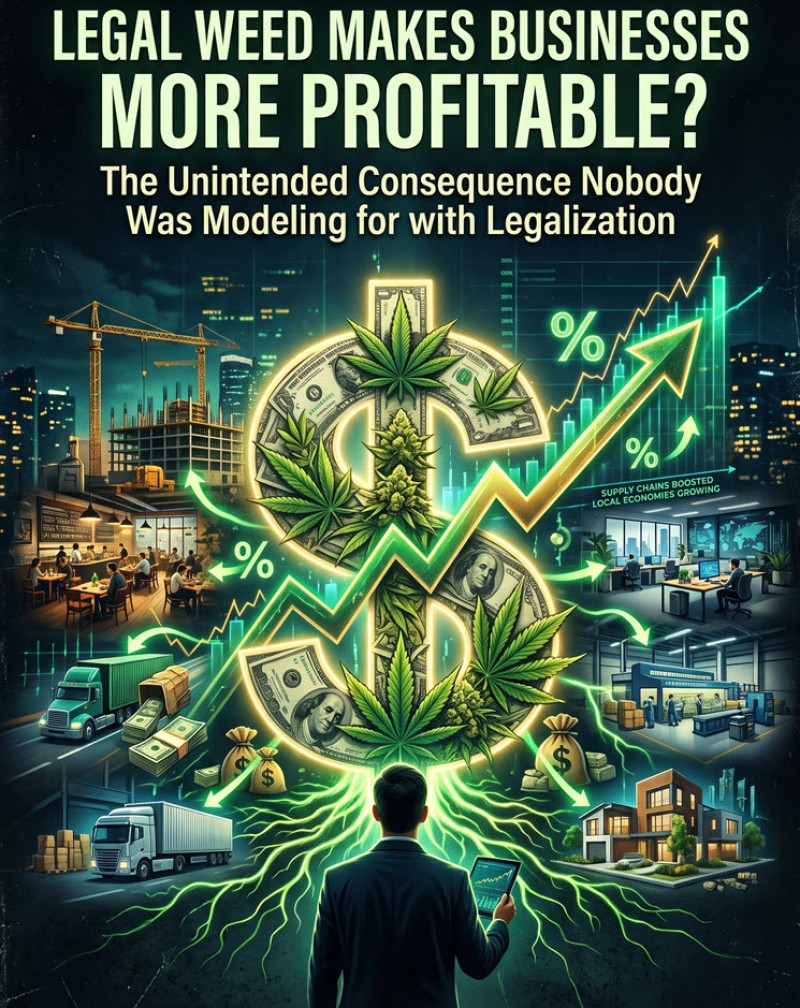
Every argument about cannabis legalization tends to orbit the same handful of poles: public health, criminal justice, tax revenue, personal freedom. Rarely does anyone ask what legalizing medical marijuana does to the balance sheet of a completely unrelated publicly traded company three states over that has nothing to do with cannabis. Turns out, according to new research out of the University of Iowa, quite a lot — and it's worth taking seriously precisely because nobody designed the policy to produce this effect.
What the Study Actually Found
The research, led by University of Iowa finance professor Tong Yao and published in the journal Financial Management under the title "Do firms get high? The impact of medical marijuana legalization on firm performance and corporate innovation," looked at more than 13,000 publicly traded companies between 2001 and 2022. The question wasn't whether stoned employees are more productive — Yao is explicit that this isn't about anyone getting high at their desk. It's about what happens to corporate performance in a state after that state legalizes medical marijuana.
The numbers are genuinely striking. Corporate valuation increased in 21 of the 38 states studied following medical marijuana legalization. Gross profit per employee and gross sales per employee each rose by more than $8,000. Patent output climbed 10.4% across those states, and the economic value of those patents — not just the count, but how much they were actually worth — rose 22%, as states became better at both retaining their existing inventors and pulling in new ones from states that hadn't legalized. Notably, Yao found the effect wasn't partisan: it showed up regardless of whether the state had a Democratic or Republican governor, which cuts against the idea that this is just a proxy for generic blue-state economic dynamism.
This builds on earlier work out of the same research pipeline. A related study reviewed by Marijuana Moment, analyzing roughly 9,810 corporations between 1991 and 2017, found firms headquartered in newly-legal states saw a 4.2% increase in company value — an average market-value bump of $166 million per firm — plus higher abnormal stock returns and increased innovation output after a medical marijuana law passed. Different sample windows, same directional story, which is the kind of replication that should make you sit up.
Yao's Theory: Legalization as a Signal, Not a Substance Effect
The mechanism Yao proposes isn't about cannabis itself doing anything to workers. It's about what legalizing medical marijuana signals about a state's broader culture. In his words, legalization can give a state a "cool image" — a costly, hard-to-fake signal of openness to unconventional policy that highly skilled, creative workers read as a proxy for other things they care about: tolerance, forward-thinking governance, quality of life. Those workers are mobile. They can choose where to live. States that send that signal apparently pull in a disproportionate share of the "creative class" — inventors, engineers, knowledge workers — who then show up in the patent data and the productivity numbers of firms already operating there.
If that's right, it's a genuinely elegant finding: cannabis reform functions as an economic development policy nobody voted on it as. States passing medical marijuana laws for compassionate-use or public-health reasons may be getting a side helping of Silicon Valley-style talent magnetism as a bonus.
Where I Want to Slow Down
I try not to hand you a study and just cheerlead it, because that's not useful to anyone. There are real limitations here that deserve equal airtime.
The biggest one is the classic correlation-versus-causation problem, and it's not fully solved just because Yao controlled for governor party. States that legalized medical marijuana earlier — California in 1996, followed by the usual early-mover cohort — were often already unusually dynamic, high-immigration, high-innovation economies before legalization ever passed. Legalization could be a marker of an underlying cultural and economic trajectory rather than an independent cause of it. Controlling for one political variable (governor's party) doesn't rule out that legalization and economic dynamism share deeper roots — things like urbanization, existing tech-sector concentration, or ballot-initiative-friendly state constitutions — that the study doesn't fully isolate.
Second, this study only looked at medical marijuana legalization, not adult-use recreational legalization. Yao was explicit about that scope. So this tells us nothing directly about whether Colorado or California's move to full recreational legality produced the same signal effect, a bigger one, or a diminished one as the novelty wore off.
Third — and this one matters a lot to me as someone who actually follows the cannabis industry — this study is measuring the fortunes of publicly traded companies with no connection to cannabis whatsoever. It is not telling you how actual cannabis operators are doing. Those businesses are dealing with a completely different reality: Section 280E of the federal tax code still bars state-legal cannabis businesses from deducting standard business expenses because the plant remains federally Schedule I, banking access is still constrained because most national banks won't touch cannabis deposits, and margins in mature markets like California and Colorado have been brutally compressed by oversupply and taxation. The "cool image" halo effect Yao documents is accruing to Google and pharmaceutical firms and biotech startups down the street from a dispensary — not to the dispensary itself.
Fourth, the effect isn't static. Yao himself notes that the boost was more dramatic in the early-adopter states and has weakened as more states have legalized medical marijuana — now 38 of them. That tracks with the signaling theory: a costly signal only works if it's rare. If nearly every state has legalized medical cannabis, the policy stops distinguishing a state from its neighbors, and the talent-magnet effect should keep shrinking toward zero. Any state legalizing today for the economic development bump specifically should not expect California-1996 results.
Finally, there's a self-selection wrinkle worth flagging: some of the "productivity" gain in these datasets could reflect firms and inventors relocating or reincorporating rather than existing workers becoming more productive in place. The paper accounts for out-of-state inventor attraction, which is good, but it's a reminder that some of this could be redistribution of talent between states rather than a net increase in national economic output.
So Is This a Real Unintended Consequence?
I think the honest answer is: probably yes, at least directionally, but smaller and more time-limited than the headline numbers suggest. It's a legitimately interesting rebuttal to the old "reefer madness" assumption that legal weed would somehow drag down a state's business climate or workforce reliability — the data says the opposite happened, at least on a macro level. But it shouldn't be oversold as proof that cannabis reform is a general-purpose economic stimulant. It's more precise, and more interesting, than that: it's evidence that signaling cultural openness matters to where mobile, high-value talent chooses to plant itself, and legalizing medical marijuana was one of several signals states could send.
The Sticky Bottom Line
A university finance professor set out to measure corporate balance sheets and stumbled into evidence that cannabis reform doubles as an economic development tool — not because anyone's more productive high, but because tolerance reads as a hiring incentive to the people states most want to keep. It's a real finding, worth taking seriously, and worth citing the next time someone claims legalization only brings costs. Just don't mistake it for the whole picture, and don't confuse Wall Street's reaction to a policy signal with how the actual cannabis industry is faring under 280E and a banking system that still won't pick up the phone.
CANNABIS HELPS THE BUSINESS COMMUNITY, READ ON..