
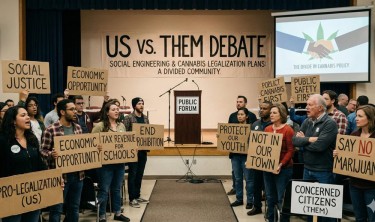
There's a pattern in history that repeats with disturbing regularity. It goes something like this: create an enemy, amplify the threat, demand loyalty, punish dissent, consolidate power. Rinse and repeat.
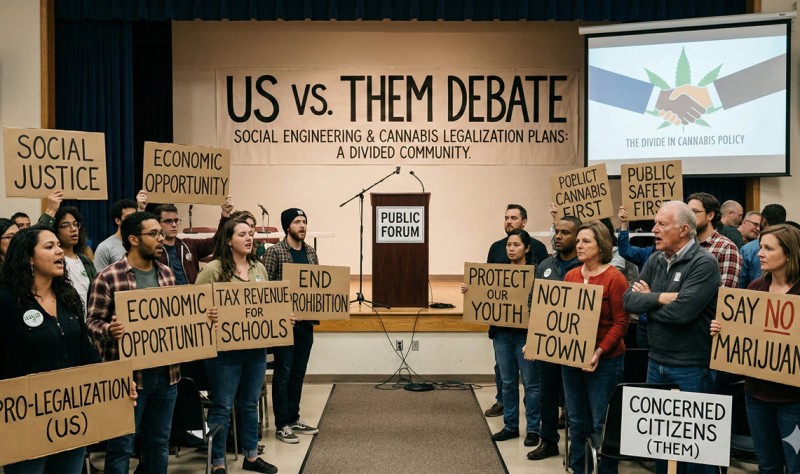
The enemy changes—communists, terrorists, witches, heretics, the other political party—but the mechanism remains the same. Polarization. The deliberate construction of an "us vs. them" narrative that reduces complex human beings into simplistic categories: good or evil, patriot or traitor, with us or against us.
This isn't politics. This is social engineering.
And before you think I'm about to launch into some predictable left-vs-right tirade, let me stop you right there. That's exactly the trap I'm talking about. The moment you pick a side in their manufactured conflict, you've already lost. You've accepted the premise that there are only two sides, that your neighbor who votes differently is your enemy, and that the solution to our problems lies in defeating "them" rather than questioning the people who benefit from keeping us divided.
I used to think we'd moved past this. I really did. Pre-2020, I looked at history books showing neighbors turning on neighbors, citizens reporting "subversives" to the state, entire populations swept up in mass hysteria—and I thought, "Surely we're too sophisticated for that now. Surely we've learned."
Then COVID happened.
And I watched, in real-time, as people who claimed to love freedom demanded their neighbors be fired from their jobs for refusing medical procedures. I watched as families disowned each other over mask mandates. I watched as the word "selfish" became the ultimate moral condemnation, and obedience to authority became the highest virtue.
I watched humanity fail the test spectacularly.
The playbook was simple: Create fear. Amplify division. Demand compliance. Punish dissent. And suddenly, people who considered themselves rational, compassionate, and free-thinking were ready to sell out their own family members to appease the state.
It was terrifying. Not because of the virus. Because of how easily it worked.
And now, as we stand in 2026, I'm watching the same playbook get deployed again. Different enemy. Different crisis. Same mechanism. The Great Polarization is accelerating, and the stakes are higher than ever.
But here's where it gets interesting—and here's where cannabis enters the conversation in a way that might surprise you.
The Mechanism of Mass Control: Polarization as Political Technology
Let's talk about how polarization actually works as a control mechanism.
At its core, polarization is about collapsing complexity into binary choices. Nuance is the enemy of totalitarianism. Gray areas are dangerous to power structures that rely on absolute loyalty.
So the game is to create clear categories:
-
Whites vs. Blacks
-
Citizens vs. Migrants
-
Patriots vs. Terrorists
-
The Faithful vs. The Devil Worshippers
Once you've established these categories, you can activate them whenever you need to consolidate power or distract from uncomfortable truths. The category doesn't even need to be accurate—it just needs to be emotionally charged enough to bypass critical thinking.
This is why political rhetoric increasingly sounds religious. It's not about policy anymore. It's about salvation vs. damnation. You're not just voting for a candidate; you're fighting for the soul of the nation against literal evil.
The other side isn't just wrong—they're unredeemable. Nazis. Racists. Bigots. Crazy. Violent. Subhuman.
Once you've dehumanized the other, anything becomes justifiable. Violence. Censorship. Imprisonment. Because you're not hurting a person—you're stopping evil.
This is the mechanism. And it works because it taps into our tribal psychology—the evolutionary hardwiring that helped our ancestors survive by quickly identifying threats and rallying around the in-group.
But here's the problem: that same tribal psychology, when hijacked by sophisticated propaganda and amplified by social media algorithms, becomes a weapon of mass manipulation.
And the people deploying this weapon? They don't actually believe in the polarization they're selling. They're above it.
The Epstein Files and the Uniparty Revelation
Let me be blunt: The Epstein files should have been a wake-up call.
When the client list of a convicted sex trafficker includes politicians from both parties, CEOs of major corporations, members of the intelligence community, and global elites from every ideology—you should probably start questioning whether the left-vs-right paradigm is even real.
Because it's not.
There is no "right" and "left" at the level of actual power. There's only the donor class and everyone else. There's only the people who write the checks and the politicians who cash them.
The "fierce political battles" you see on TV? Theater. The real decisions—who gets wars, who gets bailouts, who gets prosecuted, who gets pardoned—those happen behind closed doors, and the donors get what they want regardless of which party controls Congress.
This is the uniparty. And their game is simple: keep us fighting each other so we never look up and notice who's actually robbing us blind.
They want you angry at your Trump-voting neighbor, not questioning why pharmaceutical companies were granted legal immunity for vaccine injuries. They want you outraged at your Biden-supporting coworker, not asking why insider trading is legal for members of Congress but not for you.
The polarization isn't a bug. It's a feature. It's the entire point.
Because as long as you're focused on the constructed enemy—the other tribe, the other party, the other race—you're not focused on the parasitic class that continues to steal your awareness, your freedom, and your future.
They want you living in a state of perpetual fear and outrage. Fear and outrage are low-frequency emotional states that make you reactive, tribal, and easy to control.
Love, peace, connection, nuance—these are high-frequency states that make you dangerous to power structures built on division.
This is where cannabis comes in.
Cannabis: The Polarization Disruptor
Here's something the CIA knows very well, even if they'd never admit it publicly: Cannabis disrupts mass programming.
I'm not saying cannabis makes you immune to propaganda. We're all susceptible—our brains are wired for pattern recognition and tribal belonging, and sophisticated influence operations exploit these vulnerabilities ruthlessly.
But cannabis does something subtle and profoundly important: it alters the flow of information just enough that your perception of the "message" differs from others receiving the same programming.
In that variance, you find nuance. And within nuance, all polarities collapse.
Let me explain.
When you're sober and consuming media—whether it's news, social media, political speeches—your brain processes information in predictable patterns. You unconsciously filter incoming data through your existing beliefs, tribal affiliations, and emotional states. This is normal. It's how humans work.
But cannabis interrupts these automatic processes. It slows down your cognitive filtering. It makes you notice things you'd normally overlook. It creates space between stimulus and response.
Suddenly, the politician's speech doesn't sound as convincing. The outrage-bait headline doesn't trigger the automatic emotional reaction. The binary choice between "us" and "them" starts to feel... false.
You see the shades. The highlights. The contradictions. The complexity.
This is why cannabis is called a reflective drug. One of prohibition's favorite talking points is "it makes you lazy." But that's a mischaracterization. Cannabis doesn't make you lazy—it makes you reflective. It makes you ask: "Is this actually worth my energy? Do I actually believe this? Is this genuinely important, or am I being manipulated into thinking it is?"
These are dangerous questions from the perspective of power structures that rely on unquestioning obedience.
Cannabis makes you pause and consider. And consideration is the enemy of polarization.
Can cannabis make you complacent? Sure. Can it make you slower, more sedated? Absolutely, depending on frequency, strain, dosage, set, and setting. But here's the thing: sometimes being a bit sedated isn't such a bad thing—especially when the alternative is being whipped into a frenzy of tribal rage by algorithms designed to maximize engagement through outrage.
Sometimes the most revolutionary act is to refuse to participate in the emotional manipulation.
Why the Renewed War on Cannabis Now?
This brings us to the present moment. If you've been paying attention, you've noticed something: there's been a stringent campaign against cannabis over the past two years that seems bizarrely disconnected from public sentiment.
71% of Americans support legalization. 38 states have medical programs. 24 states have adult-use legalization. The scientific evidence is overwhelming. The economic benefits are undeniable.
And yet, we're seeing:
-
Federal hemp bans
-
Legislative attempts to repeal state legalization
-
Schedule III rescheduling (which benefits Big Pharma, not patients)
-
Potency caps and restrictive regulations in states that already legalized
-
Constitutional prohibition amendments on state ballots
Why? Why now, when public consensus has clearly shifted toward legalization?
Because they need us polarized. And cannabis works against polarization.
Think about it: What happens when people consume cannabis in a group setting? They laugh. They connect. They have philosophical conversations. They question assumptions. They see commonality across political, racial, and ideological lines.
Cannabis culture is inherently anti-tribal in the ways that matter to power structures. A stoner isn't going to storm the Capitol or burn down a city because a talking head on TV told them the other tribe is evil. A stoner is going to ask, "Wait, but why? Who benefits from this? Is this actually real?"
This is dangerous thinking when you're trying to manufacture consent for authoritarian policies, endless wars, or corporate giveaways disguised as legislation.
Cannabis doesn't fit neatly into the polarization paradigm. It's used by conservatives and liberals, rich and poor, young and old, every race and religion. It creates bridges instead of walls.
And right now, as we're being pushed toward the Great Divide, bridges are the last thing the parasitic class wants.
The Great Divide: Recognizing the Game
Let me be explicit about what's happening right now in 2026.
We are being forced into a Great Divide. Politicians on both sides are calling each other Nazis, racists, bigots, traitors, insurrectionists, crazy, violent, unredeemable.
This language isn't accidental. It's dehumanization. Once you've established that the other side is literally evil—not misguided, not wrong, but evil—you can justify anything.
History is littered with examples of what happens when populations accept dehumanization of the "other": genocide, pogroms, purges, mass incarceration, civil war.
And before you say "that could never happen here," remember: that's what every population thinks right before it happens.
The mechanism is always the same:
-
Create or amplify a crisis (real or manufactured)
-
Identify an enemy responsible for the crisis
-
Demand loyalty and obedience from your tribe
-
Demonize and dehumanize the other tribe
-
Escalate until violence becomes normalized
We're currently somewhere between steps 4 and 5.
The Epstein files, the Panama Papers, the endless wars that benefit weapons manufacturers, the bailouts for banks while ordinary people drown in debt—all of this should have taught us by now that there is no right or left at the top. There's only the people who own everything and the rest of us fighting over scraps.
But they've done such a good job with the polarization programming that even pointing this out gets you labeled a conspiracy theorist or an enlightened centrist or whatever other dismissive term they've invented to shut down this line of thinking.
The game is control. The method is division. The goal is to keep us fighting each other so we never unite against them.
Raising Your Frequency: The Counter-Strategy
So what do we do?
I'm not naïve enough to say cannabis will save us from this trajectory. This is bigger than any single plant or practice. This is a spiritual and psychological crisis on a civilization-wide scale.
But cannabis can help. Not as a cure. As a tool.
A filter. A moment to reflect. A pause button on the programming. A reminder that there's another way to experience reality beyond the fear-saturated, outrage-fueled, low-vibrational state they want us trapped in.
Here's my suggestion, and I mean this sincerely:
Take a hit. Close your eyes. Breathe. Just be.
Don't consume media. Don't scroll. Don't engage with the outrage. Just exist for a moment in your own direct experience of reality, unmediated by algorithms or talking heads.
Notice how you feel in your body. Notice the quality of your thoughts. Notice whether the anger and fear you've been carrying actually belongs to you or whether it was given to you by people who profit from your emotional reactivity.
Then:
-
Hum. Vibration resets your nervous system.
-
Stretch. Get out of your head and into your body.
-
Run. Move. Burn off the cortisol.
-
Smile. Even if you don't feel like it. The physical act of smiling triggers neurological responses.
-
Laugh. Comedy is subversive. Humor breaks spell.
-
Hug someone. Physical connection is the antidote to digital isolation.
-
Eat a good meal. Slowly. With gratitude.
-
Go for a hike. Nature doesn't give a shit about your political affiliation.
These aren't distractions. These are acts of resistance.
Because when you raise your frequency—when you operate from love, peace, connection, and wholeness—you become immune to the polarization virus.
You stop seeing enemies everywhere. You stop reducing human beings to their worst political opinions. You start seeing people again, in all their complexity and contradiction.
This is infectiously dangerous to systems built on division.
If enough of us refuse to hate each other, refuse to play their game, refuse to reduce our neighbors to tribal categories—if we can demonstrate that another way is possible—maybe we break the spell.
Maybe we make it.
The Sticky Bottom Line
I know this piece is less "article" and more "philosophical ramble." That's intentional. Because what we're facing right now isn't a policy problem that can be solved with better legislation or smarter arguments.
We're facing a spiritual crisis. A crisis of consciousness. A choice between descending further into tribalistic violence and fear, or waking the fuck up and refusing to participate in our own enslavement.
Cannabis won't save us. But it might help us remember who we are beneath the programming. It might give us just enough cognitive distance from the propaganda to ask: "Wait, is this actually real? Or is this a game being played on me?"
The Great Polarization is real. The manufactured division is real. The parasitic class that benefits from keeping us at each other's throats is real.
But so is your capacity to choose differently.
So smoke a joint if that helps you reflect. Or don't—meditation works too, or breathwork, or psychedelics, or just turning off your phone and going outside.
The specific method doesn't matter. What matters is that you raise your frequency. That you refuse to participate in the low-vibrational states of fear, hate, and division.
That you see through the game.
That you love anyway.
Because in the end, that's the only thing that's ever changed anything. Not better arguments. Not political victories. But people choosing love over fear, even when the entire system is designed to make that choice as difficult as possible.
Cannabis vs. The Great Polarization?
Cannabis offers a pause. A moment of reflection. A reminder that there's more to reality than the binary nightmare they're selling.
Use it wisely. Stay whole. And for the love of whatever you consider sacred, stop hating your neighbors.
They're not your enemy. They never were.
WHAT IS SOCIAL ENGINEERING, READ MORE...