


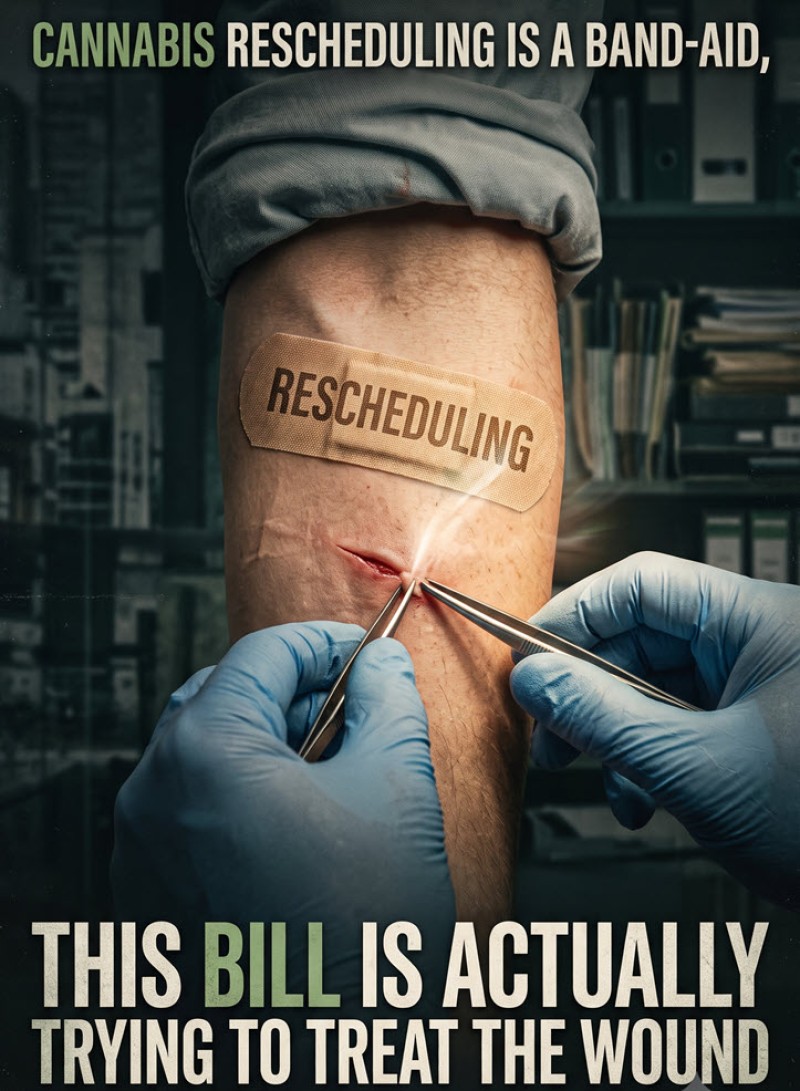
Senate Democrats just refiled a bill that does the thing rescheduling was never designed to do: end federal cannabis prohibition outright. Cory Booker, Chuck Schumer, and Ron Wyden reintroduced the Cannabis Administration and Opportunity Act on July 16, and while it will almost certainly die in a Republican-controlled House the same way its last two versions did, it's worth sitting with why this bill matters more than the rescheduling process everyone in Washington is currently fixated on.
Patchwork versus foundation
Rescheduling marijuana from Schedule I to Schedule III, which is what the Trump administration is pursuing through the DEA right now, sounds like progress and in a narrow sense it is. It would acknowledge that cannabis has accepted medical use, which is more than the government has admitted in over fifty years of federal policy. But Schedule III still leaves cannabis inside the Controlled Substances Act. It still leaves it federally illegal to sell without a DEA registration designed for pharmaceutical manufacturing, not dispensaries. It does nothing to expunge criminal records, nothing to open up interstate banking the way state-legal businesses actually need, and nothing to stop a future administration from reversing the whole thing with an act of bureaucratic will instead of Congress.
That's the problem with patchwork. You're constantly one election, one agency head, one lawsuit away from losing the ground you gained. The CAOA, by contrast, would order the attorney general to remove marijuana from the CSA entirely within 180 days of the bill becoming law. That's descheduling, not rescheduling. It's the difference between changing what shelf the drug sits on and taking it out of the pharmacy altogether.
What's actually in it
The bill isn't just a legalization gesture. It's an attempt to build the regulatory plumbing that federal legalization would require, and the scope of it is worth laying out plainly because most coverage skims past the mechanics:
-
A federal excise tax structure starting at 5 percent for small producers and 10 percent for large ones, scaling up to 12.5 and 25 percent respectively over five years.
-
Automatic expungement of low-level federal cannabis convictions within a year of enactment, plus a path for people currently incarcerated to petition for release.
-
A new Center for Cannabis Products inside the FDA, with the ATF and Treasury's Alcohol and Tobacco Tax and Trade Bureau sharing regulatory duties.
-
A requirement that FinCEN clarify to banks that they can legally service cannabis businesses, which is the single biggest operational headache the legal industry has dealt with since state markets opened.
-
Federal protections against losing benefits, housing, or security clearances over cannabis use or a past conviction.
-
A ban on federal employment drug testing for marijuana, with carve-outs for law enforcement and national security roles.
-
A DOJ-run Cannabis Justice Office funding reentry services, job training, and legal aid in communities hit hardest by prohibition enforcement.
-
A ten-year small business lending pilot aimed at people economically disadvantaged by the War on Drugs.
-
A ban on flavored vape cartridges, which is aimed at youth appeal but will also annoy plenty of adult consumers who don't understand why their industry keeps getting regulated like tobacco.
This is a bill trying to do what Congress should have done from the start: build an actual regulatory framework instead of asking forty-plus states to keep improvising around a federal law that pretends none of them exist.
The Controlled Substances Act was never built on solid ground
Here's the part I won't soften. The entire premise of where cannabis sits in the Controlled Substances Act was rotten from the moment it was written. Schedule I is supposed to mean no accepted medical use and a high potential for abuse with no safety margin, even under medical supervision. That classification survived not because the science supported it, but because Harry Anslinger and later Richard Nixon's own domestic policy advisor, John Ehrlichman, needed a legal weapon against political enemies and communities they wanted to control. Nixon's advisor admitted decades later that the drug war was built to criminalize Black communities and the antiwar left, not to protect public health. You cannot build fifty years of enforcement policy on a foundation like that and then act surprised when the resulting law doesn't line up with the actual pharmacology of the plant.
Rescheduling to Schedule III doesn't fix that history. It just moves cannabis into a category built for ketamine and anabolic steroids and calls it a win. The CAOA at least tries to remove cannabis from that architecture entirely, which is the only approach that actually reckons with how badly the original scheduling was botched.
I'd go a step further than most legalization advocates are willing to go publicly. The Controlled Substances Act itself needs a full renegotiation, not just a cannabis carve-out. The same 1970 framework that misclassified marijuana also misclassified psilocybin, MDMA, and a long list of substances now being studied at places like Johns Hopkins and NYU for treatment-resistant depression, PTSD, and end-of-life anxiety. A law built to serve a political enforcement agenda rather than actual pharmacology shouldn't still be the operating document for federal drug policy fifty-plus years later. Fixing cannabis alone and leaving the rest of the scheduling system untouched is treating one symptom of a document that was sick from the day it was signed.
What descheduling would actually change for the industry
It's worth being concrete about why full descheduling matters more to the existing legal industry than rescheduling does, because the difference isn't abstract. Under Schedule I, state-legal cannabis businesses have been barred from deducting ordinary business expenses under IRS code section 280E, which taxes gross revenue instead of net profit and has bankrupted more than a few operators who did everything right at the state level. Schedule III loosens 280E somewhat, but full descheduling under the CAOA would eliminate the problem entirely and open the door to interstate commerce, something no rescheduling move can touch because interstate transport of a Schedule III substance still requires DEA-registered manufacturing and distribution licenses that don't remotely resemble how a dispensary operates. Banking access has the same story. Rescheduling nudges FinCEN guidance; the CAOA would force it. Those aren't cosmetic differences. They're the difference between an industry that can finally operate like a normal regulated business and one that keeps limping along on state-by-state workarounds.
Will it pass? No. Should you care anyway? Yes.
Let's be honest about where this bill is headed. The House is run by a Republican majority that has already advanced legislation specifically to block the Trump administration's rescheduling effort, and the same House Appropriations Committee has attached riders blocking federal workers' comp from covering medical cannabis and directing agencies to keep drug testing truck drivers and pilots "regardless of any future changes to the legal status or scheduling." That's not a Congress in the mood to deschedule anything.
The math here is simple and a little grim. Most Republicans in this Congress vote the way Trump signals, full stop. Independent judgment on cannabis policy from the GOP conference has mostly evaporated. If Trump personally decided descheleduling was a win worth having, you'd probably see movement. Absent that, the CAOA is a marker bill, not a governing strategy. It tells voters where Democrats stand, it forces the rescheduling debate to happen next to a more ambitious alternative, and it keeps the full-legalization option alive in the Congressional Record for whenever the political math changes.
That's not nothing. Marker bills shape the Overton window. The CAOA has been filed in the last two Congresses and gone nowhere both times, and it's still worth filing again, because "fully legal, taxed, expunged, and banked" needs to stay in the conversation while Washington debates the much smaller question of which government schedule to lock cannabis into next.
I'd rather have a bill on record aiming at the real target and missing than a bill that succeeds at aiming for the wrong one. Rescheduling might pass. It just won't fix what's actually broken.
Whether Trump ever attaches his name to full descheduling is genuinely uncertain, and I won't pretend to know his calculus on an issue that's never been core to his political brand either way. But if the CAOA's sponsors actually want this thing to move instead of just getting reintroduced on a two-year loop, courting him directly is the only strategy on the table that has any chance of working with the current Republican conference. Everything else is symbolic, and symbolism has its place, but symbolism doesn't expunge a single record.
Sources referenced: Marijuana Moment, "Senate Democrats File Bill To Fully Legalize Marijuana Under Federal Law As Trump Moves To Merely Reclassify It" (July 16, 2026); official CAOA bill summary and sponsor statements from Sens. Booker, Schumer, and Wyden.
CANNABIS RESCHEDULING, READ ON...



.jpg?width=350)