
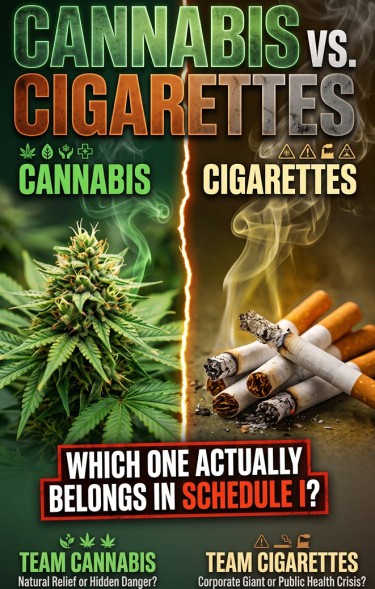
For the first time in recorded history, more Americans are getting high on cannabis than they are getting hooked on cigarettes. According to the 2025 National Survey on Drug Use and Health, released by the Substance Abuse and Mental Health Services Administration (SAMHSA), 43.8 million Americans used marijuana regularly last year, compared to 36.1 million who smoked cigarettes. Zoom in on daily or near-daily use and the gap gets even more interesting: 21.4 million people fire up cannabis almost every day, edging out the 19.9 million daily cigarette smokers and the 17.2 million daily drinkers. Weed, in other words, just out-consumed two of America's oldest vices, and it did it in a country where it's still federally illegal in most of its forms.
That milestone raises an obvious question, and it's one I've been chewing on for years: federally, cannabis (for anyone without a state medical license or an FDA-approved prescription) still sits in Schedule I of the Controlled Substances Act, the DEA's most restrictive tier, reserved on paper for drugs with "a high potential for abuse" and "no currently accepted medical use." That's the same shelf as heroin and LSD. Cigarettes, meanwhile, despite killing more Americans every single year than every Schedule I, II, and III drug combined, aren't scheduled at all. Neither is alcohol. So let's actually run the numbers and see which of these two substances behaves more like the "highly dangerous, medically useless" drug the law claims one of them is.
The Schedule I Question, Explained
A substance lands in Schedule I only if it meets three federal criteria: high potential for abuse, no currently accepted medical use in the United States, and no accepted safety for use even under a doctor's supervision. Cannabis got a partial reprieve from that box in April 2026, when Acting Attorney General Todd Blanche ordered FDA-approved marijuana products and state-licensed medical marijuana into Schedule III. Everything else, including the flower at your neighborhood dispensary, stays in Schedule I while the DEA runs a broader rescheduling hearing that wrapped on July 15, 2026, with closing briefs due to the administrative law judge today. Cigarettes, by contrast, have never been scheduled at all, because the Controlled Substances Act, written in 1970, carved tobacco and alcohol out of the entire system by definition, regardless of what the pharmacology actually shows.
Lethality: Not a Close Contest
Cigarette smoking is responsible for more than 480,000 deaths a year in the United States, according to the CDC, about one in five deaths annually, or roughly 1,300 people a day. That includes 41,000 deaths from secondhand smoke alone, meaning tobacco kills people who never chose to use it. Smokers die, on average, about a decade earlier than nonsmokers.
Cannabis has no confirmed fatal overdose from THC toxicity alone anywhere in the medical literature. There's no established lethal dose in humans, largely because cannabinoid receptors aren't concentrated in the brainstem centers that control breathing the way opioid receptors are. That doesn't make cannabis risk-free: impaired driving, accidental pediatric ingestion of edibles, and interactions with other medications are real and documented hazards. But those hazards land people in an emergency room, not a morgue, and virtually never the latter.
The Irony: Nicotine Gets You High Too
Here's a fact that gets lost in the cigarette-versus-weed conversation: nicotine is a genuinely psychoactive stimulant. It binds nicotinic acetylcholine receptors and triggers a dopamine release, and in a naive or recently-abstinent user, it produces a real head rush, a light stimulant buzz, sometimes mild euphoria. Go a month without nicotine, then take a hit, and you will absolutely feel it. The catch is that chronic exposure causes the brain to sprout more nicotinic receptors (a process called upregulation), which blunts that high within days to a couple of weeks. At that point the drug stops delivering a reward and starts merely relieving the anxious, irritable state of withdrawal between doses. That cycle, described extensively in NIDA's addiction literature, is the defining engine of nicotine dependence: you're not smoking to get high anymore, you're smoking to feel normal.
Medical Use: Advantage Cannabis, Officially
Cannabis has an FDA-approved derivative, Epidiolex, prescribed since 2018 for severe pediatric epilepsy, and roughly 40 states run medical cannabis programs treating chronic pain, chemotherapy-induced nausea, MS-related spasticity, and other conditions. That clinical track record is the entire reason the DOJ moved FDA-approved and state-licensed medical marijuana into Schedule III this past April: regulators concluded it does have an accepted medical use, at least in that lane. Nicotine's only FDA-sanctioned medical use, by comparison, is treating nicotine addiction itself, through patches and gum. Its sole officially accepted purpose is helping people quit the same drug it delivers.
Long-Term Effects: Still Not a Free Pass for Weed
Tobacco's damage is irreversible and well quantified: COPD, emphysema, cancers of the lung, mouth, throat, and esophagus, and elevated cardiovascular disease risk that compounds over decades of use.
Cannabis smoke irritates the airways too, and a long-running Kaiser Permanente cohort study published in JAMA (Pletcher et al., 2012) found that moderate long-term cannabis smokers didn't show the same lung-function decline as tobacco smokers, though heavy daily users over many years still report chronic bronchitis symptoms. The more serious concern, and one I won't wave away just because it's inconvenient for the legalization case, involves the developing brain. The endocannabinoid system keeps maturing into a person's mid-twenties, and a growing body of research, including a study published earlier this year, has linked early and heavy cannabis use, particularly today's high-THC concentrates, to roughly double the risk of psychotic disorders like schizophrenia in vulnerable individuals by their twenties. That's not reefer-madness propaganda. It's a replicated, dose- and age-dependent signal that serious researchers take seriously, and it's exactly the nuance that gets lost when either side of this debate oversimplifies.
Addiction, By the Numbers
Nicotine remains one of the most addictive substances known, with roughly two-thirds of regular smokers meeting criteria for dependence. But here's a number that should give legalization cheerleaders pause: that same 2025 SAMHSA survey found 20.6 million Americans now meet the clinical criteria for cannabis use disorder, compared to 19.8 million who meet the criteria for nicotine dependence from cigarettes. Cannabis use disorder has essentially caught up to nicotine dependence in raw numbers. Rising THC potency, today's flower and concentrates dwarf the 3 to 5 percent THC joint of the 1990s, is the likely driver.
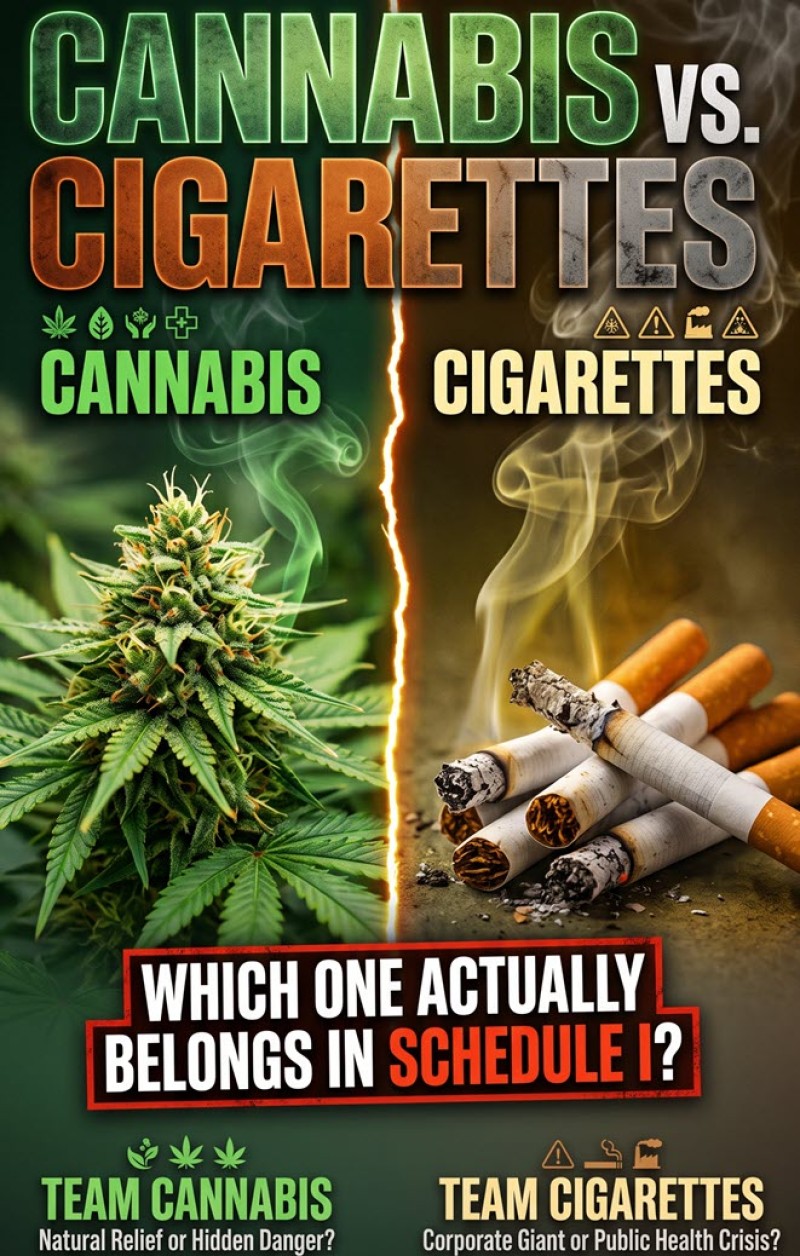
So, Which One Actually Belongs in Schedule I?
On lethality, disease burden, and irreversible long-term harm, it isn't close: tobacco is the more dangerous drug by orders of magnitude, and it isn't scheduled at all. On medical utility, the federal government has now formally conceded that cannabis has accepted uses that nicotine simply doesn't. But if you're the type who assumes "natural" and "harmless" are synonyms, the youth mental-health data and the climbing use-disorder numbers say otherwise.
The honest verdict is that neither drug fits the Schedule I box as written, and cigarettes fit it worse than cannabis by nearly every metric that matters. Whether that verdict survives the DEA's ongoing rescheduling hearing, and the political fight sure to follow it, is a different question entirely, and one worth watching closely.
Sources
CDC, "Tobacco-Related Mortality" and "Diseases and Death" fact sheets, archive.cdc.gov/tobacco.
SAMHSA, 2025 National Survey on Drug Use and Health (NSDUH), released July 2026.
U.S. DEA, "Drug Scheduling" (dea.gov/drug-information/drug-scheduling) and Marijuana Rescheduling Regulatory Actions, dea.gov.
U.S. Department of Justice, Office of Public Affairs, order placing FDA-approved and state-licensed medical marijuana in Schedule III, April 2026.
Pletcher, M.J., et al., "Association Between Marijuana Exposure and Pulmonary Function Over 20 Years," JAMA, 2012.
Fox News Health, coverage of SAMHSA 2025 NSDUH data and adolescent cannabis/psychosis research, August 2026.
CANNABIS AND CIGARETTES, READ ON...