
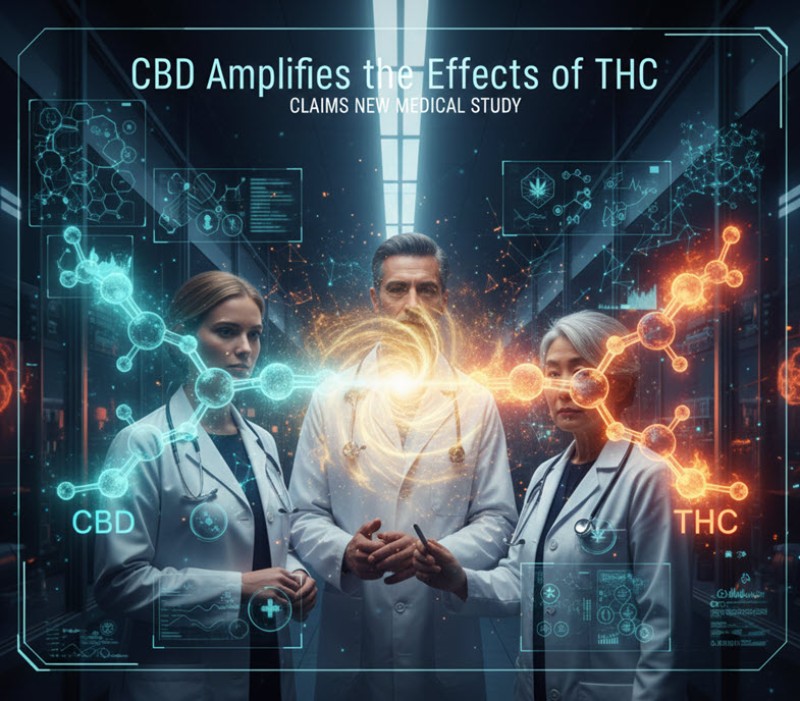
CBD increases the effects of THC claims new study
For years, cannabis enthusiasts and medical professionals alike have subscribed to a simple narrative: THC gets you high, while CBD chills you out. This conventional wisdom has shaped everything from product development to dosing recommendations. But what if we've had it all wrong?
A recent study published in the journal Clinical Pharmacology and Therapeutics is challenging this long-held belief. Contrary to popular opinion, the research suggests that CBD may actually intensify the effects of THC, not dampen them. This revelation is sending ripples through the cannabis community and forcing us to reconsider our understanding of how these cannabinoids interact.
But should we really be surprised? Those familiar with the concept of the "entourage effect" have long understood that cannabinoids don't exist in isolation. This phenomenon, first proposed by Israeli researchers in 1998, suggests that the various compounds in cannabis work synergistically, producing effects that are greater than the sum of their parts.
This interplay between cannabinoids isn't just a matter of academic interest - it has real-world implications for medical cannabis users. It's one of the primary reasons why "whole plant extracts" often demonstrate superior therapeutic efficacy compared to isolated cannabinoids. The complex dance of compounds in full-spectrum products can provide a more comprehensive and potentially more effective treatment option for many conditions.
As we delve into the details of this groundbreaking study, we'll explore how it challenges our preconceptions about CBD and THC. We'll examine the methodology, unpack the findings, and consider what this means for both recreational and medicinal cannabis users. Most importantly, we'll contemplate how this new understanding might shape the future of cannabis research and product development.
So, strap in, fellow cannabis enthusiasts. We're about to embark on a journey that might just change everything you thought you knew about CBD and THC. Let's dive into the science and see what this study really has to say.
A deep dive into the Study
The groundbreaking research, published in the journal Clinical Pharmacology and Therapeutics, challenges our long-held beliefs about the interplay between CBD and THC. The study, conducted by a seven-person research team from the Netherlands and the U.S., employed a rigorous methodology to explore this complex relationship.
At its core, the study was a randomized, double-blind, placebo-controlled trial involving 37 healthy volunteers. The researchers set out to test the hypothesis that CBD would reduce the adverse effects of THC, potentially making therapeutic THC more tolerable for chronic pain patients. However, the results painted a very different picture.
The study's findings were unequivocal: "In contrast to what is commonly hypothesized in (popular) literature, CBD did not reduce the adverse effects of THC." In fact, the researchers found that high doses of CBD actually amplified THC's effects. As they stated, "This study found no evidence of CBD reducing adverse THC effects. On the contrary, THC effects were significantly increased by 450 mg of CBD."
One of the most intriguing aspects of this study is the apparent dose-dependent nature of CBD's interaction with THC. The researchers observed that smaller doses of CBD (10 mg and 30 mg) did not significantly alter THC's effects. However, when participants took a high dose of CBD (450 mg) alongside a smaller 9-mg dose of THC, they experienced "significantly increased subjective, psychomotor, cognitive, and autonomous effects of THC."
This dose-dependency suggests a complex relationship between these cannabinoids. It appears that CBD's potential to enhance THC's effects only kicks in at higher concentrations, a finding that could have significant implications for both recreational users and medical patients.
But the story doesn't end with cannabinoids. The researchers also touched on the role of terpenes, another crucial component of the cannabis plant. While this particular study didn't focus on terpenes, the authors acknowledged their potential importance, referencing other research that has explored the impact of these aromatic compounds.
For instance, they cited a separate study that found D-limonene, a terpene commonly found in cannabis and citrus fruits, could reduce anxiety and paranoia in people who took THC. This highlights the intricate dance between cannabinoids and terpenes in shaping the overall cannabis experience.
The inclusion of terpenes in this discussion underscores the complexity of cannabis pharmacology. As the researchers noted, "The complex interaction between phytocannabinoids and biological systems offers hope for novel treatment approaches." This statement echoes the growing recognition in the scientific community that whole-plant cannabis medicine, incorporating the full spectrum of cannabinoids and terpenes, may offer unique therapeutic benefits.
In conclusion, this study serves as a stark reminder of how much we still have to learn about cannabis. It challenges our assumptions, forcing us to reconsider the relationship between CBD and THC. Moreover, it highlights the need for further research into the intricate interplay between cannabinoids, terpenes, and other compounds found in the cannabis plant.
As we continue to unravel these complex interactions, we may discover new ways to harness the therapeutic potential of cannabis. The journey of understanding is far from over, but studies like this one are lighting the way forward, revealing the depth and complexity of this remarkable plant.
What we know about the Entourage Effect
JG
Now let's write a section called "What we know about the entourage effect"
In this section focus on:
-
What is the entourage effect?
-
How diverse cannabinoids interact with our endocannabinoid system
-
Why isolates still have their place within the medical world (especially in making pharmaceutical medication based on cannabis)
-
Yet, due to the entourage effect, this is what makes cannabis a good medicine, it's complex, diverse, and considering that the whole plant acts for superior health, accessible by anyone with a bit of dirt, water, sun and love.
Certainly! Here's a section on "What we know about the entourage effect" based on your outlined points:
What We Know About the Entourage Effect
The entourage effect is a fascinating concept that's been buzzing around cannabis circles for years. In essence, it's the idea that the various compounds in cannabis work together synergistically, producing effects that are greater than the sum of their parts. It's nature's own chemical cocktail party, and we're just beginning to understand the complex interactions at play.
When we consume cannabis, we're not just getting a dose of THC or CBD. We're ingesting a complex mixture of cannabinoids, terpenes, flavonoids, and other compounds. Each of these components interacts with our endocannabinoid system in unique ways. THC might be binding to CB1 receptors in our brain, while CBD is modulating that interaction. Meanwhile, terpenes like myrcene might be enhancing the passage of these cannabinoids through the blood-brain barrier.
It's like a carefully orchestrated symphony, with each compound playing its part to create a harmonious whole. This is why many users report that whole-plant extracts often provide more comprehensive relief than isolated cannabinoids.
Now, don't get me wrong - isolates still have their place in the medical world. They're especially useful when it comes to developing pharmaceutical medications based on cannabis. Isolates provide consistency and standardization, which are crucial in clinical settings. They allow for precise dosing and can be helpful for patients who need specific effects without the influence of other compounds.
But here's the kicker - while isolates have their uses, the entourage effect is what makes cannabis such a versatile and effective medicine. The plant's natural complexity allows it to address multiple symptoms simultaneously, often with fewer side effects than synthetic alternatives. It's like the Swiss Army knife of natural medicine.
And perhaps the most beautiful aspect of all this? Cannabis, in its whole-plant form, is incredibly accessible. Anyone with a bit of dirt, water, sunlight, and love can grow this remarkable medicine. It's a testament to nature's ingenuity - packaging a complex pharmacy into a single plant that can be cultivated in your backyard.
The Sticky Bottom Line
As we've explored in this article, the relationship between CBD and THC is far more complex than we once thought. The recent study challenging our assumptions about CBD's ability to counteract THC's effects serves as a potent reminder of how much we still have to learn about cannabis.
The entourage effect continues to fascinate researchers and enthusiasts alike, highlighting the intricate dance of cannabinoids and terpenes that makes cannabis such a unique and versatile plant. While isolates have their place in medical applications, the power of whole-plant medicine cannot be overlooked.
For those intrigued by cannabis' potential as a medicine, now is an exciting time to dive deeper. Consider exploring different strains and their unique cannabinoid and terpene profiles. Keep a journal of your experiences, noting how different products affect you. This personal data can be invaluable in finding the right cannabis medicine for your needs.
Don't shy away from asking questions at your local dispensary or seeking out a cannabis-friendly healthcare provider. As our understanding of cannabis evolves, so too should our approach to using it medicinally.
Remember, everyone's endocannabinoid system is unique. What works for one person may not work for another. Patience and careful experimentation are key.
As we continue to unravel the mysteries of this remarkable plant, one thing is clear: cannabis has much more to teach us. Stay curious, stay informed, and above all, listen to your body. The journey of discovery is just beginning, and the potential benefits are as vast as the plant's complexity itself.
REF: https://www.marijuanamoment.net/cbd-may-actually-increase-thcs-intoxicating-effect
-new-marijuana-study-finds-contrary-to-conventional-wisdom/
HOW DO CBD AND THC WORK TOGETHER? READ ON...