


Grow Your Own Damn Weed
Gen Z Chose the Vape Cart. Here's Why That Matters — and What We All Lost When Cannabis Became a Commodity.
The data landed last week and the industry is treating it like a business story. Vape pens just overtook flower as the top-selling cannabis product in California — the largest legal cannabis market in the world. Gen Z drove the shift. For the first time in the history of the plant's commercial existence, a generation has grown up choosing a cartridge over a bud.
Business analysts are talking about market share and SKU optimization. I want to talk about something else.
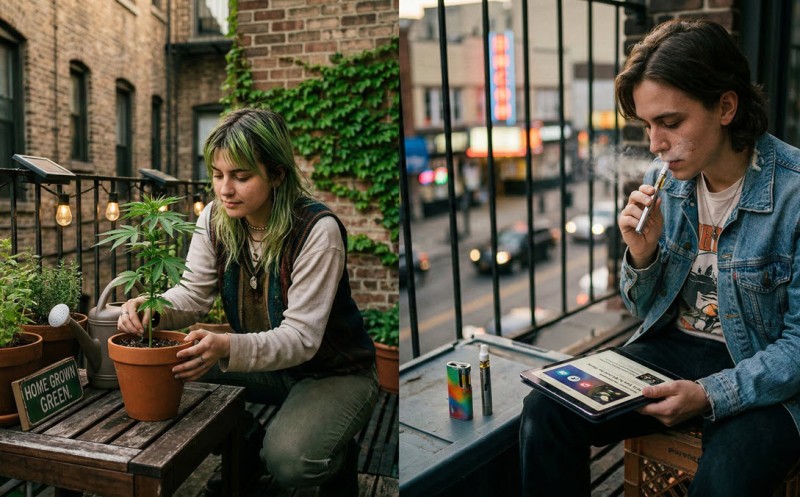
I want to talk about what we lost when cannabis became a product you tap twice and pocket — and why the most radical thing you can do for your relationship with this plant is put a seed in some dirt and leave your dispensary app alone for a few months.
The Numbers First — Then What They Mean
In February 2026, California cannabis retailers moved $110.4 million in vape products against $98.4 million in flower. That sounds like a rounding error until you pull the comparison: in April 2021, flower was outselling vapes nearly two-to-one — $214.8 million to $104.2 million. That's not a trend shifting. That's a tectonic reversal in under five years.
The engine is Gen Z. Analytics firm Headset found that over the past year of national cannabis sales, Gen Z spent 38% of their dollars on vapor pens and only 32.5% on flower — the exact inverse of Millennials, who put 40% into flower and 25.7% into vapes. Gen Z is also the first cannabis-consuming generation to prefer the cart over everything else as their primary format.
The reasons the industry cites are sensible on their surface: discretion, portability, dose control, no smell, no ash, no paraphernalia. Vapes slip into pockets. They don't announce themselves. For a generation raised on smartphones and shaped by wellness culture and financial anxiety, the ergonomics make obvious sense.
But ergonomics aren't the whole story. And the industry framing — that this is simply a preference evolution, a natural market maturation — papers over something worth examining honestly.
|
"In 2021, California flower outsold vapes nearly 2-to-1. By February 2026, vapes led by over $12 million. Gen Z drove every point of that reversal. |
What's Actually in the Cart — An Honest Look
Let's be precise here, because the vape conversation collapses into misinformation quickly if you don't draw the right distinctions.
A dry herb vaporizer heating whole flower, or a cartridge filled with pure live rosin — single-source, solventless, no additives — is essentially just cannabis consumed at a lower combustion temperature. The plant, expressed differently. There's a strong argument that this is actually a cleaner consumption method than rolling papers and a lighter. I'm not here to make the case against vaporization.
What I'm talking about is the industrial distillate cart — which is the majority of what's in those $110 million of monthly California vape sales. Distillate is cannabis oil that has been stripped of virtually everything except THC through a process of high-heat extraction, winterization, and distillation. What goes back in afterward — terpenes, cutting agents, carrier oils — is where the questions live.
The long-term pulmonary effects of repeatedly inhaling aerosolized cannabis oil combined with carrier compounds are not established. The EVALI crisis of 2019, where hundreds of people were hospitalized with severe lung injury from vaping, was traced primarily to vitamin E acetate used as a cutting agent in illicit market carts — but it put a legitimate question mark over the chemistry of what we're inhaling when we hit a cart, regardless of source. We don't have thirty years of data here. We don't know what we don't know.
That's not a prohibition argument. That's a purity argument. And purity — knowing exactly what you're consuming, where it came from, how it was processed — is the thing that gets quietly engineered out of the equation when cannabis becomes a commodity.
Commoditization as Context Collapse
Here is what the vape cart actually represents, culturally: cannabis with all the friction removed.
Cannabis has a sensory vocabulary that took humanity thousands of years to develop. The smell of a fresh-broken bud — that's terpenes, specific compounds that exist in relationship with cannabinoids in ways science is still mapping. The act of grinding, rolling, packing, lighting — these are rituals. Not superstition. Rituals in the sense that any repeated intentional process calibrates your relationship to what you're about to do. You don't slam a fine whiskey. You don't rush a ceremony. The preparation is part of the experience, and the experience shapes how you metabolize what follows — psychologically if not biochemically.
The vape cart removes all of that. Two taps, a breath, done. No smell until you exhale. No visual relationship with the plant. No knowledge of cultivar, cure, or origin unless you're actively seeking it out — and the design of the product doesn't encourage you to seek it out. It encourages you to consume again.
Gen Z data reflects this: they buy more frequently, spend less per trip, and lean toward discreet dosing. What that pattern describes, without editorializing, is a consumption relationship rather than an intentional one. Cannabis as a background application rather than a foreground experience.
And I'll say the part that makes industry people uncomfortable: when you remove all the friction from any substance, you remove a natural governor on your relationship with it. The effort required to roll a joint isn't just effort — it's a pause. A small ritual of intention. The cart doesn't pause. The cart just delivers.
I'm not saying Gen Z has a drug problem. I'm saying the format they inherited was optimized for consumption, not for relationship. Those are different things.
|
"Cannabis is medicinal. It's spiritual. The recreational elements are real — but if you don't treat it with respect, as with anything, there is a downside. And the format you consume it in shapes whether respect is even possible." |
One Crop Cycle Will Change Your Life
I want to tell you about the best cannabis I've ever smoked.
It wasn't something I found at a dispensary. It wasn't a craft brand with a well-designed label and a QR code linking to lab results. It was something I grew, harvested, trimmed with my own hands, and cured in glass jars until the time was right. And when I finally opened one of those jars and smoked what was inside, it was — without exaggeration — an experience unlike anything that had come before it.
Not because the genetics were extraordinary. Because I had lived with that plant for months. I understood its water schedule and its light cycle and the specific color its leaves turned under stress. I had watched it transition from seedling to vegetative growth to that unmistakable moment when the first pistils appear and you know you're weeks away from something real. I had smelled it every day — that evolving terpene profile shifting as the trichomes matured, from sharp and vegetal to something dense and complex.
By the time I cured and smoked it, I knew what it was. And knowing what it was changed how I related to it.
That's not mysticism. That's what happens when you have a relationship with the source of what you consume rather than a transaction with an intermediary. Farmers who raise their own food will tell you the same thing. There is a qualitative difference in how you experience something you grew and understand versus something that appeared on a shelf.
One crop cycle will do more for your understanding of cannabis — its nature, its requirements, its range of expression, what responsible consumption actually looks like — than any number of articles, podcasts, or lab reports. I genuinely believe this. It changed my relationship with the plant permanently, and not in a way I could have anticipated before I experienced it.
The Rosin Press and the Return to Purity
Growing is the foundation. But the path continues.
A rosin press is a simple mechanical device — heated plates, controlled pressure, your cured flower or hash — that extracts concentrate without solvents, without additives, without any chemistry beyond applied heat and force. What comes out is full-spectrum rosin: every cannabinoid, every terpene, in the ratios the plant produced them. Nothing added. Nothing industrial.
When you press rosin from flower you grew, you now have a complete chain of custody from seed to extract. You know the genetics, the growing conditions, the cure, the extraction temperature. You know exactly what's in it because you made exactly what's in it. Put that in a ceramic cartridge and vape it, and now you have a clean consumption format filled with a pure product you understand end to end.
That is a radically different experience from buying a distillate cart produced from anonymous biomass, stripped of terpenes, reconstituted with whatever the manufacturer decided to add back, and packaged in hardware of unknown provenance.
The equipment is accessible. A quality rosin press runs anywhere from a few hundred dollars for a hand-press unit to a couple thousand for a hydraulic setup that can handle larger quantities. The learning curve is measured in afternoons, not years. And the result — pure, solventless, full-spectrum concentrate from plant material you control — is a different product category entirely from what dominates dispensary shelves.
This is what I mean by reconnecting with agrarian roots. Not because home cultivation is some kind of nostalgic virtue signal, but because the act of growing and processing your own medicine reconnects you to something real: the knowledge of what you're consuming and the respect that knowledge generates.
|
THE GROW-TO-PRESS PATHWAY — A STARTING POINT Seed to harvest: 3-5 months depending on genetics and growing method. Basic indoor setup (tent, light, ventilation, nutrients): $300-600. Beginner-friendly strains: photoperiod indicas for predictability; autoflowers for a shorter, lower-maintenance cycle. Cure time post-harvest: minimum 4-6 weeks in sealed glass jars, burped daily for the first two weeks. Rosin press entry point: a quality hand-press (like a Dulytek or Rosin Tech Go) runs $200-400 and will process personal quantities effectively. Dry-sift or bubble hash as an input improves yield and quality significantly. The result: full-spectrum, solventless concentrate from plant material you grew and understand. Purity by construction, not by label claim. |
The Plant Deserves More Than a Tap and a Pocket
Cannabis has been used as medicine, as ritual tool, as sacrament, as creative catalyst, and as a means of collective resistance for longer than most of the world's current nations have existed. Every culture that encountered it developed a relationship with it — a framework of context, intention, and respect that shaped how it was used and what it provided.
Modern legal cannabis, at its most commoditized, has stripped most of that away in the name of convenience and margin. And the result — an entire generation learning to relate to the plant primarily through a device designed to maximize frictionless consumption — is worth examining without pretending the market knows best.
The market knows how to sell. It does not know how to cultivate a healthy relationship between a person and a psychoactive plant. That knowledge lives in practice, in patience, in actually engaging with the thing rather than just consuming it.
I'm not anti-vape. I'm anti-disconnection. And the best antidote to disconnection I've found — in cannabis or in most things — is to understand, at a visceral level, where something comes from and what goes into it.
Grow one plant. Just one. Nurse it through its full cycle. Harvest it. Cure it. Smoke it. And then tell me your relationship with cannabis is the same as it was before.
It won't be. That's the whole point.
The Sticky Bottom Line
Vapes just became California's top-selling cannabis product. Gen Z drove the shift. The industry is celebrating. I'm asking a different question.
When you buy a distillate cart, you are buying the furthest thing from the plant that still technically qualifies as cannabis. The terpenes were stripped out. The minor cannabinoids were stripped out. Something was put back in. You don't know what the long-term effects of inhaling it are, and neither does anyone else — because we haven't had time to find out.
More importantly: you have no relationship with what you're consuming. No knowledge, no context, no ritual. Just delivery. And delivery without context is how any substance — cannabis included — starts to become a problem rather than a tool.
The answer isn't prohibition. It isn't regulation. It isn't a warning label. The answer is older than all of that: grow your own. Press your own. Understand your own medicine from the root up. Reconnect with the agrarian reality of what cannabis actually is — a plant, subject to soil and light and water and time, producing something remarkable when you treat it with the respect it earns.
The best cannabis you'll ever smoke is the one you grew. I'd bet my rosin press on it.
SOURCES & REFERENCES
1. MJBizDaily — 'Cannabis vapes outsell flower in California, thanks to Gen Z' (Mar 2026): DCC sales data, Feb 2026 figures, Headset generational breakdown
2. GreenState/SFGate — 'Gen Z's weed habits are flipping California's cannabis industry' (Mar 2026): Headset consumer data, vape preference statistics
3. MJBizDaily — 'How Gen Z is reshaping cannabis retail' (Dec 2025): Purchase frequency, dose preference, spending patterns
4. Caliterpenes — 'New Consumption Patterns Led by Gen Z': Gen Z/Millennial share of vaporizer sales, wellness-orientation trends
5. Flowhub / 2026 Cannabis Industry Statistics: National consumption data, NSDUH survey figures, category growth rates
6. CDC / EVALI Investigation (2019-2020): Vitamin E acetate as primary identified cause of vaping-associated lung injury; ongoing unknowns in commercial vape chemistry
7. Headset Cannabis Analytics — Generational spending data cited across multiple industry publications, 2025-2026
MORE GEN Z TALK ON CANNABIS, READ ON...