
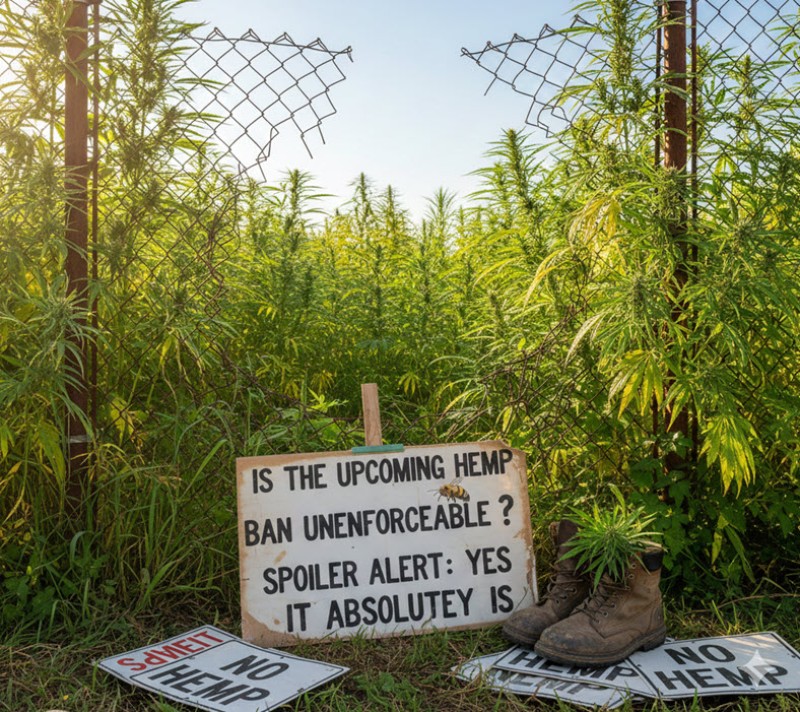
Could the Hemp Ban Be Unenforceable? Spoiler Alert: It Absolutely Is
Cannabis just took a major blow. After years of operating in a legal gray area that allowed hemp-derived THC products to flourish, Congress decided to slam the door shut with a ban set to take effect in 2026. But here's the kicker: this ban might be one of the most spectacularly unenforceable pieces of legislation in recent history. And in trying to "protect the children" with this ban, the government is about to hand a $32 billion industry directly to the black market and the cartels they claim to be fighting.
Let me explain how we got here and why this is such a catastrophic policy failure.
The Government Shutdown That Wasn't
Remember the government shutdown saga? After weeks of political theater and brinkmanship, Congress finally passed a continuing resolution to keep the government running. Buried in that massive spending bill was a provision that fundamentally rewrote the definition of "hemp" to exclude products containing intoxicating amounts of THC.
The language essentially bans any hemp-derived product with more than 0.3% total THC (including Delta-8, Delta-9, Delta-10, THC-O, and basically any cannabinoid that gets you high). The ban gives the industry until November 2026 to comply, which sounds like a generous runway until you realize that "comply" means "shut down your entire business model."
This wasn't some carefully considered piece of legislation debated in committee hearings with expert testimony. It was a last-minute addition to a must-pass spending bill, dropped on an industry that had been operating legally—or at least in a legal gray area—since the 2018 Farm Bill opened the door for hemp-derived products.
What's Actually at Stake Here
Let's talk numbers, because the scale of this ban is staggering.
The intoxicating hemp market is currently worth approximately $32 billion annually. That's not a typo. Thirty-two billion dollars in economic activity, built up over the past six years since the 2018 Farm Bill.
This market supports an estimated 150,000 jobs across cultivation, manufacturing, distribution, retail, and ancillary services. These aren't just numbers on a spreadsheet—these are real people with mortgages, families, and livelihoods that depend on this industry.
In terms of tax revenue, states have been collecting sales taxes on these products, generating hundreds of millions of dollars annually. Some estimates put total state and local tax revenue from hemp-derived products at over $500 million per year. When the ban takes effect, that revenue disappears overnight.
But wait, there's more! The ripple effects extend beyond direct industry participants:
-
Landlords who rent commercial space to hemp businesses
-
Equipment manufacturers who supply extraction and processing equipment
-
Testing laboratories that verify product potency and safety
-
Marketing agencies that work with hemp brands
-
Payment processors and financial services
-
Packaging companies and label printers
-
Logistics and shipping companies
All of these ancillary businesses will take a hit when this ban goes into effect. We're looking at potential job losses in the 200,000+ range when you account for the entire ecosystem.
And for what? To protect the children from a product that's been available for six years without any epidemic of youth use or public health crisis?
The Unenforceable Law
Here's where things get interesting: according to a recent report covered by MJ Biz Daily, the hemp THC ban may be completely unenforceable.
Why? Several reasons:
1. Testing and Detection Issues
Hemp and marijuana are the same plant—Cannabis sativa. The only legal distinction is the THC concentration. But here's the problem: you can't tell the difference between hemp-derived THC and marijuana-derived THC through simple testing. They're chemically identical.
This means law enforcement would need to trace the supply chain of every product to determine if the THC came from hemp or marijuana. Good luck with that. In practical terms, this is nearly impossible, especially for products like edibles, tinctures, or vapes where the source material isn't visible.
2. Interstate Commerce Complications
Hemp is legal to transport across state lines. Marijuana isn't. But if you can't easily distinguish between hemp-derived and marijuana-derived products, how do you enforce this? Every hemp shipment becomes a potential federal crime, but proving it requires extensive testing and documentation that most enforcement agencies simply don't have the resources to pursue.
3. Limited Federal Resources
The DEA and FDA are already stretched thin. The idea that they're going to dedicate significant resources to tracking down hemp-derived THC products when they're dealing with fentanyl, human trafficking, and other serious crimes is laughable. Federal prosecutors have better things to do than prosecute small-time hemp businesses.
4. State-Level Resistance
Many states have embraced the hemp industry and have no interest in enforcing this federal ban. We've already seen this dynamic play out with marijuana legalization—states simply refused to enforce federal prohibition, and the feds didn't have the resources to do it themselves. The same thing is likely to happen here.
5. Chemical Innovation
The hemp industry has already shown its ability to innovate around regulations. When one cannabinoid gets banned, chemists find another. THC-O, Delta-10, THC-P—these are all cannabinoids that didn't exist in the commercial market a few years ago. The ban might target current products, but it won't stop the development of new ones.
Handing a Gift to the Black Market
Here's the most absurd part of this entire situation: the Trump administration, which claims to be tough on cartels and serious about border security, is about to hand those same cartels a $32 billion market on a silver platter.
Think about what happens when this ban goes into effect. Does demand for these products magically disappear? Of course not. People who've been using hemp-derived THC products for the past six years aren't suddenly going to stop. They're just going to get their products from unregulated sources.
The legal, taxpaying businesses that have been selling tested, labeled, regulated products will shut down. But the demand remains. So who fills that gap? Black market operators who don't pay taxes, don't test their products, don't verify customer ages, and don't follow any safety standards.
In other words, the government is taking a $32 billion industry that was:
-
Creating jobs
-
Following safety standards
-
Operating transparently
And transforming it into a black market that:
-
Generates zero tax revenue
-
Enriches criminals
-
Sells untested, potentially dangerous products
-
Has no age verification
-
Can't be regulated or controlled
This is the exact opposite of good policy. It's prohibition logic at its most brain-dead: "If we make it illegal, it will go away." Except it never goes away. It just goes underground.
But... The Children!
Why are we doing this? According to the lawmakers who pushed for this ban, it's all about protecting the children. Won't someone please think of the children!
This is the same tired drug warrior rhetoric we've been hearing for decades. And it's just as hollow now as it was during "Just Say No" and "Reefer Madness."
The reality? There's no evidence of an epidemic of youth use of hemp-derived THC products. No spike in emergency room visits. No public health crisis. The products have been available for six years, and the sky hasn't fallen.
But "protecting the children" is an evergreen justification for prohibition, immune to evidence or rational analysis. It's an emotional appeal that short-circuits critical thinking: "If you oppose this ban, you must not care about children!"
Never mind that the ban will make these products more dangerous by pushing them into an unregulated black market. Never mind that it will destroy tens of thousands of jobs and eliminate hundreds of millions in tax revenue. Never mind that it's unenforceable and counterproductive. Think of the children!
What Actually Happens Next
Here's my prediction: the ban goes into effect in November 2026. Some businesses shut down, especially the smaller operators who can't afford legal battles or pivot to other products. Tax revenue from these products drops significantly as official sales disappear.
But the products don't disappear. They just move to the black market, sold through the same channels that marijuana has always been sold through in prohibition states. Maybe prices even drop because sellers don't have to worry about taxes, licensing fees, or compliance costs.
Consumers continue buying these products, now from unregulated sources with no testing, no quality control, and no age verification. Some of these products will be safer than what was sold legally. Many will be worse. Nobody knows, because there's no oversight.
The cartels and black market operators that Trump claims to be fighting get a massive new revenue stream, courtesy of federal prohibition. They won't need to smuggle anything across the border—they can produce these products domestically using legally grown hemp and sell them through existing networks.
Law enforcement wastes resources going after hemp businesses and consumers while actual violent criminals continue operating. Federal prosecutors decline to bring most cases because they're not worth the resources. States largely ignore the federal ban, just like they've ignored federal marijuana prohibition.
In short: all of the negative consequences of prohibition, with none of the purported benefits.
The Sticky Bottom Line
The hemp THC ban is a masterclass in how not to make policy. It destroys a legal industry worth billions, eliminates hundreds of thousands of jobs, costs states hundreds of millions in tax revenue, and hands the entire market to black market operators and cartels—all while being largely unenforceable and based on zero evidence of actual harm.
This is what happens when policy is driven by fear rather than evidence, by drug war ideology rather than practical considerations, and by "protecting the children" rhetoric rather than honest assessment of costs and benefits.
The industry isn't going away. The demand isn't disappearing. The products will still be available—just from untaxed, unregulated, criminal sources instead of legal, taxpaying businesses.
So congratulations, Congress. In your quest to protect the children, you've managed to make these products more dangerous, enrich criminals, destroy legitimate businesses, eliminate tax revenue, and waste law enforcement resources on an unenforceable ban.
Bang-up job, guys. Really efficient work there.
The hemp ban might become law, but it won't become reality. The products will still be available. People will still use them. The only difference is that instead of supporting legal businesses and generating tax revenue, we'll be enriching lawbreakers.
Thanks to the current administration, you can now help fund the black market! It's not a bug—it's a feature.
BAN THC FROM HEMP? READ ON...