
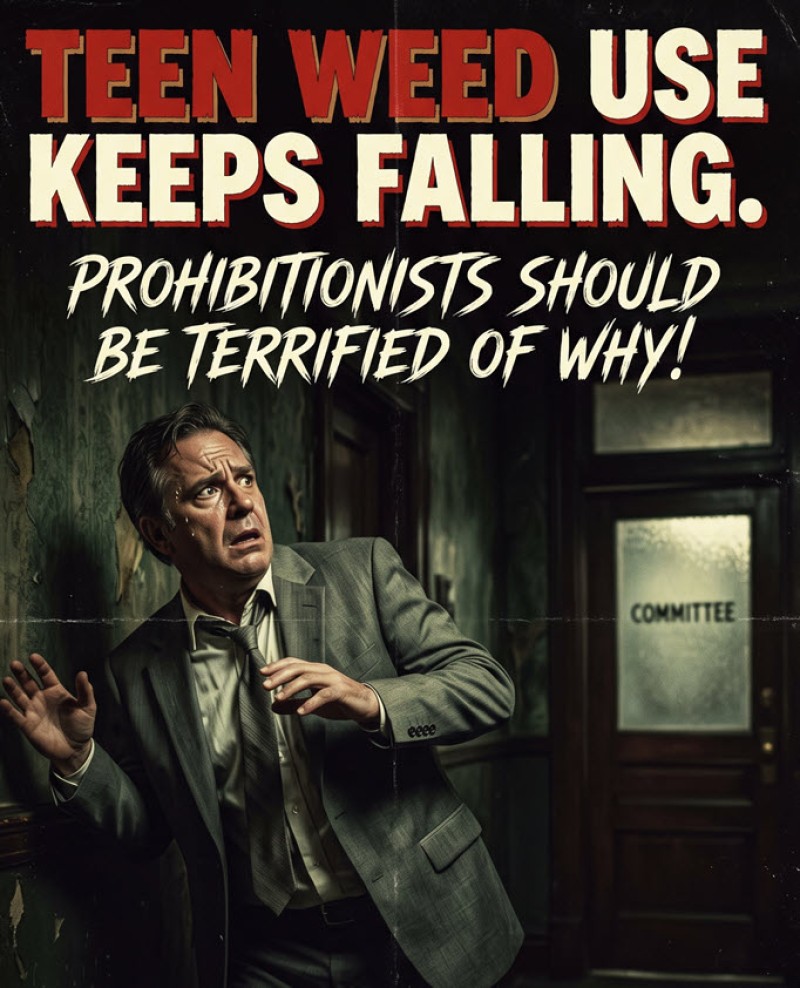
SAMHSA dropped its annual National Survey on Drug Use and Health at the end of July, and the numbers should be front page news in every state legislature still clutching pearls over legalization. Past-month cannabis use among teenagers fell 22 percent between 2022 and 2025. Past-year use dropped 25 percent over the same stretch. Fewer teens are even trying the stuff for the first time. Young adults, ages 18 to 25, saw smaller but still real declines: 10 percent for past-month use, 12 percent for past-year use.
This isn't a rogue data point. NORML flagged that the finding lines up with the CDC's youth risk survey and the University of Michigan's long-running Monitoring the Future study, both of which have clocked teen cannabis use at historic lows for several years running. A Marijuana Policy Project analysis published last year found teen use declined in nearly every state that legalized and regulated adult-use cannabis. Meanwhile, use among adults 26 and older, particularly older adults, keeps climbing. Grandma's more likely to have a vape pen in her nightstand than your teenage cousin is to have a joint in his backpack, and the data backs that up nationally, not anecdotally.
For thirty years, the central argument against legalization has been some version of "think of the children." Legalize it and teen use will spike, the reasoning goes, because access gets easier and the message gets muddier. We now have close to a decade of real-world data from states that actually ran this experiment, and the result is the opposite of what prohibitionists predicted. So what's actually going on?
Taboo is the Real Gateway Drug
Here's my theory, and it's not exotic: forbidden fruit tastes best when it's forbidden. Teenagers have built an entire developmental stage around doing the thing adults specifically told them not to do. Strip away the tell-your-friends-you're-a-rebel factor and you strip away a huge chunk of the appeal. Cannabis used to be the ultimate teenage transgression, the thing that got you sent to the principal's office and gave you a story to tell at lunch. Now it's the thing your mom picks up at the dispensary on her way home from work to deal with her joint pain. There's no rebellion in doing what your parents do.
Compare that to alcohol, which has never carried the same taboo weight precisely because it's never been illegal for adults. Teen drinking rates have declined too, but nowhere near as steeply as teen cannabis use, and alcohol remains the substance most commonly used by high schoolers according to Monitoring the Future data. Alcohol was never the rebellious choice. It was always just there, at the holiday table, in the fridge, unremarkable. Cannabis is rapidly becoming just as unremarkable, and unremarkable things don't generate the same pull for a fifteen-year-old looking for an identity.
The Facebook Problem
I keep coming back to the same comparison when I talk to people about this: cannabis is becoming the Facebook of drugs. Facebook didn't die because it got worse. It died with teenagers because their parents joined. Once mom and dad and every aunt and uncle had an account, the platform lost whatever cultural currency it had with a sixteen-year-old looking to carve out space that belonged to them and nobody older. Teens moved to TikTok and Snapchat and whatever comes next specifically because those spaces hadn't been colonized by the adults in their lives yet.
Cannabis is going through the exact same generational handoff. Once it's the thing grandpa uses for his arthritis and grandma uses to sleep through chemo side effects, it stops being cool by simple association. There will always be a subset of teenagers who smoke weed, the same way there will always be teenagers who drink, but the drug is losing its status as a marker of youth rebellion precisely because it's being adopted, loudly and visibly, by the least rebellious demographic in America: senior citizens managing chronic pain.
Options Also Multiplied
It would be dishonest to hand the entire explanation to taboo erosion. Researchers studying the broader decline in teen substance use, including alcohol and tobacco, keep landing on the same secondary factor: teenagers today have more competing ways to spend their time and chase a dopamine hit than any generation before them. Smartphones, social media, streaming, and gaming didn't exist, or existed in far more primitive forms, for previous cohorts of teens who came of age during cannabis's most rebellious cultural period in the 1970s and 90s. Getting high with friends in a basement used to be a primary form of teenage entertainment. Now it competes with a screen that's engineered by some of the smartest engineers on the planet specifically to be more compelling than whatever's happening in the physical room around you. That's not an excuse to hand kids more screen time, it's just an honest accounting of where the competition for a bored teenager's attention actually comes from.
The Counterargument Deserves a Fair Hearing
I said at the top I'd be objective, so let's steelman the other side instead of just declaring victory. Prohibitionists and public health researchers who remain skeptical of legalization make a real point when they note that fewer teens using cannabis doesn't automatically mean the harm profile improved. Legal-market cannabis today runs far higher in THC potency than what circulated in the 1990s, with some concentrates and vapes testing above 80 percent THC. Their argument goes: even if participation is down, the smaller pool of teens who do use are more likely to be using significantly stronger products, and youth cannabis use disorder diagnoses haven't necessarily fallen in lockstep with usage rates. There's also a fair question about survey methodology. Self-reported drug use surveys rely on teenagers being honest with government interviewers, and some researchers argue destigmatization could just as easily be making kids more willing to admit use in some contexts and less willing in others, muddying comparisons across years.
Those are legitimate empirical questions, and I'm not going to pretend the SAMHSA topline erases them. But they're arguments about potency regulation and product safety standards, which is precisely the kind of granular policy work that legal, regulated markets are equipped to do and illegal markets never were. A black market dealer never checked ID, never tested potency, and never printed a dosage warning on the bag. If the remaining concern is potency among the teens who do use, the answer is tighter regulation of legal products, not a return to a prohibition regime that produced higher youth use rates with zero quality control to show for it.
What This Actually Proves
Put those threads together and you get a genuinely inconvenient conclusion for anyone still running the "won't someone think of the children" playbook against legalization. The states that regulated cannabis like alcohol, with age limits, licensed retail, and product testing, saw teen use fall. The federal government, tracking the country as a whole through a period when legal markets expanded from a handful of states to more than half the country, watched the same decline happen nationally. If access were the driver of youth use that prohibitionists insisted it was, legalization should have produced the opposite trend. It didn't.
NORML's Paul Armentano put it about as plainly as a policy advocate can: alarmist claims linking legalization to greater teen use "are simply not backed by government data." I'd go a step further. The data suggests regulation does something prohibition never managed in a century of trying: it makes the product boring enough, and accessible enough through legitimate channels controlled by carded adults, that it stops functioning as a rite of passage. Prohibition kept cannabis exciting by keeping it illegal. Legalization is quietly killing that excitement by handing it to the people teenagers are least interested in copying.
That's not the story prohibitionists wanted this data to tell. It's the story it's telling anyway.
Nine states, plus the District of Columbia, still haven't voted on legalizing adult-use cannabis in any form, and several that have keep facing repeal efforts from lawmakers who insist the youth-access argument still holds. Massachusetts, for instance, has a marijuana repeal initiative headed to November's ballot. Every one of those fights is going to run into the same wall this SAMHSA data just put up: the actual evidence, gathered over nearly a decade and across dozens of state experiments, points the opposite direction from the one repeal advocates are betting on.
Sources
NORML, "Federal Survey: Marijuana Use Continues Multiyear Decline Among Teens, Young Adults," July 27, 2026
SAMHSA, 2025 National Survey on Drug Use and Health, Annual National Report
Marijuana Policy Project, "Analysis: Steep Declines in Teen Marijuana Use in States With Regulated Cannabis Markets," Jan. 2025
TEEN USE IS DROPPING, READ ON...