

THC Beverages and the Billion-Dollar Panic: Why Alcohol Companies Are Funding Your Favorite Prohibitionist
Source: PsyPost
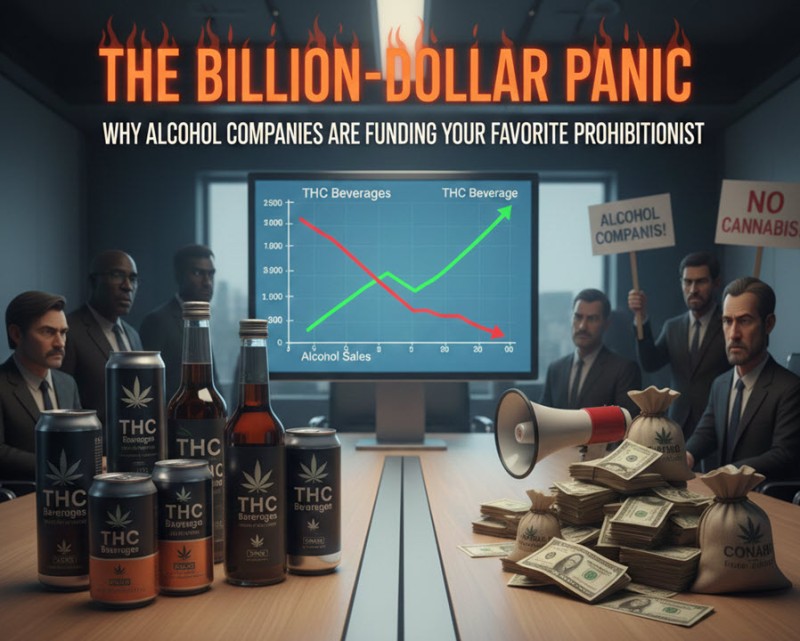
Let me hit you with a statistic that probably won't surprise you, but should piss you off: cannabis beverages are making people drink less alcohol. And the alcohol industry is absolutely losing their shit over it.
A recent study published in the International Journal of Drug Policy examined the drinking habits of cannabis beverage consumers and found something the alcohol industry has been dreading for years—people who consume THC-infused drinks report significant reductions in their alcohol consumption. We're not talking about a negligible dip. We're talking about people actively substituting a non-toxic, non-addictive substance (cannabis) for one of the most dangerous drugs legally available (alcohol).
But here's where it gets interesting—and by interesting, I mean infuriating. The alcohol industry has known this was coming. They've seen the writing on the wall for years. And rather than adapt their business model or, I don't know, maybe produce a product that doesn't kill 95,000 Americans annually, they decided to dump millions into anti-cannabis propaganda and lobbying efforts to protect their market share.
Today, we're going to connect the dots. We're going to talk about why THC beverages represent an existential threat to Big Alcohol. Then we're going to zoom out and identify the three industries that have spent decades—and billions of dollars—ensuring that cannabis remains illegal, demonized, and inaccessible.
Spoiler alert: it's not about public health. It's never been about public health.
The THC Beverage Threat: Why Alcohol Execs Can't Sleep at Night
The research from International Journal of Drug Policy isn't groundbreaking in the sense that anyone paying attention didn't already know this. But it's groundbreaking in that it provides empirical evidence for what cannabis consumers have been saying forever: given the choice, people prefer cannabis to alcohol.
Why? Let's count the ways:
1. No Hangover. You can consume a THC beverage, have a pleasant evening, and wake up the next day feeling... fine. No pounding headache. No nausea. No regret-induced existential crisis at 3 AM.
2. No Calories (or Far Fewer). Most THC beverages are low-calorie or zero-calorie. Compare that to beer, wine, or cocktails, which can pack hundreds of empty calories per serving.
3. No Liver Damage. Alcohol is literally poison. Your liver has to work overtime to metabolize it, and chronic consumption leads to cirrhosis, fatty liver disease, and a host of other medical nightmares. THC? Not hepatotoxic.
4. No Addiction Potential (Comparatively). Alcohol is physically addictive. Cannabis is not—or at least, not in any way comparable to alcohol. Withdrawal from alcohol can literally kill you. Withdrawal from cannabis means you might be irritable for a few days.
5. Controlled Dosing. THC beverages typically contain 5-10mg of THC per serving, allowing for predictable, manageable effects. Alcohol? Good luck knowing exactly how drunk you'll be after two IPAs versus two light beers. The variability in alcohol content, individual tolerance, and consumption speed makes alcohol dosing a crapshoot.
So yeah, when people discover they can achieve a similar relaxing, social buzz from a cannabis beverage without the downsides of alcohol, they start making the switch. And the alcohol industry knows this.
But instead of competing on product quality or innovation, they've chosen a different strategy: regulatory capture and propaganda.
Alcohol companies have been quietly funding anti-cannabis research, lobbying against legalization efforts, and bankrolling "concerned parent" groups that warn about the dangers of cannabis—all while their product kills nearly 100,000 Americans every year and contributes to countless cases of domestic violence, drunk driving fatalities, and alcohol-related diseases.
The hypocrisy is staggering. But it's also just one piece of a much larger puzzle.
The Unholy Trinity: The Three Industries Waging War on Cannabis
Big Alcohol isn't alone in their fight to keep cannabis illegal. They've got company—powerful, well-funded, deeply entrenched company. Let's meet the other members of the anti-cannabis alliance.
1. Big Pharma: The Monopoly Keepers
Let's start with the biggest villain in this story: Big Pharma.
The Controlled Substances Act (CSA), enacted in 1971, didn't just criminalize drugs—it granted pharmaceutical companies a de facto monopoly on drug production, research, and distribution. Under the CSA framework, only FDA-approved drugs can be legally manufactured and sold. And guess who controls the FDA approval pipeline? That's right—Big Pharma.
Here's how the scam works:
The FDA approval process costs millions of dollars. Small companies, independent researchers, and non-profit organizations can't afford to navigate the regulatory labyrinth. Only massive pharmaceutical corporations have the capital to bring a drug to market. This creates a system where Big Pharma controls what gets studied, what gets approved, and ultimately, what gets prescribed.
Cannabis threatens this entire model.
Cannabis is a plant. You can't patent a plant. Sure, you can patent specific extraction methods, formulations, or delivery mechanisms—but you can't patent the raw plant itself. This means anyone with seeds and soil can grow their own medicine. No prescription required. No pharmacy middleman. No insurance co-pay. No pharmaceutical CEO getting his third yacht.
And Big Pharma hates this.
Every state that legalizes medical marijuana sees a corresponding decrease in opioid prescriptions. Studies have shown that legal cannabis access reduces opioid use, opioid overdose deaths, and even prescriptions for medications treating chronic pain, anxiety, insomnia, and nausea. That's billions of dollars in lost revenue for pharmaceutical companies.
Let me give you a concrete example: according to research, in states with legal medical cannabis, Big Pharma loses approximately $10 billion annually in prescription drug sales. Ten. Billion. Dollars. Per year. Per state with medical access.
Multiply that across the 38 states with medical programs, and you're looking at a catastrophic revenue loss for an industry that has spent decades building a monopoly.
So what does Big Pharma do? They lobby. They fund "research" designed to find negative health effects. They bankroll organizations like Smart Approaches to Marijuana (SAM) that spread fear, uncertainty, and doubt about cannabis. They influence the DEA to maintain cannabis as a Schedule I substance, ensuring that independent research remains nearly impossible.
And now, with the push to reschedule cannabis to Schedule III, Big Pharma is positioning itself to dominate the cannabis market through FDA-approved, patented cannabis-derived medications—cutting out small businesses, craft growers, and patients who've been using cannabis for decades.
Schedule III isn't legalization. It's a corporate takeover.
2. Big Alcohol: The Market Share Protectors
We've already covered why Big Alcohol fears cannabis beverages, but let's dig deeper into their specific tactics.
Alcohol companies have been funding anti-legalization campaigns for years. In 2016, court documents revealed that the alcohol industry donated money to anti-legalization groups in states like Arizona and Massachusetts. They've also lobbied heavily against cannabis legalization at the federal level, knowing that nationwide legal access would devastate their market share.
But it's not just about lobbying. It's about narrative control.
Ever notice how alcohol advertising focuses on fun, social connection, and celebration, while cannabis is still portrayed as dangerous, lazy, and irresponsible? That's not an accident. The alcohol industry spends billions on advertising to maintain its cultural dominance, while simultaneously funding media campaigns that demonize cannabis.
And it's working—at least, it was working. But the tide is turning.
As more people discover THC beverages, the comparison becomes unavoidable. One product makes you sick, addicted, and potentially violent. The other makes you relaxed, hungry, and sleepy. The choice isn't complicated.
The alcohol industry knows they can't win on product quality. So they're fighting a rear-guard action through regulation, propaganda, and political influence—desperately trying to delay the inevitable market shift away from alcohol and toward cannabis.
3. The DOJ/Prison Industrial Complex: The Enforcement Profiteers
And now, the ugliest piece of the puzzle: the prison industrial complex and its symbiotic relationship with the Department of Justice.
Despite the so-called "legalization" movement, people are still being arrested for cannabis. Thousands of them. Every single year.
In 2023, even with 38 states having medical programs and 24 states with adult-use legalization, there were still over 200,000 cannabis-related arrests in the United States. Let that sink in. Two hundred thousand people arrested for a plant that's legal in half the country.
Why? Because prohibition is profitable.
Here's how the scam works:
1. Asset Forfeiture. When law enforcement arrests someone for cannabis, they can seize cash, cars, homes, and other property under civil asset forfeiture laws. This property is then sold, and the proceeds go directly to the police department. No conviction required. Just an arrest.
Cannabis prohibition is a funding mechanism for law enforcement. It's free money, taken directly from citizens without due process.
2. Private Prisons. The private prison industry—companies like CoreCivic and GEO Group—make money by incarcerating people. More inmates = more profit. Cannabis arrests provide a steady stream of non-violent offenders to fill prison beds. These companies have spent millions lobbying against cannabis legalization because legal cannabis means fewer prisoners, which means less profit.
3. Federal Grants and Funding. The federal government distributes billions in grants to state and local law enforcement agencies for drug enforcement activities. This includes funding for drug task forces, equipment, training, and personnel. If cannabis is descheduled or legalized federally, that funding dries up.
Law enforcement agencies are financially incentivized to maintain cannabis prohibition. It's not about public safety. It's about budget justification.
The DOJ and the prison industrial complex represent the most cynical aspect of cannabis prohibition: the willingness to destroy lives, families, and communities in order to protect a revenue stream.
The Media Connection: Who Controls the Narrative?
Here's where it all ties together: Big Pharma owns the media.
Pharmaceutical companies are the largest advertisers on television news networks. In 2022 alone, Big Pharma spent over $6.5 billion on TV advertising. When you're spending that kind of money, you buy more than ad slots—you buy influence over editorial content.
This is why you see news segments fearmongering about "high-potency THC" and "marijuana-related emergency room visits," but you rarely see investigative reports on opioid overprescription or the FDA's cozy relationship with pharmaceutical executives.
The media narratives around cannabis aren't organic. They're manufactured by industries with billions of dollars at stake.
When you see headlines like "Study Shows Cannabis Impairs Driving" (based on a tiny sample size and flawed methodology), that's Big Pharma's ad dollars at work. When you see politicians on TV warning about "the dangers of marijuana," check who's funding their campaigns—it's alcohol companies, pharmaceutical corporations, and police unions.
The propaganda machine is real, it's well-funded, and it's been running for decades.
The Solution: Complete Descheduling and Abolishing the CSA
So what do we do about it?
The answer is simple, though the execution is difficult: Complete descheduling of cannabis and, if America is brave enough, abolishing the Controlled Substances Act entirely.
Schedule III rescheduling is a trap. It positions cannabis as a pharmaceutical product, maintains federal control, and ensures that Big Pharma dominates the market. It does nothing to address the fundamental injustice of prohibition or the corporate monopoly enabled by the CSA.
Complete descheduling means:
-
Cannabis is removed from the Controlled Substances Act entirely
-
States regulate it like alcohol or tobacco
-
Research is unrestricted
-
Small businesses can compete with corporations
-
Patients have access without prescriptions or gatekeepers
-
No more arrests, no more asset forfeiture, no more lives destroyed over a plant
And abolishing the CSA? That's the real goal. As Trump might say (and I never thought I'd quote him approvingly), "It's a bad deal." The CSA was signed in 1971. Most Americans alive today never consented to this framework. We've inherited a system that criminalizes natural substances, empowers pharmaceutical monopolies, and justifies mass incarceration—all under the guise of "public safety."
It's time to renegotiate.
The Sticky Bottom Line
THC beverages aren't just a fun new product category—they're a market disruptor that exposes the weakness of the alcohol industry's business model. And the alcohol industry's response (lobbying for prohibition rather than competing on product quality) reveals the deeper truth about cannabis prohibition: it's not about health, it's about profit.
Big Pharma wants to maintain their monopoly on drug production. Big Alcohol wants to protect their market share. The DOJ and prison industrial complex want to maintain their funding streams. And all three industries have spent decades using propaganda, lobbying, and regulatory capture to ensure that cannabis remains illegal, demonized, and inaccessible.
But the cracks are showing. People are waking up. The research is undeniable. The public support is overwhelming.
Now is the time to push for complete descheduling. Now is the time to demand that lawmakers stop protecting corporate interests and start representing the will of the people.
Because if we don't, we'll wake up one day to find that Big Pharma has successfully turned cannabis into another patented, overpriced pharmaceutical product—and the unregulated, accessible, people-powered cannabis movement we've built over the last decade will be nothing but a memory.
The fight isn't over. It's just beginning.
THE SWITCH TO CANNABIS BEVERAGES, READ ON...
56% OF BEER DRINKERS SWITCH TO THC BEVERAGES AFTER TRYING THEM!