
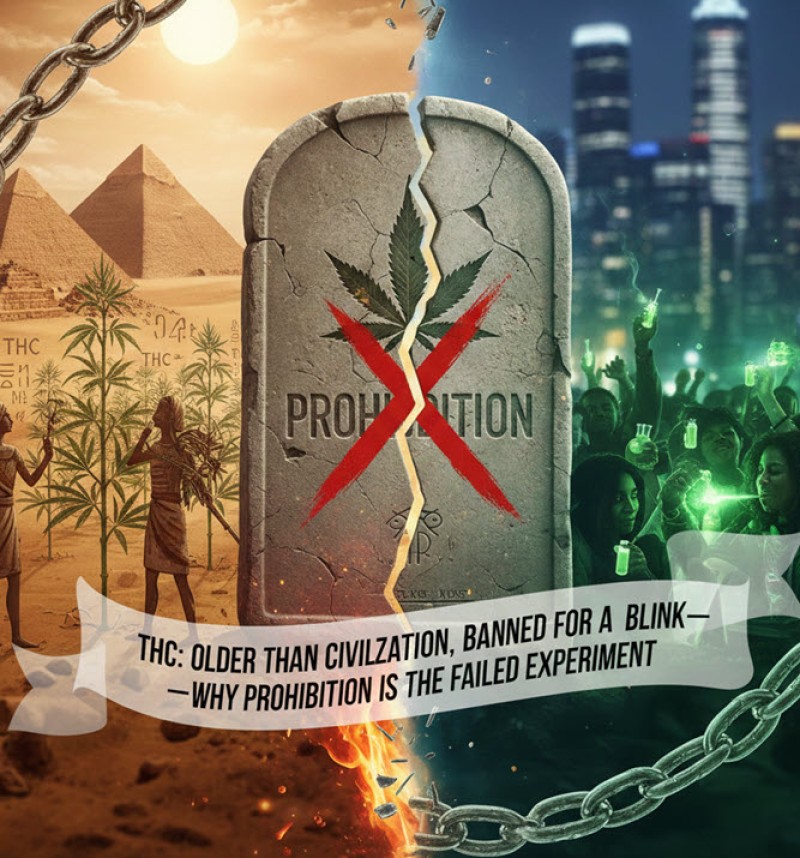
Let's talk about time scales.
Cannabis evolved the ability to produce THC approximately 28 million years ago—long before humans existed, before our primate ancestors descended from trees, before most of the species we recognize today walked the earth.
Humans began cultivating cannabis approximately 12,000 years ago—making it one of our very first domesticated crops, possibly the founding crop that helped kickstart the Neolithic Revolution and human civilization itself.
For the next 11,900+ years, cannabis was a cornerstone of human society. Fiber. Food. Medicine. Ritual. Culture. It was as fundamental to human civilization as wheat or rice.
Then, in 1937, we banned it.
For 87 years—a literal blink in the timeline of cannabis-human partnership—we've been running an experiment in prohibition.
And it has failed. Spectacularly.
Today, we're going to talk about the deep history of THC, how this molecule came to exist millions of years before humans, how it helped build civilization, and why the idea that we can or should ban it represents a fundamental misunderstanding of both biology and human history.
Because here's the truth: Prohibition is the aberration. The experiment. The deviation from 28 million years of evolutionary success and 12,000 years of human partnership.
And like most experiments that ignore basic reality, it's failing.
Part 1: Before Humans—The Evolution of THC
About 28 million years ago, on the high-altitude steppes of Central Asia—likely the Tibetan Plateau—the cannabis plant was evolving in one of the harshest environments on Earth.
High elevation. Intense solar radiation. Dry, windy conditions. Herbivorous insects looking for food.
The plant needed defenses. So it invented THC.
Not for human enjoyment. Not as a gift to future stoners. But as a multi-purpose survival strategy that would prove so successful that the plant would eventually partner with the most successful species on the planet.
Chemical Warfare: The Insect Defense
The most widely accepted hypothesis for THC's evolution is that it functioned as a chemical defense against herbivorous insects.
The mechanism is elegant:
Cannabinoids like THC are sticky and lipid-soluble. When an insect—a caterpillar, beetle, or aphid—attempts to feed on the flowering tops (where seeds develop), the resin literally gums up their mouthparts and digestive systems.
But it doesn't stop there. THC also acts as a mild neurotoxin to these simple creatures. It disrupts their feeding behavior, making them disoriented and causing them to abandon the plant.
The plant protected its most vulnerable parts—its reproductive organs—with a chemical that confused and repelled attackers.
The irony is beautiful: the very compound evolved to make insects "too high to function" is what eventually attracted humans for exactly that property.
The Sunscreen Hypothesis: UV Protection
At high altitudes, UV radiation is intense enough to damage DNA and kill developing seeds. Cannabis evolved a remarkable solution: biological sunscreen.
THC and other cannabinoids absorb UV-B radiation. The plant produces them in dense concentrations in trichomes—tiny resin glands that cover the flowers like a protective blanket.
Think of it as the plant's SPF 1000. The thick layer of cannabinoid-rich resin physically and chemically shields developing seeds from mutating radiation.
Cannabis essentially evolved its own sun protection factor millions of years before humans invented sunscreen.
Desiccation Tolerance: Moisture Lock
The Tibetan Plateau isn't just sunny—it's arid and windy. Developing seeds need moisture to mature, but the environment actively works against that.
The oily resin coating serves another function: preventing water loss.
The cannabinoid-rich trichomes lock in moisture, creating a protective seal around developing flowers that allows seeds to mature even in harsh, dry conditions.
The Multi-Tool Defense System
So THC wasn't a single-purpose adaptation. It was a multi-tool survival strategy:
-
Chemical weapon against insects
-
Sunscreen against UV radiation
-
Moisture barrier against desiccation
This multi-functionality made it an extraordinarily successful evolutionary adaptation. Plants that produced higher concentrations of cannabinoids survived better, reproduced more successfully, and passed on their THC-producing genes.
For 28 million years, this molecule refined itself through natural selection.
By the time humans arrived on the scene, cannabis had already perfected the art of producing THC. We didn't create this. We discovered it.
And then we built civilization with it.
Part 2: The Partnership Begins—12,000 Years Ago
Recent genomic studies—particularly a landmark 2021 study published in Science Advances—have revolutionized our understanding of cannabis domestication.
Cannabis was domesticated approximately 12,000 years ago in East Asia (modern-day Northwestern China), making it one of humanity's very first cultivated crops.
This coincides exactly with the dawn of the Neolithic Revolution—the transition from nomadic hunter-gatherer societies to settled agricultural civilizations.
That's not coincidence. That's causation.
The Genetic Evidence
DNA sequencing shows that wild cannabis diverged into two distinct varieties roughly 12,000 years ago:
Hemp lineage: Selected for strong fibers and abundant seeds Drug lineage: Selected for high resin content (THC)
This split indicates intentional human selection. We weren't just harvesting wild plants—we were actively breeding them for specific traits.
And we were doing this at the same time we were domesticating wheat and barley.
Cannabis wasn't just a founding crop. It may have been the founding crop.
The "Dump Heap" Theory: How It Started
Cannabis is a nitrophile—it loves nitrogen-rich soil. Early human settlements created perfect conditions for cannabis growth: waste dumps, latrines, food scraps—all high in nitrogen.
Cannabis likely colonized these areas naturally, becoming what archaeobotanists call a "camp follower"—a wild plant that thrived near human settlements.
Early humans noticed this incredibly useful plant growing right outside their shelters. Strong fibers. Nutritious seeds. Interesting psychoactive properties when burned.
So we started caring for it. Selecting it. Breeding it. Protecting it.
The partnership had begun.
Part 3: The Triple Threat—How Cannabis Built Civilization
Cannabis wasn't just useful. It was transformatively useful in three critical ways that directly enabled the rise of settled civilization.
1. The Fiber Revolution: Cordage, Nets, and Technology
Before pottery. Before metallurgy. Before writing. Humans needed string.
String for binding. Rope for pulling. Nets for fishing and hunting. Fabric for carrying and storage.
Hemp fiber provided all of this.
It's incredibly strong—stronger than cotton. It's rot-resistant, crucial for fishing nets. It's durable enough for ropes that can haul building materials.
Archaeological evidence from ancient pottery shows hemp cord impressions—proof that early humans were using cannabis fiber to create pottery, fishing nets, and carrying bags.
The ability to create fishing nets specifically revolutionized food production. A single net could catch more fish in a day than weeks of individual fishing. This food surplus allowed populations to grow and settle permanently.
You can't build a village if everyone's out hunting individually. But you can if you have nets that provide consistent protein while others build shelters.
2. The Food Source: The Nutritional Powerhouse
Cannabis seeds are a complete protein, containing all nine essential amino acids. They're rich in omega-3 and omega-6 fatty acids in an ideal ratio for human nutrition.
For early agricultural societies facing uncertain food supplies, cannabis seeds provided:
-
Storable protein (non-perishable, lasted through winter)
-
Caloric density (high energy content)
-
Nutritional completeness (essential fats and proteins)
This wasn't a minor crop. This was a survival food that could be stored, transported, and relied upon during lean seasons.
The caloric security provided by cannabis seeds gave communities the stability needed to invest in permanent settlements rather than following migratory food sources.
3. The Shamanic Catalyst: Ritual, Medicine, and Social Cohesion
Archaeological sites like the Jirzankal Cemetery in the Pamir Mountains (dated to 2,500 years ago) show braziers containing charred cannabis with elevated THC levels.
This wasn't accidental. This was intentional ritualistic use.
The psychoactive properties of cannabis served multiple crucial functions in early societies:
Shamanic/Religious Practice: Altered states facilitated communication with ancestors, deities, or spirit realms. This wasn't recreational—this was the technology of early religion.
Social Bonding: Shared ritual experiences created group cohesion. Communities that ritually consumed cannabis together developed stronger social bonds.
Medical Applications: Pain relief, anxiety reduction, appetite stimulation—early humans discovered cannabis's medical properties through direct experience.
The fiber built the village. The seeds fed the village. The flowers unified the village.
This three-way utility made cannabis uniquely valuable. No other single plant provided structural materials, complete nutrition, AND psychoactive/medicinal properties.
Part 4: 12,000 Years of Continuous Partnership
From that initial domestication 12,000 years ago until 1937, cannabis was a constant companion of human civilization.
Ancient China: Used for fiber, food, medicine, and ritual. Mentioned in the world's oldest pharmacopeia.
Ancient Egypt: Hemp rope found in pyramids. Cannabis pollen found on mummies.
Ancient India: Sacred plant in Ayurvedic medicine. Associated with Shiva.
Ancient Persia/Middle East: Mentioned in religious texts. Used medicinally and recreationally.
Medieval Europe: Hemp was so essential that England's King Henry VIII mandated farmers grow it. Naval powers depended on hemp rope for their ships.
Colonial America: Hemp was legal tender in some colonies. Farmers were required by law to grow it. The first drafts of the Declaration of Independence were written on hemp paper.
For 11,900+ years, cannabis was everywhere humans were. It clothed us, fed us, healed us, and helped us commune with whatever we considered divine.
Then we banned it.
Part 5: The 87-Year Experiment in Prohibition
In 1937, the United States passed the Marihuana Tax Act, effectively criminalizing cannabis.
In 1970, the Controlled Substances Act placed cannabis in Schedule I—reserved for substances with "no medical value and high potential for abuse."
For 87 years—0.7% of the cannabis-human partnership timeline—we've been trying to erase a relationship that literally helped build civilization.
Let's be clear about what prohibition represents:
It's not the restoration of a natural order. Cannabis has been with us for 12,000 years.
It's not based on science. THC evolved 28 million years ago as a successful survival strategy.
It's not protecting anyone. Legal cannabis states haven't collapsed. Society continues functioning.
Prohibition is the experiment. The aberration. The deviation.
And it's failed by every metric:
Cannabis is more available than ever. Prohibition didn't reduce supply—it handed the market to criminals.
More people use cannabis now than before prohibition. Criminalization didn't reduce demand.
The plant didn't disappear. 28 million years of evolution don't get erased by 87 years of law.
We didn't stop the partnership. We just made it illegal and dangerous.
Part 6: Why Prohibition Can Never Work
You cannot successfully prohibit a plant that:
1. Evolved for 28 million years to be resilient, hardy, and successful in diverse environments.
2. Has been humanity's partner for 12,000 years across every culture, continent, and civilization.
3. Literally helped build human civilization by providing essential materials, nutrition, and social/spiritual cohesion.
4. Grows easily in most climates with minimal care.
5. Provides genuine benefits that humans consistently seek across all cultures and time periods.
This is why prohibition has failed. Not because enforcement wasn't harsh enough. Not because penalties weren't severe enough.
Because you're fighting biology, evolution, history, and human nature simultaneously.
It's like trying to prohibit wheat. Or dogs. Or fire. These partnerships are too deep, too old, too mutually beneficial to simply legislate away.
The Sticky Bottom Line: Return to Reality
Here's what the timeline looks like when you actually lay it out:
28 million years: THC evolves as multi-purpose plant defense 12,000 years: Humans domesticate cannabis as founding crop 11,900 years: Continuous human-cannabis partnership across all civilizations 87 years: Prohibition experiment Present day: Prohibition failing, legalization returning
Prohibition represents 0.7% of the human-cannabis relationship and 0.0003% of THC's existence.
We are not legalizing a dangerous new drug. We are ending a failed experiment that tried to prohibit a foundational plant that's been with us since the dawn of civilization.
The question isn't "Should we legalize cannabis?"
The question is "Why did we ever think we could prohibit a plant that helped build human society?"
The experiment has run its course. The data is in. Prohibition doesn't work because it's fighting:
-
28 million years of evolution
-
12,000 years of domestication
-
Fundamental human needs (fiber, food, medicine, spiritual experience)
-
Biology (the plant grows easily)
-
Economics (huge demand creates huge supply)
-
Culture (deeply embedded across all societies)
You can't ban the sun. You can't ban rain. You can't ban a partnership that predates written language.
For 12,000 years, we knew this plant's value. For 87 years, we pretended we didn't.
It's time to remember.
The partnership is older than civilization. The prohibition is younger than your grandparents.
Which one do you think has more legitimacy?
Time to end the experiment. Return to the relationship that helped make us human in the first place.
28 million years of evolution. 12,000 years of partnership. 87 years of failure.
The math is simple. Let's act like it.
WHAT IS THC, READ ON...