

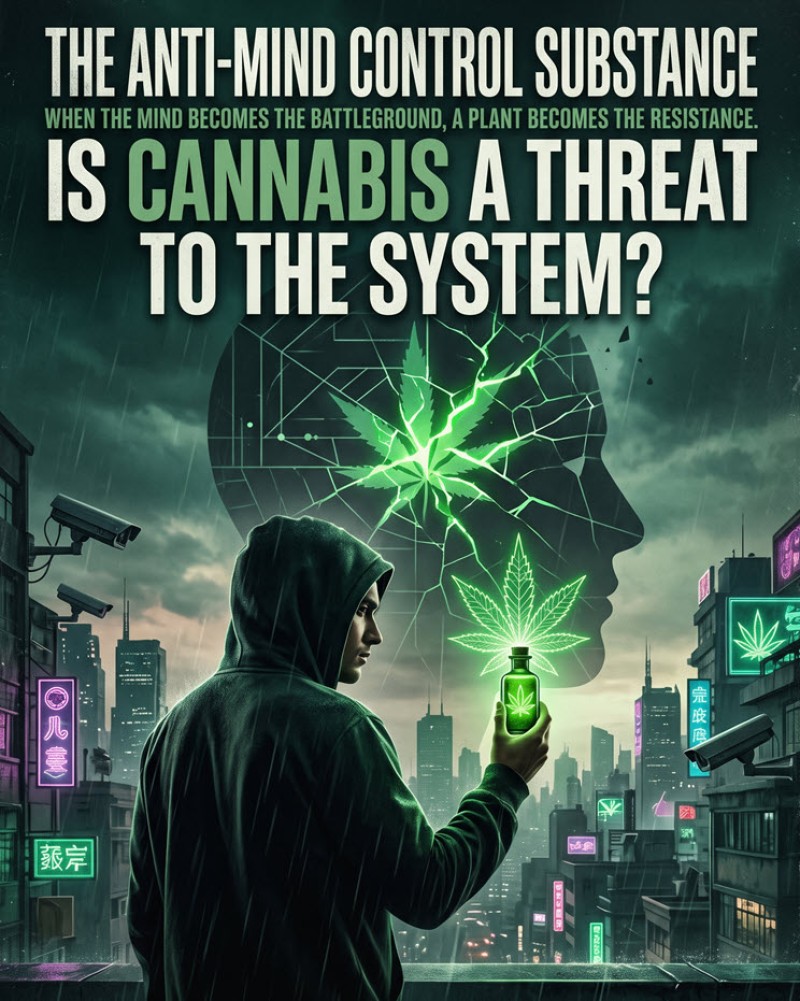
Cathy O'Brien is a controversial figure. A survivor of what she claims was a CIA-connected mind control program called MK-Ultra, her testimony occupies the uncomfortable intersection between documented government abuse of citizens and conspiracy theory territory that most mainstream commentators prefer to dismiss wholesale. I'm not here to adjudicate her specific claims. What I am here to do is take one underlying idea seriously on its own terms: could cannabis function, by its neurochemical properties, as a substance that disrupts the kind of repetitive, authority-accepting thought patterns that a controlled population requires?
Because when you pull the neuroscience, the history, and the policy record together, the answer is surprisingly coherent. And it has nothing to do with conspiracy. It has everything to do with how the brain works, how power operates, and why the plant was banned by virtually every major political system on earth around the same time.
1. The Default Mode Network
The Default Mode Network (DMN) is the brain's baseline operating mode — the system active when you're not focused on an external task. It's involved in self-referential thinking, social cognition, mind-wandering, and what neuroscientists sometimes call the "narrative self" — the ongoing internal story you tell yourself about who you are and what your place in the world is.
It is also, critically, the neural architecture of habit. The DMN is where repetitive thought patterns live. Where conditioning sits. Where "I do this because this is what people like me do" originates.
Cannabis, particularly THC, is consistently shown in neuroimaging studies to reduce DMN activity. A 2016 study published in Human Brain Mapping found that THC disrupts DMN connectivity, while a broader body of research associates cannabis use with increased divergent thinking — the capacity to generate multiple solutions to a problem rather than defaulting to the expected one. (Cannabis and creativity: a systematic review, European Neuropsychopharmacology, 2021.)
From a control-systems perspective, a population whose DMN is regularly interrupted — whose internal narrative loop gets disrupted on a chemical level — is a population more likely to ask "why" than to simply comply. That is not a useful feature in citizens you need to mobilize for war, keep on the production line, or maintain in comfortable ideological compliance.
2. The Labor and Military Argument
The Protestant work ethic that shaped industrial capitalism depended on a specific psychological profile: deferred gratification, productivity as virtue, discomfort with idleness, and a relationship to authority built on compliance rather than consent. Cannabis cuts against almost all of this at a cultural and chemical level.
Alcohol, in its social function, serves the system reasonably well. It lets workers blow off steam, lubricates social bonding without producing deep introspection, and sends people back to the factory on Monday morning. The hangover is itself a kind of punishment for having taken the break. Cannabis does something different. It produces contentment. It dissolves the artificial urgency that makes people work 60-hour weeks to afford things they don't have time to enjoy. It creates what users across cultures and centuries consistently describe as a feeling of connection — to other people, to the natural world, to something larger than the economic anxieties that drive ordinary behavior.
A person who feels genuinely content — not numbed, not distracted, but actually satisfied with a simpler set of circumstances — is a harder sell on the proposition that they should pick up a rifle and go die in a mountainous region of a country they've never visited, to defend interests they don't share, on behalf of contractors who will profit from the ammunition. The plant produces the wrong psychology for the war machine's recruiting pitch.
3. Harry Anslinger Essentially Admitted This
Harry Anslinger, first commissioner of the Federal Bureau of Narcotics and the architect of federal cannabis prohibition, is typically quoted for his racist propaganda: claims that marijuana caused Black jazz musicians to "think they were as good as white men," or that it led to violence and degeneracy among Mexican immigrants. This is the part of the record most people know.
What's less often cited is that Anslinger's actual documented concern was not violence. His internal communications and congressional testimony reveal a more specific anxiety: cannabis made people peaceful, passive, and indifferent to authority. The "problem" was not that users became dangerous. The problem was that they stopped being useful.
His 1937 congressional testimony described marijuana as producing a "pacifist" attitude — the word he used was derogatory, but the neurological description is accurate. A substance that reduces DMN activity, dampens the stress response, and produces contentment does, in fact, tend to make people less interested in organized violence on behalf of someone else's agenda.
4. The Global Uniformity Problem
Here is the most structurally interesting piece of evidence, and it requires no conspiracy to explain. In the mid-20th century, cannabis was made illegal not by one political system but by nearly all of them — simultaneously. The United States banned it in 1937. The Soviet Union criminalized it. Maoist China prohibited it. Theocratic states banned it. Capitalist democracies banned it. Countries that disagreed on virtually every political, economic, and social question converged on this one policy at roughly the same historical moment.
If the concern was the specific ideology associated with cannabis use — the hippies, the jazz musicians, the Rastafarians — then you would expect capitalist states to ban it while communist states legalized it as a tool of Western decadence, or vice versa. That's not what happened. Every major industrial power, regardless of its stated ideology, moved to prohibit the same plant.
The most parsimonious explanation is not ideological. It's operational. Industrial civilization, regardless of whether it runs on capitalism or communism, requires a particular kind of citizen: predictable, productive, responsive to authority, and willing to participate in large-scale collective enterprises including warfare. Cannabis interferes with that profile not because of who uses it but because of what it chemically does to the brain.
5. The Paradox They Created
When you criminalize something, you don't eliminate it. You transform it into a symbol. Cannabis prohibition didn't reduce cannabis use over a century of effort — by 2023, 49.6 million Americans reported using it, roughly 18% of the population. What prohibition did do, with remarkable efficiency, was hand the plant a counter-cultural identity that made it more potent as a symbol of resistance than it might ever have been as a legal commodity.
By making it illegal, the state told every person who used it: you are outside the acceptable order. You are, by the act of smoking a plant, a dissident. Generations of people who might have used cannabis as a mild recreational substance without any particular ideological charge instead received it as a badge of identity — and often developed the skepticism toward official narratives that any persecuted group eventually develops toward its persecutors.
Anslinger wanted to suppress a plant that made people question authority. Instead, he created a 90-year cultural institution that identified questioning authority as a core value of everyone associated with the plant. The counterculture, the anti-war movement, the civil rights adjacency of cannabis legalization advocacy — none of this was inevitable. It was manufactured by the prohibition itself.
The Honest Assessment
I want to be precise about what I am and am not claiming here. I am not claiming that smoking cannabis will free you from mind control, make you immune to propaganda, or transform you into a fully autonomous thinker. The plant is not magic. People who use cannabis daily consume propaganda, make terrible political decisions, and participate in systems they don't examine just like everyone else.
What I am saying is that the neuroscience of DMN disruption, the documented history of prohibition's political motivations, Anslinger's own testimony, and the cross-ideological universality of cannabis criminalization all point in the same direction: the plant's tendency to interrupt habitual thought patterns and produce contentment with less was recognized as a threat to industrial civilization's operating requirements. The people who ran those systems knew it well enough to coordinate its suppression globally.
Whether you call that mind control or simply institutional self-preservation depends on your philosophical inclinations. The functional result is the same. A plant that makes people slow down, question, and feel connected to something beyond the economic machinery they're embedded in was classified as a dangerous substance — not because of violence or addiction or public health, but because of what it did to the kind of citizen power needed to perpetuate itself.
That's worth sitting with the next time someone asks you why you smoke.
MK ULTRA AND CANNABIS, READ MORE...