
There's a Pennsylvania House bill making its way through the state legislature right now, and the fact that it exists at all should embarrass us. The bill, passed with bipartisan support, would allow terminally ill patients to use medical marijuana for pain management even while hospitalized. That's the story. That's the bill. And somewhere in the machinery of American governance, enough people had enough reservations about this that it required an act of legislation to make it possible.
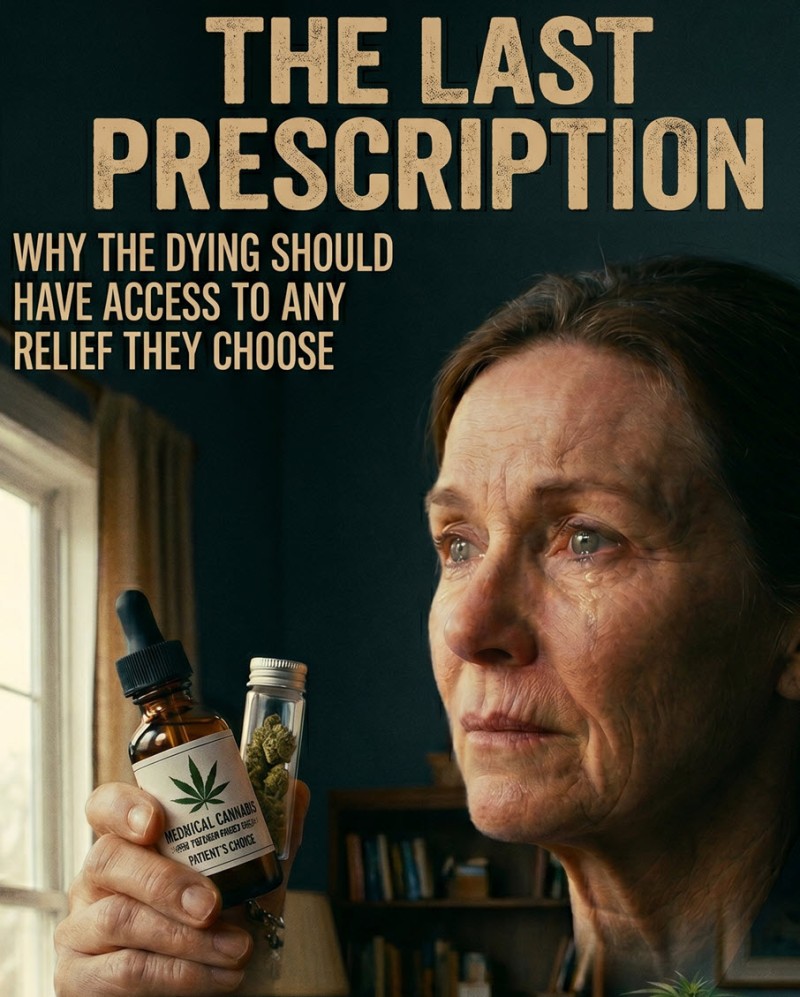
Let me put it plainly. A 41-year-old man named Ryan Bartel was in a hospital bed with stage four pancreatic cancer. He begged his father to help him get off fentanyl. His doctors agreed cannabis could help. The hospital said no. His family had him transferred to a facility that would accommodate him. In his final weeks, he was awake. He could speak. He could say goodbye.
The hospital that refused him wasn't protecting Ryan Bartel. It was protecting a policy.
The Variables That Stop Mattering
In most drug policy debates, the variables you argue about make sense. Is it addictive? Can it cause dependency? Does long-term use carry health risks? Does heavy use impair cognition? These are legitimate questions worth honest answers. The cannabis conversation has been plagued by bad-faith versions of these questions, but the questions themselves are fair.
Except when you're dying. At that point, the calculus collapses entirely.
Addiction is irrelevant if the timeline is weeks. Cognitive effects are irrelevant if the goal is to remain conscious enough to hold your child's hand. Long-term risks are irrelevant when there is no long term. Every variable that fuels the standard prohibition argument evaporates the moment a physician writes a terminal diagnosis. What remains is the only variable that ever actually mattered in the first place: does the person in pain get some relief, or not?
Stage four pancreatic cancer has a median survival of about three to six months from diagnosis. The five-year survival rate sits below four percent. The pain associated with it is brutal and progressive, and the standard management protocol runs straight through the opioid ladder. Morphine. Fentanyl. Hydromorphone. These drugs work, but they sedate. For many patients, the choice between managed pain and conscious final weeks is not a medical choice. It gets made for them by a hospital's legal team.
The Terpene Question They Won't Ask
There's a piece of research that rarely makes it into these policy conversations. A study published in the journal Neuropsychopharmacology examined cannabis terpenes, the aromatic compounds that give different strains their distinctive character, and found them as effective as morphine in animal pain models. More usefully, when combined with opioids, the terpenes appeared to enhance analgesic effects while avoiding the standalone euphoria and addiction potential. The implication is real: cannabis compounds could allow lower opioid doses while maintaining or improving pain control.
Ryan Bartel's doctors already understood this intuitively. They supported cannabis access. The obstacle wasn't medicine. It was a hospital policy written for a general population of patients, applied without modification to a man with weeks to live.
The endocannabinoid system, which cannabis compounds interact with, regulates pain sensation, mood, sleep, and inflammation. These are precisely the domains that deteriorate most brutally in terminal illness. The body's own endocannabinoid production depletes under chronic stress and illness. Supplementing it with phytocannabinoids isn't a fringe idea. It follows directly from what we know about the system's function. But try getting that conversation past a hospital's liability review.
The Moral Logic of Deprivation
I want to hold up the people who oppose this. Not the bureaucrats, they're doing what bureaucrats do. The people who look at a terminally ill patient requesting cannabis and conclude that the appropriate response is no.
What is the reasoning? That they might develop a cannabis use disorder? Over six weeks? That cannabis use sends a bad message to other patients? That it creates liability exposure for the institution? None of these arguments survive contact with a dying human being. They are policies designed for populations, applied to individuals, and the mismatch is grotesque.
We let dying patients refuse food. We let them decline dialysis. We let them choose to remove ventilators. The legal doctrine of patient autonomy is robust when the choice is to stop treatment. It becomes porous the moment someone asks for a specific type of relief the institution doesn't sanction. That inconsistency isn't medical. It's political.
If a patient at end of life wants opioids that will sedate them through their final days, the hospital provides them. If that same patient requests cannabis, which might allow them to stay conscious and present, they get transferred or denied. We've built a system that more readily offers sedation than clarity. Call that what it is.
This Should Not Be an Outlier
Pennsylvania's bill passed the House with 72 Republicans joining every Democrat. That's not a partisan issue. That's a human one. And it still has to clear the Senate, still has to survive any number of procedural objections, still has to become law before it means anything to the next Ryan Bartel.
The argument for restricting terminally ill patients from cannabis isn't medical. It's bureaucratic inertia dressed in the language of caution. Every major hospice organization in the country acknowledges cannabis as a legitimate palliative option. The National Hospice and Palliative Care Organization has called for expanded access. Oncologists use it in states where it's legal. The clinical hesitation exists not because of evidence but because of federal scheduling, hospital accreditation concerns, and a liability culture that treats a dying patient's comfort as secondary to institutional risk.
Other countries have moved faster. Canada's federal legalization resolved most of the hospital access question by removing the federal prohibition. Australia's Therapeutic Goods Administration has expanded medicinal cannabis access under palliative protocols. The United States is threading an increasingly absurd needle, where cannabis is legal in dozens of states but a hospitalized dying patient in those same states can be denied access because the hospital receives federal funding.
That federal funding hook is the mechanism. Hospitals that take Medicare and Medicaid operate under federal law, and federal law still classifies cannabis as a Schedule I substance with no accepted medical use. The irony of that classification, applied to a cancer patient begging to get off fentanyl, apparently escapes the apparatus.
The Principle Behind the Case
Terminal illness should trigger the suspension of most drug law logic. Not because dying patients should have no guardrails at all, but because the rationale for those guardrails disappears. We restrict substances to protect people's futures. A terminal diagnosis removes the future from the equation. What remains is the present, and in that present, the only question is whether a person in agony can have some relief.
Ryan Bartel wanted to be awake when he said goodbye. Cannabis gave him that. A hospital policy took it away, and his family had to move him to get it back. That shouldn't require a bill. It shouldn't require a legislative fight. It should require nothing more than a physician's agreement and a patient's request.
Pennsylvania is doing the right thing slowly. The right thing quickly would be federal descheduling that removes the hospital funding threat and lets palliative care evolve the way medicine is supposed to, by following what works for patients. Until that happens, we'll keep watching states write laws to protect dying people from institutions that were built to save them.
---
Sources: KYW Newsradio reporting on Pennsylvania HB (June 2026); Neuropsychopharmacology study on cannabis terpenes and pain modulation; National Hospice and Palliative Care Organization policy statements on cannabis access.
HOSPICE CARE WITH CANNABIS, READ ON...