
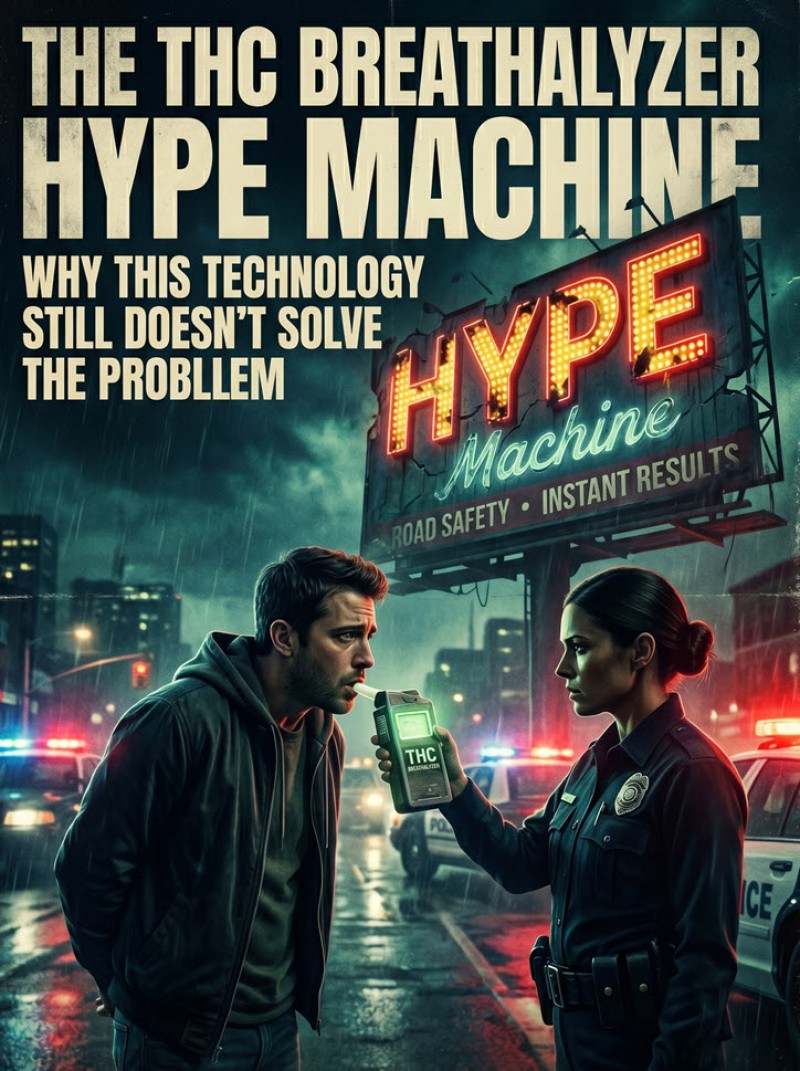
Every few years, like clockwork, a new cannabis breathalyzer story cycles through the news. The headline is always some variation of "breakthrough" or "game-changer" or "the device police have been waiting for." The funding is usually federal. The technology is always described as promising. And buried somewhere in paragraph twelve, the researchers quietly acknowledge that none of this actually tells you whether someone is impaired.
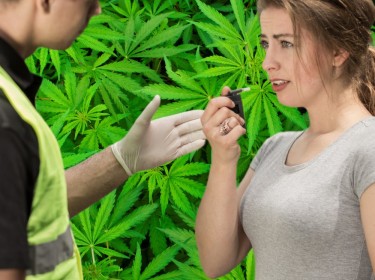
The latest version of this story comes from Virginia Commonwealth University, where researcher Emanuele Alves developed a portable, 3D-printed device shaped like an asthma inhaler that uses "Fast Blue" dye and gelatin cartridges to detect delta-9 THC in exhaled breath without requiring secondary lab analysis. The Justice Department provided funding. Marijuana Moment covered it. OregonLive called it "the marijuana breathalyzer police have been waiting for."
It isn't.
I don't say that to dismiss the science. The VCU team solved a real engineering problem: distinguishing THC from CBD in a field-deployable device, without a lab, in real time. That's genuinely difficult. The colorimetric approach — using dye reactions that produce different color signatures for different cannabinoids — is a smarter design than previous redox-based systems that would have flagged anything capable of oxidizing the reagent, making any defense attorney's job embarrassingly easy. The researchers describe their results as "foundational data supporting the feasibility" of the concept. That's honest language. That's a proof of concept.
What it is not is a reliable measure of impairment. And that distinction is the entire point.
The Problem That Detection Cannot Solve
Alcohol breathalyzers work because ethanol is ethanol. It metabolizes predictably across human biology. You drink two beers, your blood alcohol concentration rises on a documented curve, it falls on a documented curve, and the correlation between BAC and impairment has been established through decades of controlled research. You can draw a line at 0.08 because that line means something consistent across different people at different times.
THC does not behave like this. Not even close.
A 2023 federally funded study by researchers at NIST and the University of Colorado Boulder concluded that the evidence does not support the idea that detecting THC in breath as a single measurement could reliably indicate recent cannabis use. Not impairment — use. They couldn't even reliably pin down recent consumption, let alone whether someone's reaction time was compromised.
A DOJ researcher in 2024 put it more plainly: states may need to move away from the idea that THC levels are a reliable indicator of impairment at all. She specifically noted that chronic users and infrequent users have very different THC concentrations correlated with the same effect levels. The same amount of THC in the bloodstream means completely different things depending on your history with the plant.
This is not a data gap that better technology will close. It's a fundamental feature of how cannabis interacts with the human body.
Cannabis Is Not a Standard Substance
I've been in this space long enough to know the spectrum. On one end, you have someone who has smoked daily for twenty years. They take a bong rip before work, eat a sandwich, and their performance on any functional task is indistinguishable from baseline. Their brain has adapted. Their ECS is calibrated. The THC that would send an inexperienced user into a spiral of anxiety is, for them, a mild morning ritual.
On the other end, you have someone who tried cannabis twice in college and recently picked it up again after a decade away. One hit sends them to the couch for three hours. Two hits and they're considering whether they should call someone.
THC is fat-soluble. It stores in adipose tissue and can be detectable in blood and urine weeks after any actual impairment has cleared. Frequency of use, body composition, consumption method, individual tolerance, concurrent medications, and even diet all influence how THC metabolizes and how it affects cognition and motor function. You cannot draw a single threshold number and call it impaired across a population this variable.
A field sobriety test already fails here. A 2021 NIJ study found that standard field sobriety tests failed to detect cannabis intoxication in all participants tested. If the behavioral indicators trained officers use can't identify impairment reliably, a device that measures breath THC concentration is measuring the wrong variable entirely.
Detection Is Not Impairment — And That's a Legal Problem
Here's where the hype becomes genuinely dangerous. Several states have enacted per se THC laws — you hit a concentration threshold, you're charged. No further evidence of impairment required. The alcohol DUI model copy-pasted onto a substance that doesn't work like alcohol.
The VCU device detects THC in the 10-100 nanogram range from exhaled samples. That's detecting recent consumption. Maybe within a few hours, maybe not. It says nothing about whether the person driving was impaired. A cannabis grower who exhaled plant material while harvesting could register a hit. A medical patient who vaped that morning and is entirely functional at noon could register a hit.
As California Bud noted in their coverage, THC is fat-soluble and can show up in blood or urine weeks after use. A breath-based test is theoretically closer to recent consumption than a urine screen, but "closer" is doing a lot of work in that sentence. The legal system doesn't run on proximity. It runs on reliable correlation to actual harm, and that correlation has not been established.
Alves himself acknowledged that most existing THC breathalyzers are merely collection devices requiring further lab analysis. His colorimetric approach attempts to bypass that. It's clever. It still doesn't solve the impairment problem. The study's own authors are clear: "additional validation and field-oriented development are needed." That's researcher language for: this is not ready.
So Why the Hype?
Follow the money and the politics. The DOJ funded this. The political pressure to produce a cannabis roadside test has been building for years, tracking directly with legalization expansion. Law enforcement agencies want a tool. Legislators want to tell constituents they have a solution. Defense contractors and device manufacturers want a contract.
The result is a cycle where each iteration of this technology gets framed as a breakthrough, federal dollars flow in, the limitations get acknowledged quietly in the methodology section, and then everyone waits for the next iteration. It's not fraud. It's institutional momentum in a direction that may not have a valid scientific destination.
The honest answer — which nobody in a press release will say — is that THC impairment may never be measurable through a single biomarker the way alcohol is. The endocannabinoid system is not the liver. The relationship between THC concentration and impairment is not a line; it's a scatterplot with too many individual variables to standardize.
That doesn't mean impaired driving isn't a legitimate concern. It is. It means the solution might not be a device at all. It might be better behavioral assessment training, improved cognitive testing protocols, or an honest acknowledgment that the alcohol model doesn't translate and we need to develop a cannabis-specific framework from scratch rather than force-fitting an existing tool onto an incompatible substance.
Until then, read these breathalyzer breakthrough stories with the same skepticism you'd apply to any technology that solves the political problem before it solves the scientific one.
AI FOR A CANNABIS BREATHALYZER, READ ON...