
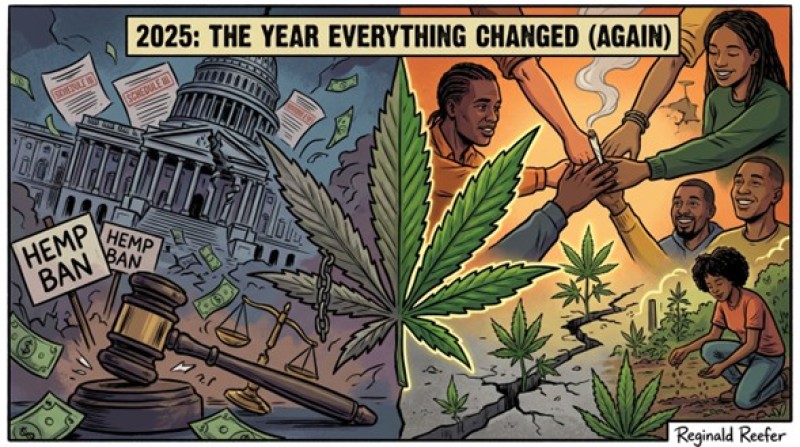
Well, folks, we made it through another year in the wildest timeline. 2025 was a rollercoaster ride through cannabis policy chaos, and I've got the whiplash to prove it. As I sit here reflecting on the year that was, I'm reminded that trying to make sense of cannabis policy in America is like trying to nail Jell-O to a wall while riding a unicycle backwards. It's messy, it's unpredictable, and you're probably going to fall on your ass.
But that's never stopped us before, has it?
So grab your preferred method of consumption, settle in, and let's walk through the ten biggest cannabis moments of 2025—the good, the bad, and the absolutely batshit insane.
10. The Hemp THC Ban: Congress Kills a $32 Billion Industry
What Happened: In a move that surprised absolutely nobody who's been paying attention, Congress effectively banned intoxicating hemp-derived products by redefining "hemp" in a last-minute addition to a must-pass spending bill. The ban is set to take effect in November 2026.
Why It Mattered: This wasn't just about Delta-8 gummies. This was about Congress taking a thriving $32 billion industry that was generating tax revenue, creating jobs, and operating legally (or at least in a legal gray area), and handing it directly to the black market. An estimated 150,000+ jobs are on the line, along with hundreds of millions in state tax revenue.
The Impact: Worse. Significantly worse. Not only did this destroy legal businesses overnight, but it also created a blueprint for how to kill any cannabis market—wait until it gets big enough to matter, then pull the regulatory rug out from under it. The only winners here are black market operators and the cartels Trump claims to be fighting against.
9. Federal Prosecutors Announce Crackdown on Cannabis Possession on Federal Lands
What Happened: Federal prosecutor Darin Smith in Montana announced his office would ramp up prosecution of misdemeanor marijuana offenses on federal lands, pursuant to a new Justice Department policy issued in September that most people haven't even seen.
Why It Mattered: Because apparently, in a country dealing with fentanyl deaths, human trafficking, and violent crime, the best use of limited federal prosecutorial resources is busting people for having a joint in Yellowstone. This signaled that the Trump administration's DOJ was going full drug warrior on cannabis despite his campaign rhetoric about reform.
The Impact: Worse. This represents a return to peak prohibition enforcement over victimless crimes. It also demonstrated that federal cannabis policy can swing wildly based on who's in charge, reinforcing why state-level legalization without federal descheduling is built on sand.
8. Biden's "Pardons" Revealed as Political Theater
What Happened: Newly revealed documents showed that while Biden was publicly pardoning people with federal marijuana convictions, his DOJ was implementing policies requiring prosecutors to seek higher-up approval before declining to pursue marijuana charges—effectively ensuring prosecutions would continue.
Why It Mattered: This exposed Biden's marijuana "reform" as performative bullshit. He pardoned people who were already out of prison (literally zero people were freed), got progressive credibility points, while his agencies maintained business-as-usual prohibition.
The Impact: Worse. Not because of the policy itself (which was always mostly theater), but because it revealed how even "pro-reform" politicians will gaslight the public about cannabis while maintaining prohibition behind the scenes. Trump later rescinded even these minimal restrictions, but they were never real reform to begin with.
7. Multiple States Consider Repealing Legal Cannabis Markets
What Happened: Several states with existing legal cannabis markets faced serious repeal efforts heading into 2026, with well-funded opposition campaigns pushing to roll back legalization entirely.
Why It Mattered: This shattered the illusion that cannabis legalization is irreversible progress. Turns out, when you combine Big Pharma money, law enforcement lobbying, and "concerned parent" groups (often funded by those same pharmaceutical companies), you can convince people to re-criminalize a plant.
The Impact: Too early to call, but the threat alone is significant. It proves that without federal descheduling, every state-level victory is vulnerable to reversal. The very fact that repeal is being seriously discussed shows how fragile state legalization really is.
6. The "Scromiting" Propaganda Campaign
What Happened: A coordinated media blitz introduced "scromiting" (screaming + vomiting) as the new scary term for Cannabis Hyperemesis Syndrome. The same article with the same framing appeared across multiple news outlets within days—classic propaganda playbook.
Why It Mattered: Because "Cannabis Hyperemesis Syndrome" wasn't scaring people enough, so they needed a visceral, TikTok-friendly rebrand. Never mind that CHS might actually be pesticide poisoning being blamed on cannabis, or that it's extremely rare. The goal was to create panic and undermine support for legalization.
The Impact: Mixed. The propaganda machine is working overtime, but people are getting better at recognizing coordinated fear campaigns. Still, this shows that prohibitionists haven't given up—they're just getting more creative with their scare tactics.
5. Singapore Doubles Down on Cannabis Execution Policy with Propaganda
What Happened: Singapore's Central Narcotics Bureau published an infographic about "medical cannabis" that was so packed with cherry-picked data, misleading claims, and deliberate omissions that it deserved its own article. This from a country that executes people for cannabis offenses.
Why It Mattered: It demonstrated how governments that have built entire drug policies on prohibition will manufacture "evidence" to justify continued brutality. When you're hanging people for possessing a plant, you can't admit you might have been wrong.
The Impact: Worse globally, but it also served as a stark reminder of what prohibition at its logical extreme looks like. When people in the U.S. complain about harsh cannabis laws, Singapore shows what "harsh" really means—state-sanctioned murder for plant possession.
4. Trump Administration Guts Anti-Human Trafficking Programs While Ramping Up Drug War
What Happened: The Trump administration slashed funding for anti-human trafficking programs by hundreds of millions of dollars (including $88 million for survivor services and $500 million for international programs), while simultaneously ramping up drug war enforcement. Human trafficking prosecutions dropped 40% while cannabis prosecutions increased.
Why It Mattered: Because it exposed the absolute hypocrisy of the "protect the children" rhetoric used to justify cannabis prohibition. They're defunding programs that actually help trafficking victims while going after people for possessing a plant. The priorities couldn't be clearer—this isn't about safety, it's about control and corporate interests.
The Impact: Catastrophically worse. At least 15,000 trafficking survivors lost access to services while the feds doubled down on arresting potheads. If you ever needed proof that drug war rhetoric about "protecting people" is bullshit, this is it.
3. The Chevron Doctrine Dies, Potentially Killing Schedule III Rescheduling
What Happened: The Supreme Court overturned the Chevron doctrine, which had told courts to defer to federal agencies' interpretations of ambiguous laws. This threw the entire cannabis rescheduling process into legal chaos, as the DEA's authority to reschedule anything became questionable.
Why It Mattered: While the Chevron ruling wasn't about cannabis specifically, it potentially killed the Schedule III rescheduling process by eliminating the legal framework that allowed agencies like the DEA to interpret and apply the Controlled Substances Act. Ironically, this could be a good thing if it forces Congress to actually do its job and legislate instead of letting agencies make policy.
The Impact: Mixed leaning better. Yes, it killed Schedule III (which was a bad idea anyway). But it also opened the door for legal challenges to the entire federal prohibition framework. Anti-cannabis groups can use it to challenge any reform, but reform advocates can use it to challenge prohibition itself. It's chaos, but chaos creates opportunities.
2. Federal Cannabis Policy Reaches Peak Confusion
What Happened: By the end of 2025, federal cannabis policy had become so contradictory and confusing that even industry lawyers couldn't keep up. Congress banned hemp THC while marijuana rescheduling sat in limbo. The DOJ wasn't enforcing prohibition in state-legal markets but announced crackdowns on federal lands. The FDA wasn't enforcing regulations on CBD but threatened to regulate everything under Schedule III.
Why It Mattered: Because this level of dysfunction is unsustainable. When nobody—not businesses, not consumers, not law enforcement, not even the people making policy—knows what's actually legal or enforceable, the system is broken beyond repair.
The Impact: Paradoxically, better in the long run. This level of chaos might finally force the conversation toward real solutions (federal descheduling) instead of half-measures. When the status quo becomes untenable for everyone, change becomes inevitable. We're not there yet, but we're getting close.
1. Trump Signs Executive Order for Schedule III (The Big Con)
What Happened: After months of discussion, Trump allegedly signed an executive order moving cannabis from Schedule I to Schedule III, claiming it as the "biggest cannabis reform in history." In reality, this was Biden's proposal that Trump slapped his name on while taking credit.
Why It Mattered: Because it perfectly encapsulates everything wrong with cannabis "reform" in America. Schedule III doesn't legalize cannabis federally. It doesn't stop arrests. It doesn't resolve banking issues. It doesn't allow interstate commerce. What it does is give massive tax breaks to big cannabis corporations, require FDA approval for products (hello, Big Pharma!), and create new federal crimes for dispensaries and growers operating without pharmaceutical-grade compliance.
The Impact: Significantly worse disguised as better. This is a corporate takeover of the cannabis market disguised as reform. Small businesses will be crushed by pharmaceutical-grade compliance requirements. Big Pharma gets to control synthetic THC products. The average consumer and small cultivator get screwed while Trump claims victory and his supporters cheer.
The real kicker? A genuine Trump reform would have been full descheduling—removing cannabis from the Controlled Substances Act entirely. But that would require actual courage and wouldn't benefit his corporate donors, so we got Schedule III instead. The swamp thing claiming to drain the swamp, right on schedule.
The Sticky Bottom Line: Who Knows What's Next?
As I sit here trying to make sense of 2025, I'm reminded of something important: I've stopped trying to predict the future the moment we hopped into another parallel universe.
Seriously, think about where we are. We've got states considering repealing legalization while the feds are sort-of-kind-of-maybe rescheduling cannabis to a category that might help corporations but definitely screws everyone else. We've got a $32 billion hemp industry being banned and handed to cartels while the administration claims to be fighting cartels. We've got "scromiting" propaganda campaigns while governments cut anti-trafficking funding. We've got Supreme Court rulings that accidentally might help cannabis reform while also empowering prohibitionists.
It's madness. Complete, unfiltered chaos.
And you know what? I'm done trying to predict what happens next. The moment everything started moving at warp speed—the moment we entered whatever timeline this is where nothing makes sense and contradictions are policy—I realized that prediction is futile.
Things are moving way too fast to get your bearings on anything these days. What seems certain one day is reversed the next. What looks like progress turns out to be a trojan horse. What appears to be disaster might accidentally create opportunities.
So what's 2026 going to bring for cannabis? Fuck if I know.
Maybe federal descheduling happens because the chaos becomes unsustainable. Maybe more states repeal legalization and we slide backward. Maybe the hemp ban gets reversed, or maybe it creates a black market boom. Maybe Schedule III gets implemented and Big Pharma takes over, or maybe legal challenges kill the whole thing.
Maybe all of the above. Maybe none of it. Maybe something completely different that we haven't even imagined yet.
What I do know is this: the fight isn't over. Not by a long shot. Every victory is fragile. Every defeat creates new opportunities. Every moment of chaos is a chance to push for real reform instead of corporate-friendly half-measures.
So here's my advice for 2026: Stay informed. Stay skeptical. Stay active. Don't celebrate half-measures as victories. Don't accept Schedule III as reform. Don't let them gaslight you into thinking prohibition-lite is progress.
Demand real legalization—federal descheduling, expungement of records, protection for small businesses, and an end to the criminalization of a plant that's been used safely for thousands of years.
And plant some seeds—literally and metaphorically. Because if the story of the Greench who stole Dankmas teaches us anything, it's that grassroots movements, one person at a time, one seed at a time, can outlast and overcome even the most powerful opposition.
2025 was absolutely bonkers. 2026 will probably be worse, or better, or both simultaneously because that's apparently how time works now.
But whatever happens, we'll be here, documenting the chaos, calling out the bullshit, and fighting for real freedom.
WHAT ABOUT WEED IN 2026? READ ON...