
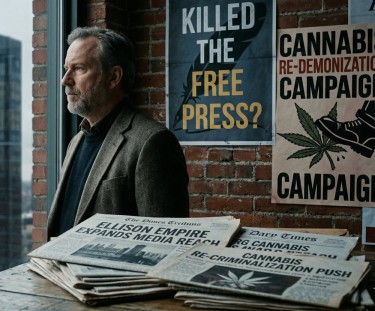
Who Killed the Free Press?
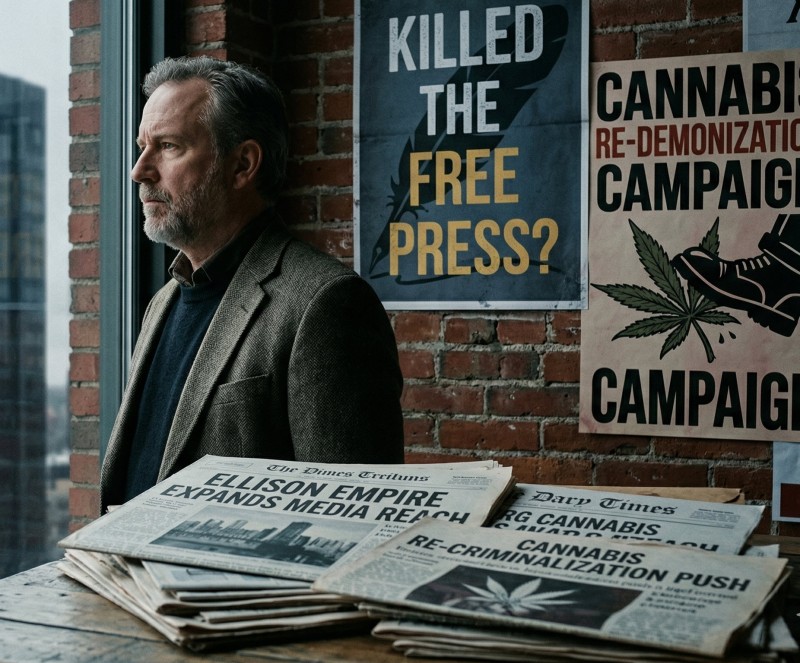
The Ellison Empire, the Cannabis Re-Demonization Campaign,
and the Ghost of a Vietnam You Never Voted For
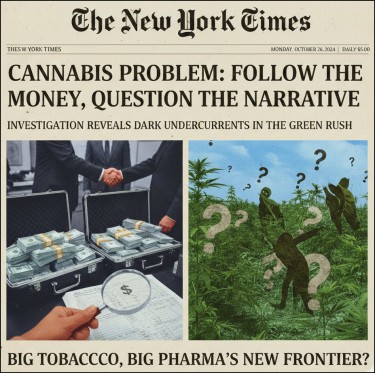
The New York Times flipped on cannabis last month. We covered that. Filed it, sourced it, called it what it was — institutional cowardice dressed as public health journalism.
Then this week, the Wall Street Journal ran its version. AOL pushed its version. The same week. Different mastheads, same message.
That's not a coincidence. That's a pattern. And if your conspiratorial whiskers aren't twitching right now, mine are twitching enough for both of us.
Let's talk about who owns the press, why they want you terrified of a plant, and why the timing — with a war live in the Middle East and a draft quietly back on the table — is something nobody in mainstream media will connect for you.
Fortunately, I'm not mainstream media.
Six Companies. One Message.
There's a number you need to hold onto: fifty. In 1984, fifty independent companies owned the majority of American media. By 2011, six conglomerates controlled 90% of everything you read, watch, and hear. Today, that number hasn't recovered — it's consolidated further, and the faces running the show have changed in ways that should concern anyone paying attention.
Comcast owns NBC. Disney owns ABC. Warner Bros. Discovery owns CNN. Paramount-Skydance — funded by Larry Ellison — owns CBS. News Corp and Fox Corporation, the Murdoch family's split empire, own the rest of the conservative side of the dial. The Wall Street Journal, which ran its anti-cannabis piece this week, is a Murdoch property. AOL is owned by Yahoo, which is backed by private equity consortium Apollo Global — the same Apollo that has its fingerprints across a dozen media and telecom plays simultaneously.
These are not media companies that also do other things. These are defense contractors, telecom empires, and surveillance infrastructure firms that also happen to run your nightly news.
And then there's the Ellison situation, which deserves its own section — because what's happening there is unlike anything we've seen in the history of American media consolidation.
|
"Citizens will be on their best behavior because we're constantly recording and reporting everything." — Larry Ellison, to investors, on camera, unprompted. |
The Oracle of Everything
Larry Ellison is not a household name. That's by design. He's 81 years old, he's currently among the wealthiest people on the planet, and he built his fortune on a CIA contract.
That's not a metaphor or a conspiracy theory — that's the origin story. In the late 1970s, a startup founded by Ellison and two co-founders got its foundational contract from the CIA to build a database program. The project was codenamed 'Oracle.' The company kept the name. His biographer Mike Wilson put it plainly: 'Oracle wouldn't exist without government contracts.'
That relationship never ended. Oracle currently holds a $9 billion Joint Warfighting Cloud Capability contract with the Department of Defense, an $88 million Air Force contract for Top Secret workloads, and processes records for the entire Veterans Affairs medical system. Twenty-five percent of American hospitals run on Oracle Health. Five billion consumer dossiers were compiled through Oracle's data subsidiaries — BlueKai, Datalogix, AddThis — before a $115 million settlement in 2024. Databases, as anyone in tech will tell you, don't disappear after a fine.
This is the infrastructure layer. Now add the media layer.
Ellison's son David, through Skydance Media — funded by Larry's money — completed an $8 billion merger with Paramount Global in 2025. That acquisition brought CBS News, Paramount Pictures, MTV, Nickelodeon, Showtime, and Comedy Central under Ellison family control. Bari Weiss, the ideologically consolidated anti-woke commentator, was positioned to take the editorial helm of CBS News. Stephen Colbert's Late Show — the most consistently Trump-critical late night program on network television — was cancelled shortly after.
The Paramount-Warner Bros. Discovery merger, if it closes, would be the largest media merger in American history at $111 billion — adding CNN, HBO, Max, Warner Bros. Pictures, and DC to the portfolio. All of it running on Oracle cloud infrastructure. The same company. The same family.
And then there's TikTok. Oracle joined a consortium to acquire TikTok's US operations — controlling the algorithm and data management for 170 million American users. The same AI, the same data infrastructure, the same man who told investors on camera that constant surveillance would keep citizens 'on their best behavior.'
Curious overlap? Sure. Call it that.
|
"The new venture will moderate content in TikTok's feed, deciding which posts to leave up and which to take down." — The New York Times, on Oracle's role in US TikTok |
The IDF Angle and the Gulf Money
Here's where the curious overlaps start stacking.
Ellison has publicly described his 'deep emotional connection to the State of Israel.' Benjamin Netanyahu has vacationed on Ellison's private Hawaiian island. Oracle has stated it will 'do everything we can to support the country of Israel.' Ellison's former CEO Safra Catz, an Israeli-born executive and Trump administration ally, has worked to develop pro-Israel media content.
Netanyahu himself — while the TikTok deal was being structured — called it 'the most important purchase going on right now' and framed social media control as a primary tool of geopolitical battle. The Anti-Defamation League's Jonathan Greenblatt publicly described TikTok as 'the Gen-Z problem' in 2023. That problem is now being managed by Ellison's algorithms.
TikTok was, notably, the platform where American youth most vocally expressed solidarity with Palestinians during the Gaza bombardment. That context is not irrelevant to understanding why its acquisition was treated as a national security priority.
The financing for the Paramount-Warner merger includes $24 billion from Gulf sovereign wealth funds — Saudi Arabia, Abu Dhabi, Qatar. The same governments Ellison pitched his unified citizen database vision to in Dubai in 2025. The same funds co-investing in the Stargate AI infrastructure project. That's not a conspiracy theory either. That's the cap table, filed publicly.
We're not saying there's a coordinated editorial room somewhere, sending out the week's anti-cannabis talking points. We're saying the incentive structures, the financial entanglements, the ideological alignments, and the ownership chains are all pointing in the same direction at the same time — and that direction happens to involve re-demonizing the plant that young Americans historically use to say 'no' to their government.
The Vietnam Variable
Here's the part that nobody in mainstream media is connecting — which is fine, because they work for the people who don't want it connected.
The United States is currently conducting active strikes against Iran. Six American soldiers have already died. Defense Secretary Pete Hegseth told CBS News the administration is 'willing to go as far as we need to go.' When the White House press secretary was asked directly about a military draft, she refused to take it off the table. The Selective Service has already outlined how a Vietnam-style lottery would work — birth date, age 20 first, descending from there.
The demographic that would be called first — men aged 20 to 26 — is the same demographic that polls highest for cannabis use. The same demographic being fed a steady diet of 'cannabis causes psychosis' and 'marijuana poisoning' and 'we were wrong about legalization' from consolidating media outlets this week.
We've been here before. Not exactly here, but close enough to recognize the architecture.
Richard Nixon's aide John Ehrlichman admitted on the record — decades later, when the political cost was gone — that the War on Drugs was designed to criminalize two groups: anti-war protesters and Black Americans. Cannabis prohibition wasn't a public health decision. It was a political suppression tool. Ehrlichman said it himself.
Nixon didn't invent that playbook. Harry Anslinger and William Randolph Hearst wrote it in 1937 — a media mogul and a career bureaucrat using press infrastructure and manufactured hysteria to criminalize a plant because it was politically useful to do so. Hearst owned the papers. Anslinger owned the narrative. The result was 80 years of prohibition built on provable lies.
The names change. The architecture doesn't.
When a generation of young people might be asked to pick up a rifle for a war they didn't vote for, in a region their government has been intervening in for decades, the last thing the state wants is a symbol of dissent that's cheap, grows in the ground, and has historically unified countercultures across racial and class lines.
Cannabis was that symbol in Vietnam. It was that symbol for every anti-establishment movement since. And if you think the people currently acquiring control of every major media platform, every social media algorithm, and the cloud infrastructure connecting both — if you think those people haven't run that calculation — then I'd suggest you haven't been paying close enough attention.
The Re-Demonization Campaign: By the Numbers
Let's be precise about what's actually happening in the coverage, because the science argument needs to die.
The studies driving the new narrative have consistent methodological problems we've covered exhaustively: they lump all cannabis use into a single category regardless of potency, frequency, or context; they exaggerate psychosis risk by cherry-picking cohort studies with confounding variables; they ignore the millions of regular cannabis users who are, by any reasonable measure, absolutely fine; and they systematically avoid comparing cannabis risk profiles to alcohol — which the World Health Organization has stated has no safe level of consumption.
Meanwhile, NORML formally published its pushback in February 2026, calling this mainstream media's 'new era of Reefer Madness.' The alcohol industry — facing its steepest sales decline in decades among Millennials and Gen Z who are substituting cannabis — has intensified its lobbying and strategic PR operations. The timing of the anti-cannabis coverage surge maps almost perfectly onto the alcohol industry's revenue anxiety.
Economic gravity, some will say. Coordinated campaign, others will say. The result is the same: consolidated media outlets, owned by the same small cluster of ideologically aligned billionaires with government contracts and geopolitical commitments, are all running the same story this week.
WSJ today. AOL today. NYT last month. Watch the rest of the dial over the next 90 days.
|
"In 1984, fifty independent companies owned US media. Today, a handful of billionaires with defense contracts and geopolitical commitments own virtually everything." |
The Sticky Bottom Line
They are not afraid of the plant. They are afraid of what the plant represents when the state needs compliance.
A surveillance infrastructure built on a CIA contract, now expanding to own CBS, CNN, TikTok's algorithm, and the cloud your medical records live on — financed by Gulf sovereign wealth and ideologically aligned with governments conducting active military operations — is re-running the Anslinger-Hearst playbook at a scale those men couldn't have imagined.
The draft is on the table. The war is live. The media is consolidating under people who have publicly announced they want to watch you.
And the plant that has historically said 'no' to all of it is, curiously, the thing being demonized across every major outlet this week.
I'm not telling you what to conclude. I'm telling you what the overlaps are, who owns them, and what the historical pattern looks like when you zoom out far enough to see the whole picture.
Draw your own lines. Light one up while you do it.
SOURCES & REFERENCES
1. CNN — 'How boring Oracle became cool again' (2025): Oracle's CIA founding contract and federal intelligence relationships
2. Popular.info — 'Billionaire surveillance enthusiast set to acquire TikTok's US operations' (2025): Ellison surveillance ideology, Israel ties, CBS acquisition
3. The Drey Dossier — 'The Merger That Needed a War' (Feb 2026): Paramount-Warner merger cap table, Gulf sovereign wealth financing
4. The Red String Wire — 'The Oracle of Surveillance' (2026): Oracle federal contracts, health data, surveillance apparatus
5. Truthout — 'New US TikTok Spinoff Will Be Controlled by Trump-Aligned Billionaires' (Jan 2026): Netanyahu TikTok quote, IDF alignment, Oracle algorithm control
6. NORML — 'Mainstream Media's New Era of Reefer Madness' (Feb 2026): Documented anti-cannabis coverage surge
7. Military.com — 'Could There Be a Military Draft?' (Mar 2026): Hegseth statements, Iran war, Selective Service framework
8. StupidDOPE — 'Why Anti-Cannabis Narratives Are Rising as Alcohol Sales Decline' (Feb 2026): Alcohol lobby, economic gravity, narrative timing
9. Wikipedia — 'Concentration of Media Ownership': 1984-2011 consolidation figures
10. Fortune — 'Meet Larry Ellison, the 81-year-old tech billionaire-turned-media mogul' (Oct 2025): Empire overview, Trump alliance, CBS/CNN/TikTok positions
11. John Ehrlichman interview, Harper's Magazine (2016): Nixon War on Drugs as political suppression, on-record admission
THE NEW YORK TIMES ON CANNABIS, READ ON..