
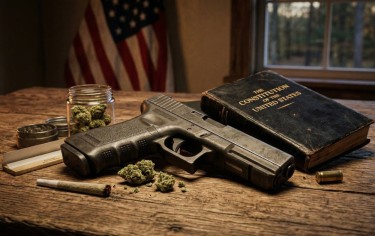
The case starts simply enough: a Texas man, a legally purchased handgun, some weed, and FBI agents who showed up looking for something else entirely.
What it became is one of the most consequential cannabis-related cases the Supreme Court has ever heard — sitting at the crossroads of the Second Amendment, federal drug law, and the legal fiction that cannabis users are inherently dangerous people who can't be trusted with firearms.
Arguments were heard on March 2, 2026. A decision is expected by late June. What happens between now and then — and what the ruling actually says when it lands — could reshape the legal reality for tens of millions of Americans who use cannabis and own, or want to own, a gun.
Let's break down what happened, what the law actually says, why even the Supreme Court's conservatives appear skeptical of it, and what you need to know about your exposure right now.
The Man, the Search, the Charges
Ali Danial Hemani is a Texas-born, University of Texas honor student and active member of his local religious community. In 2022, the FBI obtained a warrant to search his home — not for drugs, not for guns, but because agents believed he had ties to Iranian entities hostile to the United States. They found no evidence of that.
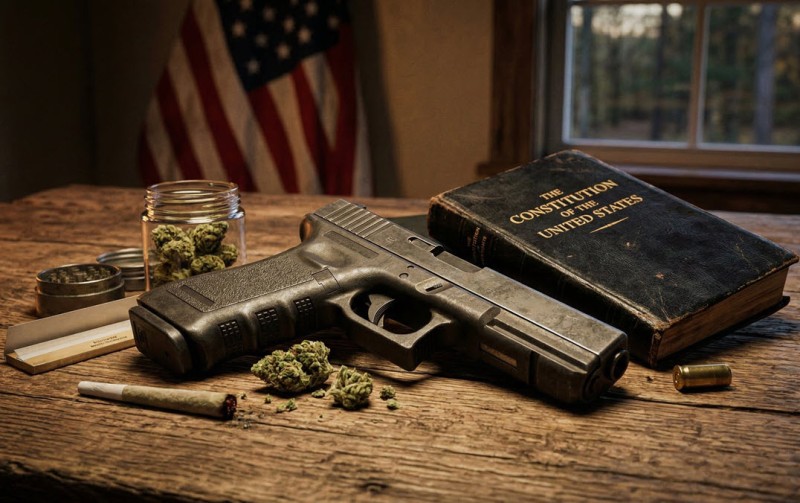
What they did find: a 9mm Glock pistol purchased legally, 60 grams of marijuana, and 4.7 grams of cocaine. Hemani told agents he smoked cannabis roughly every other day. The terrorism angle quietly disappeared. The drug charge did not.
A federal grand jury indicted Hemani under 18 U.S.C. § 922(g)(3) — a provision of the 1968 Gun Control Act that makes it a federal felony for anyone who is an 'unlawful user of or addicted to any controlled substance' to possess a firearm. Not while high. Not while threatening anyone. Just while existing as someone who uses cannabis and also happens to own a gun.
The potential sentence: up to fifteen years in federal prison.
Hemani's legal team moved to dismiss the indictment as unconstitutional. The district court agreed. The Fifth Circuit Court of Appeals agreed. The Department of Justice — under the Trump administration, which markets itself as the most pro-Second Amendment DOJ in history — appealed it to the Supreme Court.
Let that sit for a moment.
|
"The same law used to charge Hemani was used to convict Hunter Biden. The NRA and the ACLU filed briefs on the same side. This case breaks every political assumption you have." |
The Law — What 922(g)(3) Actually Says
Before getting into the constitutional arguments, you need to understand what this statute actually does — because it is broader and more casually devastating than most people realize.
18 U.S.C. § 922(g)(3) prohibits any person who 'is an unlawful user of or addicted to any controlled substance' from receiving or possessing firearms or ammunition. That prohibition applies federally, regardless of what your state law says. If you live in Colorado, California, or any of the 24 states with legal recreational cannabis, you are still an 'unlawful user' under federal law every time you consume.
The statute doesn't require you to be high when you have the gun. It doesn't require you to have ever acted dangerously. It doesn't require a court to find you posed a threat to anyone. It just requires that you use — and that use is enough to strip a constitutional right and expose you to felony prosecution.
There's a second problem the ACLU flagged directly: the statute is vague. What is an 'unlawful user'? Someone who smoked once at a party three months ago? Someone who takes a cannabis gummy twice a week as a sleep aid? Someone prescribed medical marijuana in a legal state? The law provides no threshold, no timeframe, no definition. That vagueness, the defense argued, gives federal prosecutors a blank check — and blank checks in criminal law have historically landed hardest on communities the government already wants to target.
|
YOUR CURRENT LEGAL REALITY — PRE-RULING If you use cannabis and own a firearm, you are technically violating federal law today regardless of your state's legal status. ATF Form 4473 — the federal background check form you sign at any licensed gun dealer — asks directly: 'Are you an unlawful user of, or addicted to, marijuana or any other depressant, stimulant, narcotic drug, or any other controlled substance?' Answering yes blocks the sale. Answering no while being a regular user is a federal false statement charge on top of the 922(g)(3) exposure. Until the Supreme Court rules, and depending on what that ruling says, this federal conflict remains live. |
The Bruen Test — Why History Is Killing the Government's Case
To understand why Hemani's legal argument has legs — and why a majority of the Supreme Court appeared sympathetic during oral arguments — you need to understand what the 2022 Bruen decision did to Second Amendment law.
Before Bruen, courts evaluated gun restrictions using a two-step test that weighed the government's interest against the burden on gun rights. It was a balancing act that generally gave legislatures a lot of room. Bruen threw that test out entirely.
Under Bruen, when a gun law covers conduct that the Second Amendment's text protects, the government must justify that restriction by showing it is 'consistent with the Nation's historical tradition of firearm regulation' going back to the founding era. Not consistent with modern public safety goals. Not consistent with what Congress thought was reasonable in 1968. Consistent with what the Founders understood the Second Amendment to permit.
That is a dramatically harder bar. And the government's best historical argument for disarming cannabis users is laws that allowed magistrates to disarm 'habitual drunkards' — vagrants who routinely acted dangerously and chaotically in public.
The Court dismantled that analogy in real time during oral arguments.
Justice Gorsuch noted that in the founding era, daily drinking was entirely normal — John Adams reportedly started each morning with a tankard of hard cider, James Madison had a daily pint of whiskey. The 'habitual drunkard' designation was reserved for people whose drinking made them unable to function or rendered them actively threatening to others. It was about demonstrated danger, not about the act of consuming alcohol.
Justice Barrett asked the government's attorney directly: 'What is the government's evidence that using marijuana a couple of times a week makes someone dangerous?' No clean answer came back.
Justice Jackson, from the liberal wing, went further: the government's argument, she said, was 'precisely what' Bruen's framework 'prohibits' — crediting the modern legislature's judgment about who is dangerous rather than grounding the restriction in historical tradition.
The deeper constitutional distinction the Court kept returning to is this: founding-era laws regulated behavior — carrying a firearm while actively intoxicated, which posed an immediate public danger. Section 922(g)(3) regulates status — being the kind of person who uses cannabis, whether or not you're intoxicated, whether or not you're anywhere near your firearm, whether or not you've ever done anything threatening. That is a fundamentally different legal architecture, and the historical record doesn't support it.
|
"John Adams took a tankard of hard cider with his breakfast every day. James Madison reportedly drank a pint of whiskey daily. Are they habitual drunkards who would be properly disarmed under your theory?" — Justice Gorsuch, to the government's attorney |
The Strange Bedfellows
One of the most telling signals of how badly the government's legal theory holds up is who lined up against it.
The NRA filed a brief supporting Hemani. So did the ACLU. So did NORML, the Drug Policy Alliance, the Cato Institute, and the New York State Rifle and Pistol Association. Gun rights organizations and civil liberties organizations who agree on almost nothing found common ground here: a law this vague, applied this broadly, with penalties this severe, is constitutionally indefensible.
On the other side: gun safety groups like Everytown for Gun Safety, which ordinarily opposes the Trump administration on Second Amendment issues, supported the DOJ's position. Their concern isn't the constitutional theory — it's operational. The three-day background check window at licensed gun dealers is already strained. A ruling that complicates the 'unlawful user' determination could slow or break the NICS background check system. That's a legitimate practical worry, even if it doesn't resolve the constitutional problem.
The fact that the gun lobby and the civil liberties lobby ended up on the same side tells you something important: this isn't really a guns argument. It's a 'who gets to be stripped of constitutional rights without individualized due process' argument. And on that question, the political coalitions that usually define these fights dissolved entirely.
What the Ruling Could Look Like — Three Scenarios
Based on oral argument signals, a complete vindication of Section 922(g)(3) — the government winning outright — appears unlikely. Beyond that, there are three realistic outcomes worth understanding.
SCENARIO ONE: Narrow ruling for Hemani, cannabis-specific.
The Court rules that 922(g)(3) cannot be constitutionally applied to cannabis users specifically — given cannabis's quasi-legal status across dozens of states, the lack of evidence that its use correlates with dangerous gun behavior, and the failure of the 'habitual drunkard' analogy to hold up. The statute remains intact for harder drugs. This is the most likely outcome based on what justices said during arguments.
What it means for you: federal prosecution of cannabis-only gun owners becomes substantially harder. The ATF Form 4473 question remains legally complicated. Background check procedures would likely need congressional clarification.
SCENARIO TWO: Broader ruling — the statute is unconstitutionally vague.
The Court strikes 922(g)(3) down on vagueness grounds rather than Second Amendment grounds — finding that the term 'unlawful user' provides insufficient notice of when criminal liability attaches. This would be a wider ruling with more immediate impact on prosecutions, and would force Congress to rewrite the statute with clearer definitions if it wants to maintain any version of this restriction.
What it means for you: immediate relief from prosecution under the current law. Congress would likely move to replace it with something narrower and more precisely defined, probably targeting active intoxication rather than status as a user.
SCENARIO THREE: Government wins, with modifications.
The Court upholds the statute but narrows its application, requiring prosecutors to demonstrate some individualized showing of dangerousness rather than just proving a person uses drugs. This is the worst-case outcome for cannabis users and the least likely based on the tenor of oral arguments — but Chief Justice Roberts' concern about administrative burden suggests he might prefer a version of this over a broader ruling that creates widespread case-by-case litigation.
What it means for you: the status quo largely holds, though prosecutions may require more specific factual showings. Legal exposure remains.
|
DECISION TIMELINE Oral arguments were heard March 2, 2026. The Supreme Court's current term ends in late June 2026. A ruling is expected before then. Watch for it — this will be a headline decision regardless of how it comes down. |
What to Watch For After the Ruling
The Hemani decision won't be the end of this fight. It will be the beginning of a new phase — and what to watch depends on which way the Court goes.
If Hemani wins: Congress will face immediate pressure to rewrite 922(g)(3). The question becomes whether any revised statute can pass the Bruen test — meaning it would need a clear founding-era historical analogue. Disarming people while actively intoxicated has historical support. Disarming them for their drug-use status does not. Any new law would need to thread that needle, and it's not obvious how.
The ATF Form 4473 will also need to be revised or reinterpreted. The question about controlled substance use has been a legal trap for cannabis users in legal states for years — a ruling for Hemani creates pressure on the ATF to update it, though federal bureaucracy moves slowly and cannabis remains Schedule I until or unless rescheduling is finalized.
If the government wins: expect continued prosecutorial discretion to be the de facto standard — meaning the law stays on the books, most people won't be charged under it in isolation, but it remains a tool that can be picked up against anyone the government wants to pressure. That's not legal protection. That's prosecutorial goodwill, which evaporates the moment priorities change.
The deeper issue that Hemani doesn't resolve regardless of outcome: the federal-state conflict at the heart of all of this. Millions of Americans legally use cannabis under state law. Federal law calls them criminals for doing so and, under the current statute, strips a constitutional right as a consequence. Until cannabis is descheduled or rescheduled in a way that removes it from the controlled substance framework entirely, that conflict persists — and Hemani, however it lands, is only one piece of the puzzle.
The Sticky Bottom Line
Ali Hemani smoked weed every other day, kept a legally purchased firearm locked in his home, and came within reach of a fifteen-year federal sentence for it. The FBI went looking for a terrorist, found a gun owner who used cannabis, and the Department of Justice decided that was worth taking to the Supreme Court.
The Court — both its liberal and conservative wings — appears to disagree. The historical record doesn't support treating a cannabis user as categorically more dangerous than anyone else. The Founders drank whiskey for breakfast and didn't consider that grounds for permanent disarmament. The analogy was always a stretch, and nine justices appeared to know it.
What this case makes visible is something the cannabis reform movement has been saying for decades: prohibition-era logic doesn't survive contact with actual scrutiny. When you drag the assumptions underlying these laws into the light of a real courtroom, before real jurists who have to ground their reasoning in actual history rather than drug war mythology, the foundation crumbles.
The decision lands by June. Until then, if you use cannabis and own a firearm, the federal conflict is real and your exposure exists regardless of your state's laws. That is the current legal reality — and it's worth knowing clearly, not euphemistically.
Watch this space. The ruling will matter.
SOURCES & REFERENCES
1. SCOTUSblog — 'Supreme Court skeptical of law banning drug users from possessing firearms' (Mar 2026): Oral argument coverage, Justice quotes
2. Slate — 'Marijuana and guns: The Supreme Court seems to think cannabis users can bear arms' (Mar 2026): In-person oral argument analysis
3. ACLU — 'Supreme Court Weighs Felony Conviction for Gun Owner Who Uses Marijuana': Constitutional arguments, vagueness challenge
4. Mandelbaum Barrett PC — 'Guns, Cannabis, and the Constitution: SCOTUS to Hear United States v. Hemani' (Nov 2025): Case background and implications
5. Rockefeller Institute of Government — 'Guns, Ganja, and Gavels' (Mar 2026): Five things to watch, Bruen test analysis
6. Constitution Center — 'Supreme Court to consider legality of gun bans for marijuana users': Bruen/Rahimi framework, case timeline
7. NPR — 'Supreme Court ponders law making it a crime for marijuana users to own guns' (Mar 2026): Background check system concerns, Hemani background
8. NBC News — 'Supreme Court leans toward marijuana user's challenge to gun restriction' (Mar 2026): Ruling scenarios, Roberts concerns
9. Gun Owners of America — 'Supreme Court Takes Up Guns/Marijuana': Political analysis, DOJ strategy critique
10. PBS NewsHour — 'Supreme Court considers whether marijuana and other drug users may possess firearms' (Mar 2026): Cross-ideological brief alliances
11. New York State Rifle & Pistol Assn. v. Bruen, 142 S. Ct. 2111 (2022): Foundational Second Amendment historical test
12. 18 U.S.C. § 922(g)(3), Gun Control Act of 1968: Statute at issue
GUNS AND MEDICAL MARIJUANA PATIENTS, READ ON...