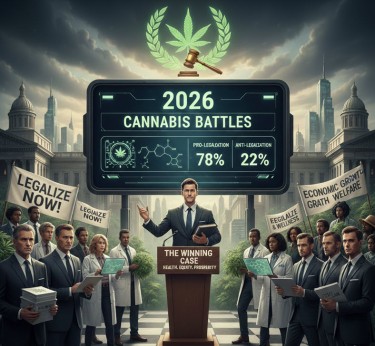

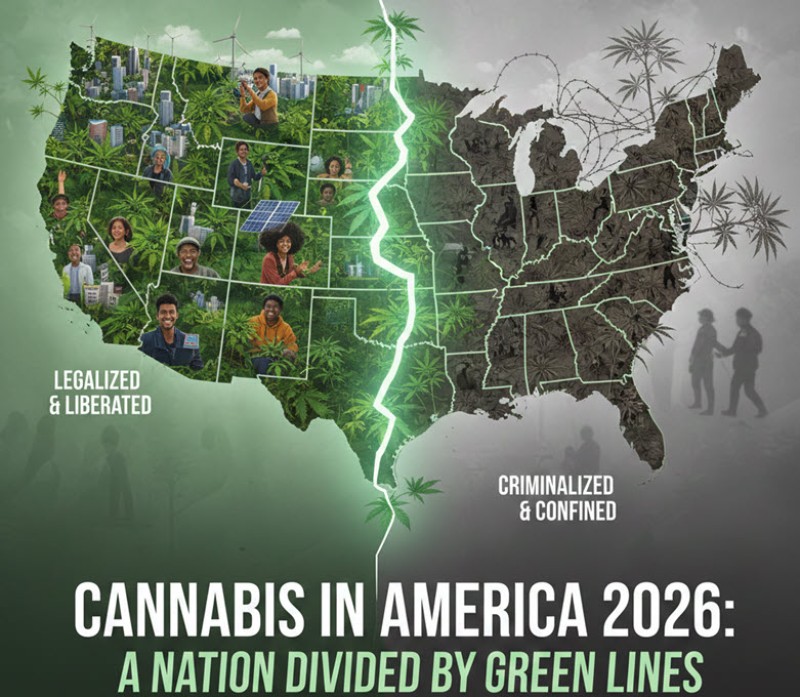
Alright folks, let's cut through the bullshit and talk about where we really stand with cannabis legalization in 2026. And spoiler alert: it's a mess of contradictions that would make Kafka weep.
Here's the reality—we've got states where you can walk into a dispensary, buy an ounce of premium flower, and legally grow a small garden in your backyard. Then, literally a few hundred miles away, you've got states where possessing a joint can still land you in handcuffs. This isn't just policy divergence; it's a full-blown schizophrenic approach to a plant that humans have been cultivating for thousands of years.
And before you think this is just another "blue state vs red state" rant, hold up. The data tells a different story—one where public support for legalization regularly hits 70-80% even in the most conservative states, yet their legislatures act like it's still 1937 and Harry Anslinger is whispering prohibition propaganda in their ears.
The Federal Tease: Schedule III and the Pharma Power Play
December 18, 2025. That's when Biden dropped an executive order to expedite the rescheduling of cannabis to Schedule III. Sounds great, right? Finally, the feds acknowledge that cannabis isn't heroin!
But here's the kicker—Schedule III doesn't legalize jack shit at the federal level. What it does do is lift the 280E tax burden from state-legal businesses, which means dispensaries can finally write off business expenses like normal companies. That's good for the industry's bottom line, but it doesn't change the fundamental reality: cannabis regulation remains in the hands of individual states, and those hands are all over the map.
More importantly, Schedule III is basically Big Pharma's wet dream. It positions cannabis-derived medications for FDA approval pathways while keeping the plant itself tightly controlled. You know who wins in that scenario? Not the small craft growers. Not the home cultivators. Not the patients who've been self-medicating for years. It's the pharmaceutical corporations who can afford the multi-million-dollar FDA approval process.
I've said it before and I'll say it again: Schedule III is prohibition with a friendlier face. Complete descheduling—removing cannabis from the Controlled Substances Act entirely—is the only real solution. But I digress. Let's look at what's actually happening on the ground.
The Northeast: When Mature Markets Meet Reactionary Backlash
Massachusetts: The Repeal That Shouldn't Exist
Massachusetts legalized recreational cannabis back in 2016, and sales have been humming along since 2018. You'd think after eight years of generating billions in tax revenue, declining youth usage rates, and a functional regulated market, the debate would be over.
Nope.
There's a ballot initiative heading to voters in November 2026 that would repeal adult-use sales entirely. Let me repeat that: a state with a mature, successful cannabis market is being asked to vote on whether to shut the whole thing down.
This is what happens when prohibitionist groups realize they can't win in legislatures anymore—they go straight to the ballot box, banking on confusion and fear to override common sense. And they only need to convince 51% of voters once to undo years of progress.
The good news? Massachusetts also passed H. 4206 in 2025, which increased personal possession limits to two ounces and created regulations for hemp-derived beverages and cannabis cafes. So while one hand is building out the infrastructure for social consumption, the other is trying to burn the whole house down.
The Massachusetts Reality Check:
-
Legal Status: Adult-use and medical since 2016/2012
-
Home Grow: Yes—6 plants per person, 12 per household
-
Medical Conditions: Cancer, Glaucoma, HIV/AIDS, Hepatitis C, ALS, Crohn's, Parkinson's, MS, and others determined by a physician
-
2026 Threat Level: HIGH—Repeal initiative on November ballot
-
Public Support: Strong majority, though exact 2026 polling isn't available
New York: Social Equity Dreams vs. Bodega Reality
New York's cannabis rollout has been... let's call it "chaotic." The state passed the Marijuana Regulation and Taxation Act (MRTA) in March 2021 with big promises about social equity and righting the wrongs of prohibition. First legal sales didn't happen until December 2022.
Fast forward to 2026, and the state is still trying to clean up the mess. There are more unlicensed "bodega shops" selling untested products than licensed dispensaries. The CAURD (Conditional Adult-Use Retail Dispensary) program, designed to fast-track licenses for people harmed by the War on Drugs, has been plagued by delays and funding issues.
In March 2025, the state launched a $5 million grant program to help equity retailers actually get their businesses off the ground. Five million dollars. For the entire state of New York. That's not a program; that's a gesture.
Meanwhile, the legislature successfully defeated a proposal in May 2025 that would have made the smell of cannabis probable cause for police searches again. Small victories.
The New York Reality Check:
-
Legal Status: Adult-use and medical since 2021/2014
-
Home Grow: Yes—3 mature and 3 immature per person, 6 mature and 6 immature per household
-
Medical Conditions: Provider discretion since January 2022—doctors can recommend for any condition
-
Current Challenges: Illicit market dominance, slow equity licensing
-
Public Support: Majority support, though frustration with implementation is real
Maine: The Libertarian Cannabis Paradise
If you want to understand what cannabis freedom actually looks like, look at Maine. This state has consistently maintained one of the most permissive approaches in the country.
You can grow 3 mature plants, 12 immature plants, and unlimited seedlings. Read that again. Unlimited. Seedlings. That means you can maintain a perpetual harvest cycle—as soon as you harvest your mature plants, you've got the next generation ready to move up.
And for medical? Provider discretion. No list of approved conditions. If your doctor thinks cannabis will help you, you get a card. End of story.
Sure, there's a fringe movement trying to put a "Criminalize Recreational Marijuana" initiative on the 2026 ballot, but in a state where cannabis is deeply integrated into the agricultural economy, that effort is about as likely to succeed as trying to ban lobster.
The Maine Reality Check:
-
Legal Status: Adult-use and medical since 2016/1999
-
Home Grow: Yes—3 mature, 12 immature, unlimited seedlings
-
Medical Conditions: Provider discretion (no specific list since 2018)
-
2026 Threat Level: LOW—Prohibitionist initiative unlikely to gain traction
-
Public Support: Consistently high; cannabis is part of state identity
The Mid-Atlantic and South: Where Democracy Goes to Die
Virginia: Legal to Possess, Illegal to Buy
Virginia represents one of the most bizarre cannabis situations in America. Since July 1, 2021, adults have been allowed to possess cannabis and grow up to 4 plants per household.
But here's the catch: there's no legal way to buy it.
Governor Glenn Youngkin has vetoed retail market legislation in both 2024 and 2025. So Virginians can legally smoke weed and legally grow it, but if they want to acquire it, they either need to grow it themselves, have a generous friend, or hit up the unregulated illicit market.
A new adult-use sales bill was introduced on January 20, 2026, following the November 2025 elections. Whether it passes depends entirely on whether the legislature can override another Youngkin veto or if the political landscape shifts enough to actually implement the retail framework that voters authorized five years ago.
The Virginia Reality Check:
-
Legal Status: Adult-use possession/cultivation (NO SALES) and medical since 2021
-
Home Grow: Yes—4 plants per household
-
Medical Conditions: Provider discretion
-
Current Bill: Adult-use sales bill filed January 20, 2026
-
Public Support: Majority support for retail market establishment
North Carolina: 71% Support, Zero Progress
Let me hit you with a number: 71% of North Carolinians support legalizing medical marijuana according to a February 2025 Meredith Poll. Seventy. One. Percent.
The state Senate has repeatedly passed the Compassionate Care Act. It's cleared the Senate multiple times. But it dies in the House every single session because House leadership refuses to allow a vote.
This is what regulatory capture looks like, folks. When three-quarters of your constituents want something and you won't even let them vote on it, you're not representing the people—you're representing someone else's interests.
The North Carolina Reality Check:
-
Legal Status: Prohibited (decriminalized since 1977)
-
Home Grow: Not allowed
-
Medical Conditions: Currently limited to low-THC/CBD for epilepsy
-
Current Bill: Compassionate Care Act passed Senate, stalled in House
-
Public Support: 71% for medical, 63% for general legalization
Florida: The 60% Curse
Florida is a perfect example of how ballot initiative requirements can subvert majority will. In November 2024, 56% of Florida voters supported Amendment 3, which would have legalized adult-use cannabis.
Amendment 3 failed.
Why? Because Florida requires a 60% supermajority for constitutional amendments. So even though a clear majority of voters said yes, prohibition won.
Now there's a new campaign—Smart and Safe Florida—collecting signatures for a 2026 ballot initiative, hoping to clear that 60% bar this time. Meanwhile, SB 1398, a legislative attempt at legalization, is pending in the 2026 session, though anyone familiar with Florida politics knows the chances of the legislature acting are somewhere between "slim" and "Governor DeSantis will personally roll a joint at a press conference."
Oh, and speaking of restrictions: in 2025, Florida passed S2514, which mandates that medical patients be removed from the registry if they're caught cultivating cannabis. That's right—if you're a medical patient and you grow a single plant, you lose your card. Zero tolerance, maximum cruelty.
The Florida Reality Check:
-
Legal Status: Medical only since 2016
-
Home Grow: Not allowed—patients removed from registry if caught growing
-
Medical Conditions: Cancer, Epilepsy, Glaucoma, HIV/AIDS, PTSD, ALS, Crohn's, Parkinson's, MS, terminal conditions
-
Current Bills: SB 1398 (legislative legalization), Smart and Safe Florida (2026 ballot initiative in signature phase)
-
Public Support: 56% voted yes in 2024; supermajority requirement remains barrier
Texas: 79% Want It, Legislature Says No
Texas. Where everything is bigger, including the gap between what voters want and what they get.
79% of Texans support expanding medical cannabis access according to January 2025 polling. And 62% support full adult-use legalization. These aren't fringe numbers. This is a near-consensus.
And yet, Texas maintains one of the most restrictive "medical" programs in the country. For years, it was limited to low-THC products for a handful of conditions. The 2025 expansion added chronic pain to the qualifying conditions and removed the THC cap, but you still can't grow your own, and the list of conditions remains gatekept.
Meanwhile, the unregulated hemp market—Delta-8, Delta-9, THC-O, all the loopholes—has exploded. In September 2025, Governor Abbott issued Executive Order GA56 mandating age restrictions for hemp products after the legislature failed to pass a regulatory bill.
Let that sink in. The legislature couldn't even agree on how to regulate the cannabis market that already exists, so the governor had to step in with an executive order just to keep kids from buying Delta-8 gummies at gas stations.
And here's the real kicker: the State Attorney General is actively suing cities like Dallas and Austin to overturn local decriminalization ordinances passed by voters. The Dallas Freedom Act? Voter-approved. Austin's decrim policies? Voter-approved. State AG's response? Lawsuits to kill them.
The Texas Reality Check:
-
Legal Status: Low-THC medical (expanded 2025)
-
Home Grow: Not allowed
-
Medical Conditions: Epilepsy, seizure disorders, MS, spasticity, ALS, autism, terminal cancer, chronic pain (added 2025)
-
Current Bills: HB 3242 (decriminalization) failed to get hearing; GA56 executive order on hemp regulation
-
Legal Warfare: State AG suing Dallas and Austin over voter-approved decriminalization
-
Public Support: 79% for medical expansion, 62% for adult-use
The Midwest: The Green Belt and the Stubborn Holdouts
Ohio: Legalization, Then Recriminalization
Ohio voters approved Issue 2 in November 2023 with 57% support, legalizing adult-use cannabis. Sales started in August 2024. Everything seemed fine.
Then the legislature decided to "fix" what voters approved.
Enter SB 56, passed in late 2025. This bill:
-
Re-introduced criminal penalties for "importation" (e.g., driving back from Michigan with your personal stash)
-
Severely restricted public use
-
Removed employment protections for cannabis users
Essentially, the legislature took a voter-approved legalization initiative and clawed back as many freedoms as they could without technically repealing it.
The good news? A group called Ohioans for Cannabis Choice is collecting signatures right now to place a referendum on the November 2026 ballot to overturn SB 56 and restore the original intent of Issue 2.
This is the new battlefield, folks. Legalization isn't a one-time victory—it's an ongoing fight against legislators who think they know better than voters.
The Ohio Reality Check:
-
Legal Status: Adult-use and medical since 2023/2016
-
Home Grow: Yes—6 plants per person, 12 per household
-
Medical Conditions: AIDS, ALS, Alzheimer's, Cancer, CTE, Crohn's, Epilepsy, Fibromyalgia, Glaucoma, Hepatitis C, IBD, MS, Parkinson's, HIV, PTSD, Sickle Cell, Spasticity, TBI, Ulcerative Colitis
-
Current Battle: SB 56 recriminalization law passed; referendum campaign for November 2026 underway
-
Public Support: 57% approved Issue 2
Wisconsin: 67% Support, Zero Action
Wisconsin is surrounded by legal states. Michigan to the east. Illinois to the south. Minnesota to the west. Hell, even if you drive north long enough, you'll hit Canada where it's federally legal.
And yet, Wisconsin has no functional cannabis program. Not even a real medical program. Just CBD.
The latest polling from June 2025? 67% of Wisconsin voters believe marijuana should be legal.
But legislative proposals keep stalling because state lawmakers can't agree on whether the distribution model should be state-run (like liquor stores) or private. So while they debate the finer points of bureaucratic structure, billions in tax dollars flow across state lines to Michigan, Illinois, and Minnesota.
The Wisconsin Reality Check:
-
Legal Status: Prohibited (CBD only)
-
Home Grow: Not allowed
-
Current Bills: Proposals stalled over distribution model debate
-
Public Support: 67% believe marijuana should be legal
Michigan: The Midwest Weed Capital
Michigan is what happens when you get legalization right—mostly. Medical since 2008, adult-use since 2018, and home grow rights for up to 12 plants per household. No distinction between mature and immature. Just 12 plants total, do what you want.
The state has generated billions in tax revenue and serves as the cannabis supplier for much of the Midwest due to competitive pricing and high quality.
But in late 2025, the legislature passed HB 4951, imposing a 24% wholesale tax on top of existing retail taxes, effective January 1, 2026. The industry is currently challenging this in court, arguing—correctly—that jacking up taxes will just revive the illicit market that legalization was supposed to eliminate.
The Michigan Reality Check:
-
Legal Status: Adult-use and medical since 2018/2008
-
Home Grow: Yes—12 plants per household
-
Medical Conditions: Cancer, Glaucoma, HIV/AIDS, Hepatitis C, ALS, Crohn's, PTSD, OCD, Arthritis, Spinal Cord Injury, Parkinson's, Autism, Chronic Pain, Cerebral Palsy
-
Current Battle: HB 4951 (24% wholesale tax) being challenged in court
-
Public Support: Strong, though price sensitivity is high
Kansas: 70% Want Medical, Zero Delivery
Kansas is one of only three states with no legal cannabis program whatsoever. Not medical. Not decriminalized. Nothing.
And yet, 70% of Kansans support medical legalization according to October 2025 polling.
HB 2405, an adult-use legalization bill, has stalled. Medical proposals have stalled. Everything stalls because the legislature simply refuses to act, despite the overwhelming public mandate.
This is what happens when elected officials decide they know better than 70% of their constituents.
The Kansas Reality Check:
-
Legal Status: Prohibited
-
Home Grow: Not allowed
-
Current Bills: HB 2405 (adult-use) stalled
-
Public Support: 70% for medical legalization
Indiana: 59% Say Yes, Legislature Says Maybe
Indiana is feeling the pressure. Ohio just legalized. Michigan's been legal for years. Illinois is right there. The state is hemorrhaging tax revenue across every border.
And 59% of Hoosiers support adult-use legalization according to the January 2026 Bowen Center survey.
SB 0286 was introduced in the 2026 session to legalize and regulate both adult-use and medical cannabis. Historically, this would be DOA. But with Ohio's new market siphoning off Indiana customers, the economic calculus has changed.
Will it pass? Who knows. But at least it's being discussed, which is more than can be said for Kansas.
The Indiana Reality Check:
-
Legal Status: Prohibited (CBD only)
-
Home Grow: Not allowed
-
Current Bills: SB 0286 (adult-use and medical legalization)
-
Public Support: 59% for adult-use legalization
The West: Mature Markets Under Siege
Arizona: The Repeal That Could Kill a Thriving Market
Arizona legalized adult-use cannabis in November 2020 via Prop 207. The market has been a massive success, generating over $250 million in taxes in 2024 alone.
And now, just like Massachusetts, there's a repeal effort.
The "Sensible Marijuana Policy Act of Arizona" campaign is collecting signatures for the November 2026 ballot. If it succeeds and passes, it would repeal the commercial sale provisions of Prop 207—effectively shutting down all dispensaries while leaving personal possession legal.
So you'd be allowed to have weed, but you couldn't legally buy it anywhere. Sound familiar? (Looking at you, Virginia.)
They need about 256,000 signatures by July 2026. The economic argument against this repeal is strong—$250 million in annual tax revenue is nothing to sneeze at—but never underestimate the power of a well-funded prohibition campaign to muddy the waters.
The Arizona Reality Check:
-
Legal Status: Adult-use and medical since 2020/2010
-
Home Grow: Yes—6 plants per person, 12 per household
-
Medical Conditions: Cancer, Glaucoma, HIV/AIDS, Hepatitis C, ALS, Crohn's, PTSD, Cachexia, Chronic Pain, Severe Nausea, Seizures, Muscle Spasms
-
2026 Threat Level: MODERATE—Repeal initiative in signature-gathering phase
-
Public Support: Strong enough to generate $250 million in taxes
Colorado: Potency Caps and the Nanny State
Colorado was first. First to open retail stores on January 1, 2014. First to show the world that the sky wouldn't fall if you let adults buy cannabis.
Now, twelve years later, the state is dealing with "second-order problems"—namely, SB 25-076, a pending bill that would ban high-THC products (above 10%) for adults aged 21-24.
Let that sink in. You'd be old enough to vote, serve in the military, and buy a rifle, but not old enough to purchase a cannabis product stronger than 10% THC.
This is prohibition creep, folks. It starts with "protecting the youth" and ends with arbitrary limits on adult freedom based on junk science and moral panic.
The industry is fighting this hard, and they should. Once you open the door to potency caps, you open the door to endless regulation creep.
The Colorado Reality Check:
-
Legal Status: Adult-use and medical since 2012/2000
-
Home Grow: Yes—6 plants (max 3 mature) per adult, 12 per household
-
Medical Conditions: Standard list (not specified in source document)
-
Current Battle: SB 25-076 (potency cap for 21-24 age group)
-
Public Support: Strong and stable; over $2.6 billion in lifetime tax revenue
Washington: The State That Criminalized Recreational Home Grow
Washington legalized recreational cannabis the same day as Colorado—November 2012. But while Colorado embraced home cultivation, Washington went the opposite direction.
In Washington, recreational home grow is a Class C Felony. That's right—if you're a recreational user and you grow a single plant for personal use, you're committing a felony.
Medical patients can grow 6-15 plants with proper authorization. But if you're just an adult who wants to cultivate your own? Criminal.
Washington is the only adult-use state that maintains felony penalties for recreational home cultivation. This makes zero sense from a harm reduction perspective, zero sense from a personal freedom perspective, and zero sense from any rational policy perspective.
Finally, there's a campaign pushing legislation in the 2026 session to change this—"Time to bring home grow to Washington." Let's hope common sense prevails.
The Washington Reality Check:
-
Legal Status: Adult-use and medical since 2012/1998
-
Home Grow: Medical only (6-15 plants); Recreational grow is a Class C Felony
-
Medical Conditions: Standard list (not specified in source document)
-
Current Campaign: Home grow legalization effort for 2026 session
-
Public Support: High support for the market; home grow ban increasingly viewed as outdated
Idaho: 83% Want Medical, Legislature Wants a Constitutional Ban
Idaho represents the absolute worst-case scenario of democracy being subverted by ideological zealots.
83% of Idaho voters support medical marijuana legalization according to December 2025 polling. Eighty. Three. Percent.
And what's on the 2026 ballot? HJR 4, a constitutional amendment to permanently prohibit the legalization of psychoactive substances.
Read that again. While 83% of voters want medical access, the legislature is trying to enshrine prohibition into the state constitution forever.
There's also a competing 2026 initiative to legalize medical marijuana, so Idaho voters will face a choice: permanent constitutional prohibition, or medical access aligned with overwhelming public will.
If HJR 4 passes, Idaho will become a permanent prohibition island in a sea of legal states, and changing it would require another constitutional amendment—a vastly more difficult process than passing regular legislation.
The Idaho Reality Check:
-
Legal Status: Prohibited
-
Home Grow: Not allowed
-
2026 Ballot Fight: HJR 4 (constitutional ban) vs. medical marijuana initiative
-
Public Support: 83% for medical legalization
The Home Grow Divide: Who Trusts You, Who Doesn't
One of the most telling metrics for understanding a state's approach to cannabis is whether they allow home cultivation—and if so, how many plants.
Some states treat adults like adults:
-
Maine: 3 mature, 12 immature, unlimited seedlings
-
Michigan: 12 plants per household, no distinction
-
Alaska: 6 plants per person (3 mature), 12 per household
Others maintain some restrictions but still recognize the right:
-
Colorado, Arizona, Ohio, New York: Various limits, generally 6-12 plants per household
Then you've got the states that legalize commercial sales but prohibit home grow entirely:
-
Delaware: No home grow for recreational or medical
-
New Jersey: No home grow (though this varies by interpretation)
-
Washington: Recreational home grow is a felony
And finally, the states that allow medical home grow but ban recreational cultivation:
-
Illinois: Medical patients can grow 5 plants; recreational is a civil violation
-
Hawaii: Medical patients can grow 10 plants; no recreational program
The logic behind banning home cultivation in a legal market is transparently about maintaining corporate control and tax revenue. If people can grow their own, they might not buy from dispensaries. If they don't buy from dispensaries, the state doesn't collect excise taxes, and cannabis corporations don't make as much profit.
But here's the thing: people brew their own beer. They grow their own tomatoes. They roast their own coffee beans. And somehow, Anheuser-Busch and Starbucks survive.
The home grow ban is prohibition with a corporate face.
The Medical Shift: Lists Are Dying, Discretion Is Winning
Another major trend in 2026 is the abandonment of restrictive "qualifying condition lists" in favor of provider discretion.
States leading this shift:
-
Maine: Provider discretion since 2018
-
New York: Provider discretion since January 2022
-
Virginia: Provider discretion
-
Delaware: Recently removed specific list
What this means in practice: if you have a doctor willing to recommend cannabis for any diagnosed condition, you can access the medical program. No more arbitrary lists where fibromyalgia qualifies but migraines don't. No more bureaucratic gatekeeping.
This is how it should work. Doctors are licensed professionals trained to evaluate medical need. If they believe cannabis will help a patient, they should be able to recommend it—full stop.
Meanwhile, states maintaining strict condition lists often do so to limit program size and maintain control:
-
Florida: Specific list, no home grow, patients removed from registry if caught growing
-
Alabama: Restrictive list, no home grow, dispensaries not yet open
-
Texas: Ultra-restrictive list despite 79% support for expansion
The pattern is clear: states that trust medical professionals create accessible programs. States that don't create barriers disguised as "safety measures."
The Democratic Deficit: When 70% Isn't Enough
Let's talk about the elephant in the room: the massive gap between public support and policy outcomes.
States where support exceeds 70%, yet prohibition remains:
-
Idaho: 83% support medical, constitutional ban on ballot
-
Texas: 79% support medical expansion, one of the most restrictive programs in the country
-
Utah: 77% support current medical law, yet legislature has repeatedly tried to gut it
-
North Carolina: 71% support medical, Senate passes bill repeatedly, House kills it every time
-
Kansas: 70% support medical, zero legal program
This isn't democracy. This is regulatory capture, ideological obstinacy, and corporate influence overriding the clear will of the people.
When four out of five citizens want something and their elected representatives refuse to even allow a vote, the system is broken.
The Sticky Bottom Line
So here we are in 2026. Cannabis is legal for medical or adult use in the majority of states. Public support consistently exceeds 60-70% even in conservative regions. We have over a decade of data from states like Colorado and Washington showing that legalization doesn't cause the sky to fall.
And yet, we're fighting ballot repeal efforts in Massachusetts and Arizona. We're watching Ohio's legislature claw back voter-approved rights. We're seeing states like Idaho try to enshrine prohibition into their constitutions despite 83% public support for medical access.
The federal rescheduling to Schedule III is a half-measure that benefits pharmaceutical corporations more than patients or small businesses. True reform requires complete descheduling—removing cannabis from the Controlled Substances Act entirely and treating it like the plant it is.
Until that happens, we'll continue to have this absurd patchwork where you can be a legal cultivator in Maine and a felon in Idaho for the exact same activity. Where 79% of Texans want expanded access but get lawsuits against local decriminalization instead. Where voters approve legalization and legislatures immediately work to undermine it.
The fight for cannabis freedom isn't over. In many ways, it's just beginning. The prohibitionists have lost the public debate, so now they're retreating to legislative gridlock, ballot tricks, and constitutional amendments.
Stay vigilant. Stay informed. And for fuck's sake, if your state has a ballot measure in 2026—whether it's a repeal attempt or a legalization initiative—vote. Because as we've seen, your voice matters, even when your legislature pretends it doesn't.
Now, if you'll excuse me, I need to go water my legally cultivated plants here in my legally permissive state, while contemplating the absurdity of a nation that claims to value freedom while criminalizing a plant.
Stay lifted, stay informed, and keep fighting the good fight.
CANNABIS IN 2026, READ ON...