
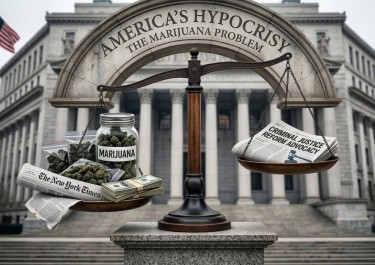
By Reginald Reefer | March 2026
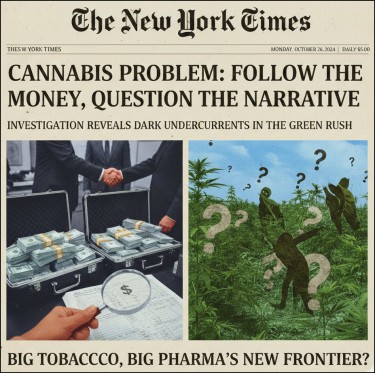
On February 9th, 2026, the New York Times editorial board published a piece titled "It's Time for America to Admit That It Has a Marijuana Problem." I read it. I read it again. I sat with my coffee and I thought: after fifty years of calling cannabis a dangerous drug, after helping architect the moral panic that sent millions of people to prison for a plant, after cheerleading a drug war that killed tens of thousands and enriched criminal organizations across two continents — the Times has decided the problem with marijuana is that people are using too much of it.
The audacity is almost artistic.
Let me be precise about what I am and am not arguing here. The Times is not entirely wrong. Dr. Timmen Cermak — whose work informed the piece — raises legitimate concerns. Eighteen million Americans using cannabis near-daily is a real number. A 20% reduction in cannabinoid receptors in the frontal lobes from chronic heavy use is a real finding. Cannabis hyperemesis syndrome affecting 2.8 million people is a real condition. These things are worth discussing. Education about moderation, as both the Times and Cermak correctly argue, is essential — and has been criminally absent from every drug policy conversation the United States has had since Harry Anslinger invented marijuana hysteria in 1937.
But here is what the Times piece does not do, cannot do, and will never do as long as the editorial board is constituted the way it is: apply the same analytical framework to alcohol and tobacco that it applies to cannabis. And until it does, everything it says about marijuana is not public health journalism. It is selective outrage dressed in the language of concern.
So let's do the comparison the Times refused to make. Let's put the numbers on the table and let them speak.
The Scoreboard Nobody Wants to Post
I want you to look at the following figures carefully. These are not from cannabis advocacy organizations. They are from the CDC, the NIH, the Surgeon General's office, and peer-reviewed epidemiology published in MMWR and PLOS Global Public Health. These are the establishment's own numbers, used against the establishment's own argument.
178,000 annual deaths from excessive alcohol use (CDC, 2020-2021)
480,000+ annual deaths from tobacco and secondhand smoke (CDC/Surgeon General 2024)
0 annual deaths directly attributable to cannabis (no established causal mortality)
Let that third number sit with you for a moment. Not zero as in "not very many." Zero as in: cannabis does not have an established causal mortality figure because there is no documented mechanism by which cannabis consumption directly kills a human being. You cannot fatally overdose on THC. There is no cannabis-induced liver disease. There is no cannabis-related cardiovascular fatality profile comparable to alcohol or tobacco.
The Times is worried about 18 million near-daily cannabis users and their frontal lobe receptor density. Meanwhile, tobacco is killing nearly half a million Americans per year — one in every five deaths in the United States. Every single year. The Surgeon General's 2024 report called it, with the quiet understatement of institutional documentation, the leading cause of preventable death in the country. Alcohol is generating 178,000 deaths annually from excessive use, a figure that rose 29% in just five years between 2016 and 2021. And alcohol-induced deaths among Americans aged 25-34 have increased by 188% among men and a staggering 255% among women since 1999.
"Cannabis: 0 established causal deaths annually. Tobacco: 480,000. Alcohol: 178,000. The New York Times is concerned about cannabis. This is what selective outrage looks like when it has a PR budget."
These are not abstractions. These are bodies. And the body count for the two substances the United States has chosen to fully legalize, aggressively market, and in tobacco's case actively subsidize with federal farm support — is not a rounding error compared to cannabis. It is a different category of harm entirely.
The Potency Problem: Hard Liquor and the Tequila Theory
The Times' most defensible recommendation is capping THC concentration — the argument being that 90% THC vape pens represent a different risk profile than the 3% joints of previous generations. This is a fair point. High-potency extracts, consumed without education or understanding of dose, create conditions for the kind of psychosis and paranoia events that are showing up more frequently in emergency room data.
But let's apply that logic consistently, because intellectual honesty demands it.
There is a direct, well-documented, empirically undeniable correlation between alcohol potency and violence. The research on this is not subtle. High-ABV spirits produce intoxication faster, at lower volumes, with less time for the liver to metabolize, which means blood alcohol levels spike more sharply and the behavioral disinhibition effects — the ones that make a certain percentage of people decide that a parking dispute requires a physical resolution — arrive before any natural governor can engage.
Ask any emergency room nurse which substance is more reliably associated with the patients who arrive bleeding. Ask any domestic violence researcher which substance appears most consistently in intimate partner violence cases — a 2022 analysis found alcohol present in between 25% and 50% of domestic violence incidents nationally. Ask any bar owner in any city in America whether they've had more trouble with the beer crowd or the tequila crowd on a Saturday night at last call.
And yet. There is no serious political movement to cap the alcohol by volume of spirits sold in the United States. There is no federal task force convening to ask whether the availability of 120-proof bourbon represents a public health crisis. There is no editorial board at the New York Times publishing pieces titled "It's Time for America to Admit It Has a Hard Liquor Problem."
The same potency logic that makes a 90% THC vape pen a legitimate policy concern makes a bottle of Everclear a legitimate policy concern. The only difference is which industry has a better lobbying infrastructure and which consumer base has historically been treated as respectable.
The Tobacco Subsidy: America's Most Spectacular Act of Self-Destruction
Tobacco deserves its own chapter because it represents the single most coherent evidence against the proposition that U.S. drug policy is driven by public health concerns.
Tobacco kills more than 480,000 Americans every year. It is, as the Surgeon General noted, the cause of approximately one in five deaths in the United States. It costs the country over $600 billion annually — $240 billion in healthcare spending and $372 billion in lost productivity. It shortens the lives of people who smoke by approximately a decade. It kills nonsmokers through secondhand exposure. It causes lung cancer, cardiovascular disease, stroke, COPD, and a catalogue of other conditions that fill oncology wards and cardiac ICUs across the country.
And the federal government subsidizes the industry that produces it.
The tobacco program — the system of federal price supports, crop insurance subsidies, and market protections that has supported tobacco farming in the United States for decades — represents the government simultaneously funding the CDC's anti-smoking campaigns with one hand and writing checks to the industry those campaigns target with the other. This is not a metaphor. This is the literal budget allocation.
"The federal government funds anti-tobacco campaigns with one hand and subsidizes tobacco farming with the other. This is not policy incoherence. This is a system working exactly as its investors designed it to."
If you believe that the United States is primarily a nation governed by laws and public health principles, this is incomprehensible. If you believe that it is primarily a large commercial enterprise managed by investment groups whose political representatives maintain policies that serve their portfolios — it makes perfect sense. Tobacco has been an agricultural and financial pillar of the American economy since the colonial period. The addiction infrastructure that sustains the industry has been methodically built and protected over generations. The health consequences are externalized onto the public, the healthcare system, and ultimately the dead. The profits are internalized by shareholders.
Cannabis, by contrast, grew its modern industry from underground, without federal protection, without agricultural subsidies, without the established political infrastructure that tobacco built over a century. It is threatening to become a competitor to pharmaceutical, alcohol, and tobacco interests simultaneously — and it arrives at exactly the moment when the Times decides America has a marijuana problem.
The timing is not coincidental.
What We Actually Need: Education Without Hypocrisy
Here is what I will concede, because intellectual honesty works both ways: the critics of heavy cannabis use are not entirely wrong, and the cannabis industry has not been innocent in the race to maximize potency at the expense of consumer safety.
The 90% THC vape pen is the cannabis industry's equivalent of Everclear. It is a product engineered to deliver maximum intoxication at maximum speed, marketed without adequate consumer education about dosage or risk. The hyperemesis syndrome cases — 2.8 million Americans experiencing severe, cyclical vomiting from cannabinoid overexposure — are real and they are underreported. The reduction in executive function from chronic near-daily heavy use is real, even if the long-term permanence of that effect remains a subject of ongoing research.
These are the conversations that a mature cannabis policy framework should be having. Not in the language of prohibition, not with the Anslinger-era moral panic that the Times piece occasionally slides toward despite its pro-legalization framing, but in the language of actual public health: here is what the evidence shows, here is what the risk is, here is how to use this substance in ways that serve your interests rather than damage them.
Cermak is right that education is the most powerful intervention available. The anti-tobacco campaigns worked — not perfectly, not immediately, but over time, the combination of honest graphic information, warning labels, and restriction on advertising to minors moved the needle in ways that criminalization never did and never would. The same model, applied to cannabis with the same rigor and the same resources currently devoted to "Just Say No" theater, would produce better outcomes than the current system of legalization without meaningful consumer education.
But that education cannot be selectively applied. It cannot treat cannabis as a uniquely dangerous substance requiring special moral concern while treating the substances that kill hundreds of thousands of Americans annually as acceptable casualties of a free market. The moment you apply one standard to cannabis and another to alcohol and tobacco, you have exited the domain of public health and entered the domain of politics. And in the domain of politics, the question is always: whose interests does this policy serve?
The Real Reason We Get High
I want to close on something that neither the Times piece nor Cermak's work addresses, because it sits outside the clinical framework they're both operating in, but it is the most honest thing that can be said about American drug use in 2026.
People want to alter their consciousness. They have always wanted to alter their consciousness. Every human culture across recorded history has found a substance or a practice to do it — fermented grain, peyote, opium, alcohol, cannabis, meditation, fasting, drumming, dance. The drive to occasionally step outside the ordinary boundaries of waking awareness is not pathology. It is part of the human experience, and no amount of public health messaging has ever eliminated it or will.
In the specific context of 2026, the desire to occasionally get thoroughly, unapologetically high is not difficult to understand. There are psychopaths with nuclear access codes. The national debt is a number with so many zeros that the mind refuses to process it as real. There is always an imminent doomsday scenario in the news cycle — geopolitical, environmental, institutional, or some novel combination of all three. The people running the show have demonstrated, repeatedly and in public, that their interests are not aligned with the interests of the people they nominally serve.
In this context, the person who comes home at the end of a week of economic anxiety and existential dread and rolls a joint is not expressing a public health crisis. They are doing something that humans have done since before civilization: using a plant to remember, briefly, that the noise is not the entirety of the experience. That there is something underneath the fear and the debt and the headlines that is quieter and more durable. That it is, as someone once said, just a ride.
"You cannot understand American drug use without understanding the America being used. The anxiety is not a bug in the system. It is a feature. And the people selling the anxiety are not interested in the cure."
The entities that manufacture and sustain that anxiety — the financial structures, the media apparatus, the political class that alternates between promising solutions and delivering new problems — have a vested interest in a population that is frightened and divided and focused on fighting each other. A population that occasionally gets high, sits with itself, and notices that most of the divisions being sold to it are manufactured is a less manageable population. And a population that stops fighting each other long enough to look at who is actually managing the system has a very clear line of sight to the people worth being angry at.
Maybe that is the real marijuana problem. Not the frontal lobe receptor density. Not the vape pen THC concentrations. The problem is that it occasionally makes people think clearly enough to notice things they were meant to keep missing.
The Sticky Bottom Line
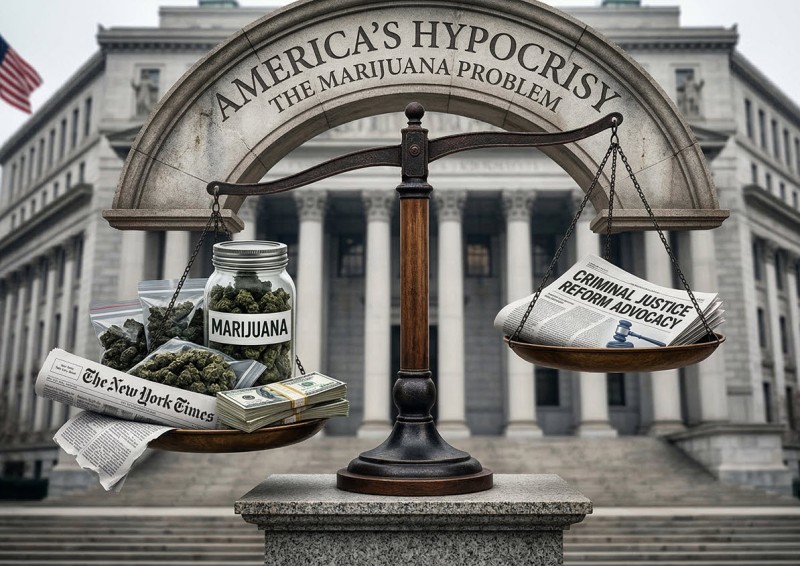
America does not have a marijuana problem. America has a consistency problem, a hypocrisy problem, and a long history of deciding which substances are acceptable based on which industries funded which political campaigns rather than which substances actually kill people.
Tobacco: 480,000 dead per year. Federally subsidized. Legal everywhere.
Alcohol: 178,000 dead per year from excessive use, rising. Legal everywhere. Sold next to candy.
Cannabis: zero established causal deaths annually. Still Schedule I in federal law. Responsible for millions of criminal convictions, disproportionately in Black and Latino communities, that were executed in the name of public health.
The New York Times is right that heavy cannabis use has real consequences and that better regulation and better education are needed. They are also right that going backward is not the answer. Where they fail — where they have always failed, where the mainstream drug policy conversation consistently fails — is in applying the same scrutiny to the substances that are actually killing people at scale.
When the Times publishes "It's Time for America to Admit It Has an Alcohol Problem" with the same urgency and the same data-driven concern it applied to cannabis, I will take its public health concern for cannabis seriously. Until then, I will note that the Times editorial board operates in a city where the bar on every corner operates with a license, the tobacco shop sells product that kills its customers reliably over time, and the cannabis dispensary is the one that gets the think pieces.
We need honest drug education. We need moderation, not abstinence — for all substances, including the ones that have been socially acceptable long enough to escape scrutiny. We need adults to be treated as adults, given real information, and trusted to make real choices. We need the revenue from legal cannabis to fund the education infrastructure that should have been built thirty years ago.
What we do not need is another round of selective concern from institutions that helped build the system they are now clucking at.
Light one up. The hypocrisy isn't going anywhere, but at least you can look at it clearly.
— Reginald Reefer
Sources: Timmen Cermak, "Does America Have a Problem With Marijuana?" Psychology Today (March 2026); CDC, "Deaths from Excessive Alcohol Use — United States, 2016-2021," MMWR (February 2024); Wong et al., "Alcohol-Induced Deaths in the United States Across Age, Race, Gender, Geography," PLOS Global Public Health (September 2025); CDC, "Tobacco-Related Mortality," National Center for Chronic Disease Prevention; 2024 Surgeon General's Report, "Eliminating Tobacco-Related Disease and Death: Addressing Disparities"; Campaign for Tobacco-Free Kids, "The Toll of Tobacco in the United States" (2025); NIAAA, "Alcohol-Related Emergencies and Deaths in the United States" (2024); KFF, "Alcohol Deaths: National Trends and Variation by Demographics and States" (February 2026).
NEW YORK TIMES ON WEED, READ ON...