

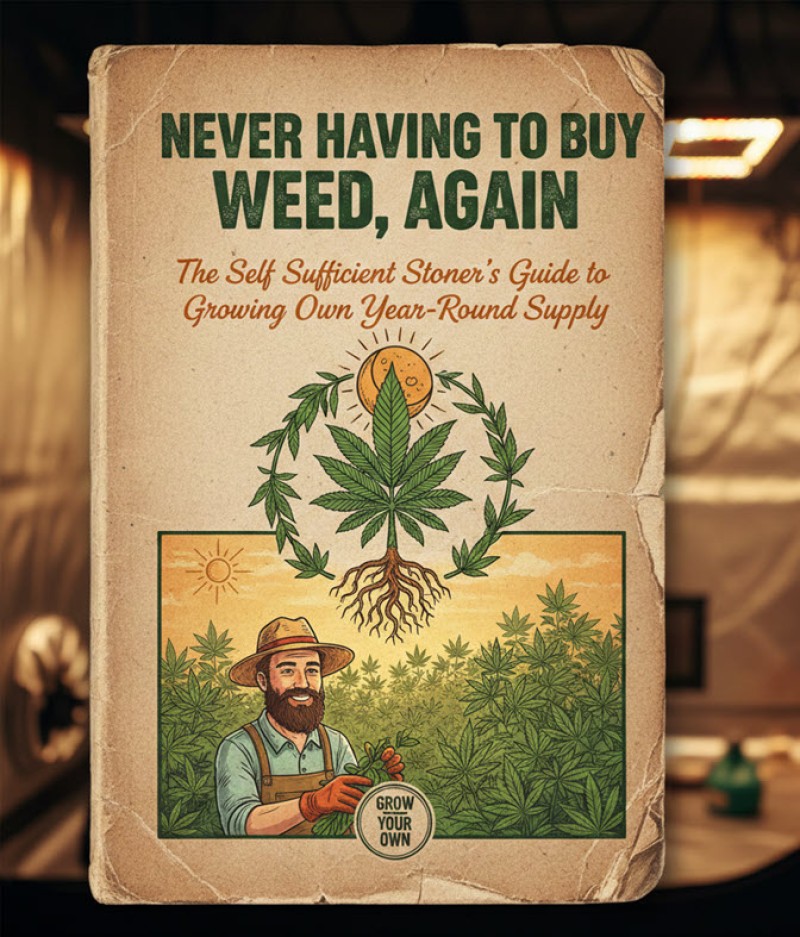

The Self-Sufficient Stoner's Guide: Growing Your Year-Round Supply
Let's talk about self-sufficiency. Not in the libertarian "off-grid compound" sense (though if that's your thing, cool), but in the practical "I'd like to stop spending hundreds of dollars a month at dispensaries and grow my own goddamn medicine" sense.
With hemp bans looming, state repeals being threatened, and federal policy remaining an absolute clusterfuck, there's never been a better time to learn how to supply your own cannabis. Because the only truly secure cannabis supply is the one you control.
But here's the question everyone asks: How much do I actually need to grow to keep myself supplied year-round?
Today, we're going to do the math. We'll figure out consumption rates, grow timelines, yields, and create an actual calendar showing you how to maintain a perpetual supply of homegrown cannabis without ever running out.
Grab your calculator and your favorite strain. We're about to get gloriously nerdy about pot math.
Step 1: Calculate Your Consumption Rate
First, we need to establish how much you actually consume. This varies wildly between users, but let's establish some baseline categories:
Light User: 0.25-0.5g per day (a bowl or two, occasional joint) Moderate User: 0.5-1.5g per day (a few bowls, maybe a joint daily) Heavy User: 1.5-3g per day (multiple joints, regular sessions) Very Heavy User: 3-5g+ per day (all-day consumption, high tolerance)
For our calculations, we'll focus on the moderate to heavy user range: 1.5g per day. This is roughly a joint in the morning, maybe a bowl or two during the day, and an evening session. Pretty typical for medical patients or regular recreational users.
Math time:
-
1.5g per day × 365 days = 547.5 grams per year
-
Let's round up to 600 grams (21 ounces) to account for:
-
Sharing with friends (because you're not a monster)
-
Special occasions (holidays, concerts, that Tuesday that felt like a Monday)
-
Quality loss over time (more on this later)
-
Trim loss during processing
-
So our target is 600 grams of usable flower per year to maintain a comfortable supply for a moderate to heavy user.
Step 2: Understanding Grow Timeline (Seed to Smoke)
Cannabis cultivation isn't instant. There's a complete timeline you need to account for:
Germination: 2-7 days Seedling Stage: 2-3 weeks Vegetative Stage: 3-8 weeks (strain dependent, grower controlled) Flowering Stage: 8-12 weeks (strain dependent) Harvest & Drying: 7-14 days Curing: 2-4 weeks minimum (longer is better)
Total time from seed to optimal smoke: approximately 4.5-6 months
Let's use 5 months (150 days) as our average timeline for planning purposes.
This means that from the day you plant a seed, you won't have smokable product for five months. And if you want properly cured cannabis (which you do, because fresh-dried weed is harsh as hell), you're looking at closer to the 6-month mark.
Critical insight: If you consume 1.5g per day, over 5 months you'll smoke:
-
1.5g × 150 days = 225 grams
This is the gap you need to bridge with your first harvest before your perpetual cycle begins.
Step 3: Average Yields Per Plant
Yield varies dramatically based on:
-
Genetics (strain selection)
-
Growing method (soil, hydro, outdoor, indoor)
-
Light quality and quantity
-
Grower skill
-
Plant training techniques
Indoor Growing (our focus, most controllable):
Untrained plant: 25-50g per plant (novice grower, minimal training) Moderately trained: 50-150g per plant (some LST, decent conditions) Well-trained plant: 150-300g per plant (experienced grower, optimal conditions) Expert with training: 300-500g+ per plant (ScrOG, mainlining, perfect environment)
For realistic planning, let's use 100 grams per plant as our target. This is achievable for someone with basic skills, decent equipment, and strains known for good yields.
Math time again:
-
Annual need: 600g
-
Yield per plant: 100g
-
Plants needed per year: 6 plants minimum
But wait—there's more to consider.
Step 4: Accounting for Murphy's Law (Shit Happens)
In a perfect world, every seed becomes a vigorous female plant yielding exactly 100g. We do not live in that world.
Factors that reduce your effective plant count:
Male plants (if using regular seeds): Roughly 50% of regular seeds will be male. You can't smoke male plants (well, you can, but you won't get high and you'll be very disappointed).
Germination failure: Even with good seeds, expect 5-10% germination failure rate.
Seedling mortality: Another 5-10% might not make it past the seedling stage if you're new to this.
Underperforming plants: Some plants just suck. Maybe 10-20% will yield significantly less than your target.
Let's be conservative:
-
If using regular seeds: 50% survival rate to female plants
-
Germination/seedling losses: 10%
-
Underperformers: 15%
-
Effective success rate: ~35-40% for regular seeds, ~75-85% for feminized seeds
Revised math:
-
Using feminized seeds: Start with 8 plants to reliably get 6 productive females
-
Using regular seeds: Start with 15 seeds to reliably get 6 productive females
My recommendation: Use feminized seeds from reputable breeders unless you're specifically trying to breed. The extra cost (usually $5-10 per seed) is worth not wasting time, space, and resources on male plants.
Step 5: Strain Selection for Yield
Not all strains are created equal. Some are finicky divas that yield 30g if you look at them wrong. Others are workhorses that produce even when you forget to water them (please don't forget to water them).
High-yielding strains for self-sufficiency:
Blue Dream (Hybrid):
-
Yield: 500-600g/m² indoor, 150-200g per plant
-
Flower time: 9-10 weeks
-
Why it's perfect: Forgiving, consistent, good potency (20-24% THC)
-
The "Toyota Corolla" of cannabis—reliable as hell
White Widow (Hybrid):
-
Yield: 450-550g/m² indoor, 100-150g per plant
-
Flower time: 8-9 weeks
-
Why it's perfect: Resilient, easy to grow, potent (18-25% THC)
-
Great for beginners
Northern Lights (Indica):
-
Yield: 400-500g/m² indoor, 100-125g per plant
-
Flower time: 7-9 weeks
-
Why it's perfect: Extremely forgiving, compact, reliable
-
The beginner's best friend
Green Crack (Sativa):
-
Yield: 500-600g/m² indoor, 150-200g per plant
-
Flower time: 7-9 weeks
-
Why it's perfect: Fast flowering, high energy effect, good yields
Critical Mass (Indica):
-
Yield: 600-700g/m² indoor, 200-250g per plant
-
Flower time: 8-9 weeks
-
Why it's perfect: Literally bred for massive yields, easy to grow
Pro tip: Choose 2-3 strains to rotate through the year. This gives you variety and insurance—if one strain underperforms, the others pick up the slack.
Step 6: Maximizing Yield (Training Techniques)
Getting 100g+ per plant requires more than just watering and hoping. Here are techniques to boost yield:
Low Stress Training (LST): Gently bending and tying branches to create an even canopy. Increases yield by 20-40%.
Topping: Cutting the main stem to create multiple colas instead of one. Increases yield by 30-50%.
ScrOG (Screen of Green): Growing plants through a horizontal screen to maximize light exposure. Increases yield by 50-100%.
Mainlining: Aggressive training creating symmetrical colas. Increases yield by 40-60% with experience.
Optimal Environment:
-
Proper lighting (600W+ HPS or equivalent LED per plant)
-
Temperature control (70-85°F during day, 58-70°F at night)
-
Humidity control (40-60% during flower)
-
Good airflow
-
Quality nutrients
-
pH management (6.0-7.0 for soil, 5.5-6.5 for hydro)
Reality check: Your first grow probably won't hit these numbers. That's fine. You'll learn. By your third grow, you should be consistently hitting 100g+ per plant with decent genetics and basic training.
Step 7: The Perpetual Harvest Calendar
Here's where it gets good. To maintain year-round supply, you need a perpetual harvest system—always having plants at different stages so you're harvesting every 2-3 months.
The Setup:
-
Grow space split into two areas: Veg/Clone area and Flower area
-
Or: Two separate tents (recommended for odor control and light management)
The Calendar (starting January 1):
JANUARY 1-15:
-
Germinate 3 seeds (feminized)
-
Seedling stage in veg area
JANUARY 15 - MARCH 1:
-
Vegetative growth (6 weeks)
-
Low stress training begins
MARCH 1 - MAY 15:
-
Flowering (10 weeks)
-
Switch to 12/12 light cycle
MAY 15 - MAY 29:
-
Harvest and dry (2 weeks)
MAY 29 - JUNE 26:
-
Cure (4 weeks minimum)
-
First harvest ready: ~300g from 3 plants
Meanwhile, for perpetual cycle:
MARCH 1: Germinate next batch of 3 seeds MARCH 15 - APRIL 29: Veg (6 weeks) APRIL 29 - JULY 14: Flower (10 weeks) JULY 14 - JULY 28: Harvest/dry JULY 28 - AUGUST 25: Cure
-
Second harvest ready: ~300g
MAY 1: Germinate third batch MAY 15 - JUNE 26: Veg JUNE 26 - SEPTEMBER 9: Flower SEPTEMBER 9 - SEPTEMBER 23: Harvest/dry SEPTEMBER 23 - OCTOBER 21: Cure
-
Third harvest ready: ~300g
JULY 1: Germinate fourth batch JULY 15 - AUGUST 26: Veg AUGUST 26 - NOVEMBER 9: Flower NOVEMBER 9 - NOVEMBER 23: Harvest/dry NOVEMBER 23 - DECEMBER 21: Cure
-
Fourth harvest ready: ~300g
Annual total: ~1,200g (42 ounces) from 12 plants grown in 4 batches
This gives you double your annual consumption needs (600g), which accounts for:
-
Learning curve losses
-
Sharing/gifts
-
Extract making (edibles, concentrates)
-
Long-term storage degradation
-
Comfortable surplus
Step 8: Storage and Preservation
Your harvest won't stay fresh forever. Proper storage is crucial:
Short-term (3-6 months):
-
Airtight glass jars (Mason jars work perfectly)
-
Cool, dark location (60-70°F)
-
Humidity control packs (62% RH - Boveda/Integra Boost)
-
Burp jars weekly for first month, then monthly
Long-term (6-12+ months):
-
Vacuum sealing (removes oxygen, prevents degradation)
-
Freezer storage (for extracts/long-term reserves)
-
Nitrogen-flushed containers (for serious long-term storage)
Degradation timeline:
-
0-6 months: Minimal potency loss (<5%)
-
6-12 months: 10-15% potency loss
-
12-24 months: 20-30% potency loss
-
24+ months: Significant degradation (not recommended)
This is why the perpetual harvest system works—you're constantly cycling through fresh product rather than trying to store a year's supply at once.
The Sticky Bottom Line: Your Growing Blueprint
Let's bring this all together into a actionable plan:
To be self-sufficient as a moderate to heavy user (1.5g/day):
-
Start with 3-4 feminized seeds every 8-10 weeks
-
Target 100g per plant minimum (achievable with training and decent genetics)
-
Use high-yielding strains (Blue Dream, White Widow, Northern Lights)
-
Implement basic training (LST minimum, topping recommended)
-
Maintain perpetual cycle (new plants every 2-3 months)
-
Expected annual yield: 900-1,200g from 12-15 plants total
-
Annual consumption: 600g (leaving comfortable surplus)
Space requirements:
-
Veg area: 2'×2' minimum (can be small tent or closet)
-
Flower area: 3'×3' to 4'×4' (dedicated tent recommended)
-
Total: ~30-50 square feet including workspace
Estimated costs:
-
Setup: $800-1,500 (tent, lights, fans, filters, pots, medium)
-
Annual operating: $200-400 (electricity, nutrients, seeds, supplies)
-
Total first year: $1,000-1,900
-
Subsequent years: $200-400
Compare to dispensary costs:
-
600g at $10/g average = $6,000 per year
-
Your growing cost: $1,000-1,900 first year, $200-400 after
-
Savings: $4,100-5,800 first year, $5,600+ annually thereafter
Plus, you know exactly what's in your cannabis, how it was grown, and that it wasn't tested with pesticides that cause "scromiting."
The math is clear: growing your own is not only more secure in uncertain legal times, it's massively more cost-effective and gives you complete control over your medicine.
So if you're serious about cannabis self-sufficiency, now you have the blueprint. Start small, learn the basics, dial in your system, and within a year you'll never need a dispensary again.
Because the best cannabis supply is the one growing in your own space, under your own control, ready to harvest no matter what bullshit prohibition 2.0 throws at us.
Stay self-sufficient, cannabis family. Plant those seeds.
GROWING YOUR OWN CANNABIS, READ ON...