

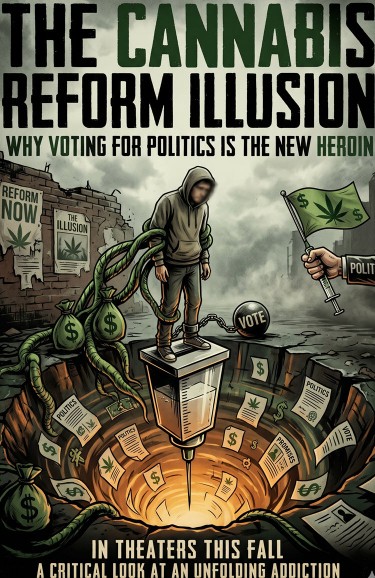
Every two years, cannabis advocates wheel out the same ritual. Ballot measures, candidate endorsements, grasstops lobbying, NORML scorecards, press releases about historic progress. Every two years, a version of the same headline runs: "Cannabis Reform Reaches Tipping Point." Every two years, the people who believed it discover that the tipping point was a marketing event.
I'm not arguing that nothing changes legislatively. Things change. Rescheduling proceedings move forward, then stall, then move again. States pass adult-use measures, then build regulatory frameworks that function as soft prohibition for anyone without capital. The federal government generates activity that resembles momentum. And yet the underlying structure—the state's claim to authority over what you grow, consume, and trade—remains entirely intact. The license is not freedom. The license is a leash with extra steps.
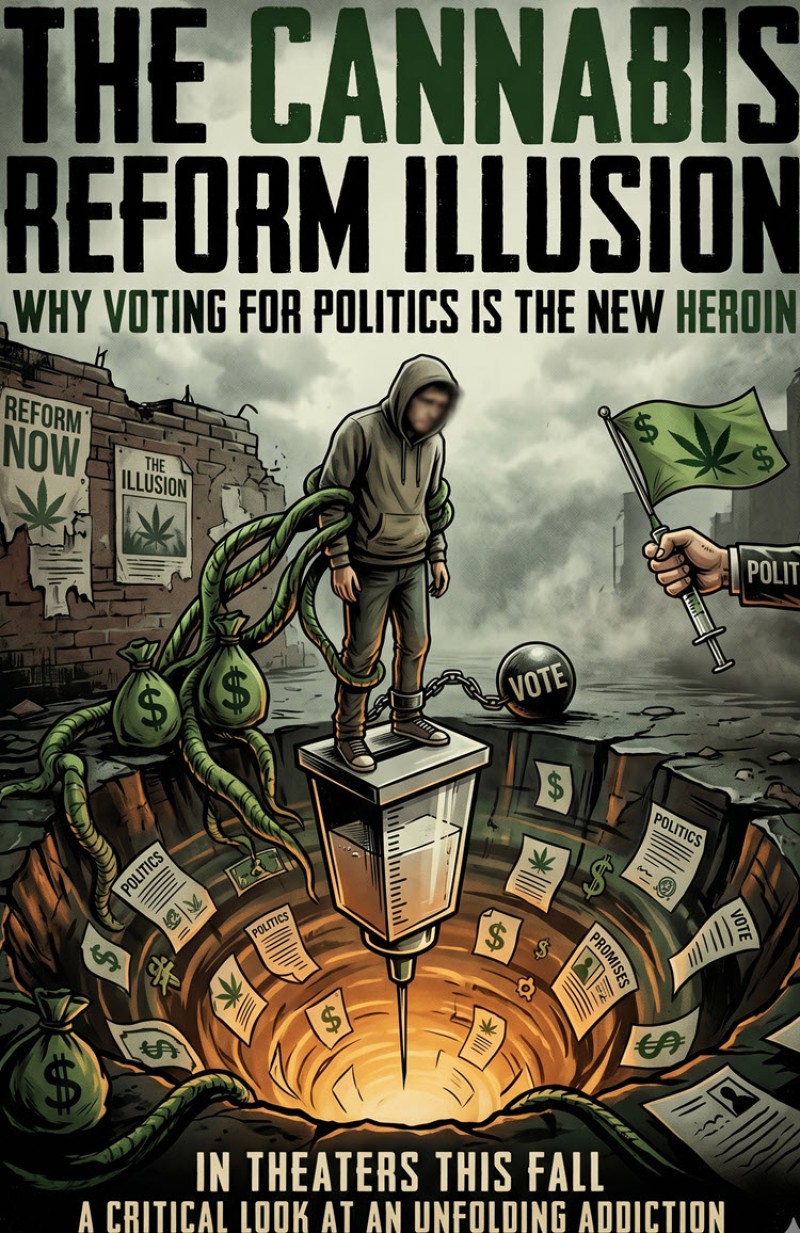
Let me explain what the addiction metaphor actually means here, because it's not rhetorical decoration.
Heroin works by hijacking the brain's reward system.
You do the thing, you get the hit—and the cycle of behavior reinforces itself independent of whether the thing actually produces the outcome you wanted. Political participation around cannabis reform operates on a structurally similar loop.
You organize, donate, vote, and occasionally win a ballot measure. The win produces a genuine neurochemical response: relief, validation, the sense that the work mattered. Then you watch the regulatory implementation turn the win into something that looks nothing like what you fought for, and the dopamine evaporates. But the behavior pattern is set. The next cycle, you do it again. The hit is real even when the outcomes aren't.
This is not an argument for nihilism or disengagement. It's an argument for accuracy about what electoral politics can and cannot produce in this domain.
The most instructive data point in recent American cannabis history isn't a legalization win—it's the hemp-derived cannabinoid market.
The 2018 Farm Bill, largely aimed at industrial hemp agriculture, created an unintended legal gray zone. Entrepreneurs moved into it. By 2023, the hemp-derived Delta-8 and THCa market had grown to roughly $28 billion annually, operating largely outside the controlled cannabis regulatory apparatus that legal states had built. Consumers had access to psychoactive cannabinoids in convenience stores and gas stations across states where marijuana remained illegal under state law. No cannabis advocacy campaign produced this. A loophole in agricultural legislation did.
The government's response was instructive. Rather than acknowledging that this unregulated market had not produced the catastrophes prohibition advocates predicted—no mass addiction events, no associated crime surge—Congress moved to close the loophole.
The 2024 and 2025 Farm Bill negotiations included provisions that would have effectively criminalized hemp-derived psychoactive cannabinoids. The legislative pushback was framed as a public safety concern.
The actual driver, visible to anyone following the lobbying activity on MJBizDaily, was pressure from the licensed cannabis industry, which viewed the unregulated hemp market as a competitive threat, and from pharmaceutical interests with a stake in maintaining controlled pathways to cannabinoid products.
This is the reform mechanism in practice. The market develops organically. Consumers benefit. The state identifies the market as a threat to organized revenue extraction and moves to capture or eliminate it. The license is not the end of prohibition. It is prohibition restructured around a different set of tollbooth operators.
Consider California's experience with adult-use legalization since 2016.
The state built what advocates called the most comprehensive legal cannabis framework in the country. What it produced was a legal market capturing roughly 30 percent of total cannabis consumption in the state, with 70 percent remaining in the unlicensed market as of recent estimates.
Combined state and local tax rates reaching 40 percent in some jurisdictions made licensed product uncompetitive. Zoning restrictions meant that fewer than 40 percent of California municipalities allowed any legal cannabis operation as of 2022.
The legacy underground market didn't collapse when legalization passed; it adapted. The legal market created next to it was a parallel system serving consumers who wanted receipts and compliance stickers, while the majority continued sourcing from the same channels they always had.
The state extracted revenue from the legal slice and prosecuted the unlicensed slice, and called this progress.
Meanwhile, cannabis advocacy organizations continued optimizing for the next ballot measure, the next legislative session, the next federal rescheduling proceeding.
The Schedule III rescheduling process at the DEA, which began in 2023 and stalled through administrative and legal challenges into 2025, consumed enormous organizational energy from reform advocates. What Schedule III would have produced, had it cleared, is primarily a tax benefit for multi-state operators under Section 280E, a research pathway controlled by institutions with pharmaceutical funding incentives, and no meaningful change in federal criminalization for individual consumers or small-scale cultivators.
The advocacy class celebrated early DEA movement as a victory. The financial beneficiaries would have been the MSO shareholders.
I want to be direct about the ideological trap here, because it catches people across the political spectrum.
The argument is not that government is always and everywhere illegitimate. The argument is narrower: for cannabis specifically, the legislative pathway has consistently produced outcomes that expand state authority over the plant while routing the economic benefits toward capitalized interests. Every time reform advocates win a political battle, they tend to lose the underlying war, because the terms of victory are set by the very institutional structures they're trying to reform.
The practical alternative is not theoretical. It is already operating. Home cultivation, where legally available, is the most subversive act in the cannabis space—it places the individual outside the supply chain entirely.
Community-scale cultivation networks, operating on trust and reciprocity rather than state licensing, have persisted through every phase of prohibition and every phase of legalization. They are harder to surveil, harder to tax, and harder to capture than any licensed dispensary.
They maintain genetic diversity, grower expertise, and price levels that the legal market cannot match.
This isn't romanticism about lawbreaking. It's an accurate description of where the plant has always lived and continues to live for most of its users globally. The legal market is the aberration. The community network is the norm.
The question worth asking before the next campaign cycle is not "which candidate has the better cannabis policy platform?"
It is: "Am I participating in a system that has consistently delivered capture in the name of liberation, and what would it look like to stop?"
Building local networks that don't require state permission is an answer. Growing your own is an answer. Keeping genetics outside the licensed supply chain is an answer.
Voting for a ballot measure that delivers another regulated market managed by investment capital is not an answer—it is the mechanism by which the question gets perpetually deferred.
I'll take the community garden over the corporate dispensary every time. The hit from the ballot win is shorter than you think.
CANNABIS UNDER TRUMP, READ ON...