



Most people have the misconception that chronic pain is an issue rooted in our joints, muscles, or overall inflammation.
While we’re right about inflammation, we’re looking at the wrong place: the root of the problem actually lies in the fascia, not isolated in the joints or muscles. We then considered treatment options that only addressed these parts of the body, offering localized pain relief. We thought that if we stretch or knead muscles enough, and strengthen them through regular exercise, we can reduce inflammation and pain.
To an extent, this logic is correct.
However, we’re missing an important piece of the puzzle.
The Fascia
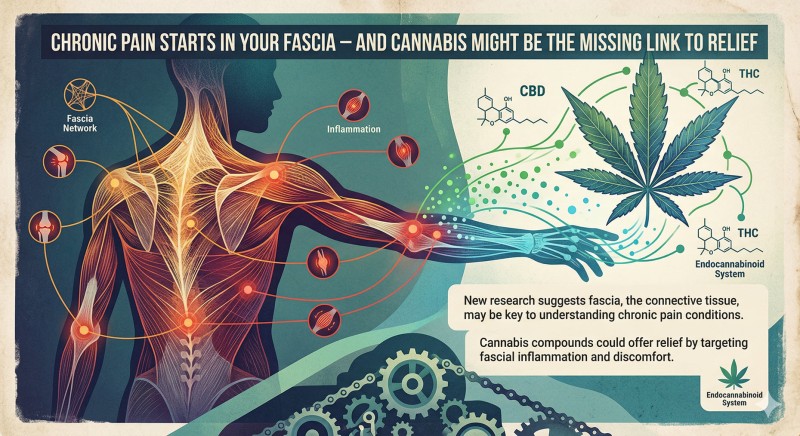
Fascia is the connective tissue that wraps around the entire human body, including every bone, muscle, organ, and nerve. We can think about it as a sort of packaging for the body, but its function is so much more important than that: the fascia acts like an internal communication system that transmits messages on sensory information, movement, tension, and pain.
The fascia is one interconnected system, and it doesn’t work in isolated areas. This means that dysfunction or pain in one area can strain another, even if the two locations are far apart. The fascia is the reason why everything is truly interconnected.
Within the fascia, there is a rich system of sensory receptors, making it one of the most neurologically active tissues in the human body. Yet, it doesn’t get mentioned enough when we try to treat our chronic pain.
Enter cannabis.
The Fascia-Cannabis Connection
Healthy fascia is hydrated, smooth, and flexible.
But inevitably, factors like poor posture, injury, stress, and a sedentary lifestyle contributes to the thickening and stiffening of the fascia. When this occurs, fascial nerves grow irritated and lead to chronic pain conditions that can be difficult to treat and pinpoint.
If you’re dealing with chronic pain, back pain, or other unexplained types of body aches, this could actually be fascial dysfunction.
So how does cannabis help?
The answer lies in the human body’s endocannabinoid system, a vital network that modulates numerous important functions including tissue health, inflammation, and pain. The fascia also contains CB1 and CB2 receptors, which are receptors that respond to the therapeutic cannabinoids in cannabis, such as THC and CBD.
Recent research shows that consuming cannabis is effective in treating myofascial pain. In fact, researchers from Brazil analyzed the efficacy of marijuana extracts and compared it against a placebo among 20 patients suffering from chronic myofascial pain, specifically Temporomandibular Disorder (TMD). For the study, participants were given placebo for 3 months, after which they were given marijuana extracts for 3 more months. The initial cannabis dose for the first week was 2mg per day, which increased to 2mg per week up until 10mg per day by week 5.
The researchers reported that cannabis turned out to be an excellent pain reliever. Patients reported a reduction of almost 4 points in TMD pain when they were given cannabis.
“Cannabinoid therapy was effective in reducing painful symptoms in TMD patients, associated with relevant functional improvements in mandibular opening, protrusion, and laterality compared to placebo,” said the authors. “These findings indicate the clinical potential of cannabinoids as a promising therapeutic alternative for managing TMD, highlighting the need for future studies with larger samples and randomized designs to validate and enhance the action mechanisms,” they added.
Meanwhile, a 2023 survey found that a significant population of women turned to marijuana products to treat myofascial pain. The data, which was published in the European Journal of Obstetrics and Gynecology and Reproductive Biology, reflected the efficacy of cannabis for myofascial pain.
For the survey, Canadian researchers polled 135 female patients who suffered from myofascial pelvic pain. Fifty-seven percent of them reported they were using weed, and among them, 79% said that the cannabis products were helpful for treating pain. A majority of them said they turned to weed since conventional treatments weren’t effective.
“On a scale of zero (totally ineffective) to 10 (totally effective), 69% of users rated the effectiveness of cannabis as 7 or higher at relieving pelvic pain,” said the authors.
Together, these findings point to the growing acceptance that cannabis is a valuable option for patients who want to manage myofascial pain. This is especially true for patients who no longer find relief with conventional treatment for pain.
It could also be beneficial to consider that cannabis can be used in conjunction with other treatments for myofascial pain. Physical therapy and movement are typically the first line of treatment, involving a range of exercises focused on strengthening, releasing, and correcting. Therapies such as deep tissue massage, dry needling, or cupping can also be effective in improving circulation and reducing stiffness.
Conclusion
Chronic pain isn’t usually a simple fix. Once we change our perspective and accept that it’s typically rooted in the fascia instead of just muscles and joints, we can find more effective ways to treat the pain.
Cannabinoids don’t just dull symptoms; they’re effective because they engage with the endocannabinoid system, which is already embedded within the fascial tissue itself. This kind of interaction is nuanced, works well, yet isn’t available from conventional therapies yet.
However, keep in mind that integrating cannabis into your chronic pain toolkit isn’t just about replacing conventional treatments altogether but expanding it. After all, the plant represents a complementary option whose efficacy is rooted in medical science.
CHRONIC PAIN AND CANNABIS, READ ON...